
Luxury custom build costs on Amelia Island are defined by a full cost stack that includes land acquisition, architectural design fees, elevated construction premiums, and coastal regulatory expenses. Together, these components push total investment well beyond what buyers typically expect from mainland luxury builds. On Amelia Island, construction premiums run 15–25% above conventional luxury specs, driven by island-mandated materials, Design Review Board requirements, and Florida's coastal permitting framework. A realistic budget for a premium custom home here ranges from the high $400s to well over $3 million, depending on lot position, finish level, and enclave. This guide breaks down every cost layer so you can plan with confidence.
What determines luxury custom build costs on amelia island?
The total cost of a custom luxury home on Amelia Island is the sum of five distinct budget categories, each carrying its own weight and risk.
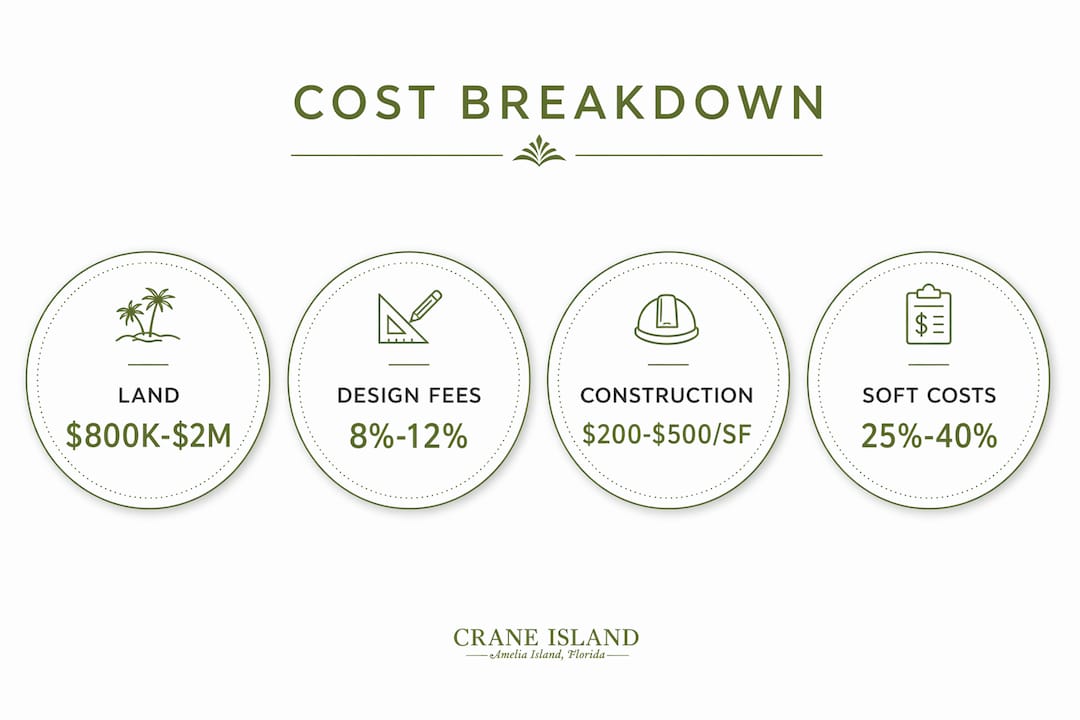
Land acquisition is the starting point. Premier lots on Amelia Island range from roughly $800,000 to $2 million or more, with Intracoastal-facing and waterfront positions commanding the highest prices. Lot position also shapes foundation requirements, which feeds directly into construction cost.
Architectural and design fees on Amelia Island run higher than the national norm. Typical architect fees nationally sit at 6–9% of construction cost. On Amelia Island, fees commonly reach 8–12% because Design Review Board submissions require more detailed documentation and multiple approval rounds. That difference adds tens of thousands of dollars to a $2 million build.
Core construction costs follow a clear tiered structure. Entry-level luxury runs $200–$500 per square foot, premium custom homes fall in the $500–$1,000 range, and ultra-luxury estates reach $1,000–$1,500 per square foot, all excluding land and soft costs. These figures reflect the elevated material and labor standards the island's design guidelines require.
Soft costs are the category buyers most often underestimate. Soft costs add 25–40% beyond construction cost and include architecture, engineering, permits, landscaping, and financing charges. On a $2 million construction budget, that means $500,000 to $800,000 in additional expenses before you move in.
Here is how a typical multi-million-dollar luxury build breaks down by category:
| Budget Category | Typical Share of Total Cost | Example on a $3M Build |
|---|---|---|
| Design and engineering | 5–15% | $150,000–$450,000 |
| Site prep and foundation | 8–12% | $240,000–$360,000 |
| Core construction | 40–50% | $1,200,000–$1,500,000 |
| Finishes and built-ins | 20–30% | $600,000–$900,000 |
| Permits, landscaping, financing | Included in soft costs | Variable |
These budget category splits reflect real multi-million-dollar project data, not theoretical estimates. Understanding them upfront prevents the most common planning mistake: budgeting only for construction and ignoring everything around it.
Pro Tip: Request an itemized pre-construction budget from your builder that separates land, soft costs, construction, and finishes before you sign anything. Builders who resist this level of transparency are a warning sign.
How do coastal regulations affect amelia island construction costs?
Florida's coastal regulatory framework adds cost and schedule complexity that mainland builds simply do not face. Amelia Island sits within Florida's Coastal Construction Control Line (CCCL) zone, and CCCL permitting typically takes 6–12 months. This timeline runs independently from Nassau County building permits, meaning you can be waiting on two separate approval tracks simultaneously.
FEMA flood zone classifications add another layer. Many Amelia Island lots fall within FEMA VE zones, the highest-risk coastal flood designation. VE zone requirements mandate pile foundations rather than conventional slab-on-grade construction. Pile foundations cost significantly more to engineer and install, and buyers who discover this requirement late in the process face both budget shocks and schedule delays.
The key regulatory cost drivers on Amelia Island include:
- CCCL permit fees and documentation: Coastal engineering reports, biological assessments, and survey work required for state review
- Pile foundation engineering: Geotechnical borings, structural engineering, and the physical cost of driven or drilled piles
- Environmental permits: Wetland delineation and mitigation requirements for lots near marshlands
- Nassau County building permits: Separate from CCCL, with their own review timeline and fee schedule
"Permitting and engineering complexity, particularly coastal and flood zone regulations, represent major schedule and budget risk on barrier islands like Amelia Island." — Creek Engineering, Inc.
Pro Tip: Engage a coastal civil engineer and a permitting consultant before you finalize your lot purchase. Their early analysis can reveal foundation requirements and permitting timelines that change your total budget by hundreds of thousands of dollars.
What design and build timeline should you expect?
The total timeline from lot purchase to move-in on Amelia Island averages 1.5–2 years. That figure surprises many buyers who expect a 12-month process. The multi-phase approval structure is the primary reason.
Here is a realistic sequence of milestones:
- Lot purchase and due diligence (1–3 months): Geotechnical analysis, flood zone review, and HOA covenant review
- Architect selection and schematic design (2–3 months): Site placement, massing, and exterior palette decisions
- Design Review Board submission and approval (3–4 months minimum, 6+ months with revisions): Three-phase review covering site plan, architectural design, and final details
- CCCL and county permit applications (filed concurrently, 6–12 months for CCCL): Parallel processing compresses total schedule
- Construction (12–16 months): Foundation, framing, mechanical systems, and finishes
- Final inspections and certificate of occupancy (1–2 months)
Experienced builders and architects reduce Design Review Board delays by front-loading major decisions like roof massing, exterior palettes, and site placement in the first submission. Resubmissions are the single biggest source of schedule loss. A team that has navigated Crane Island or Long Point approvals before knows exactly what the board expects.
Concurrent permitting is the most effective schedule compression tool available. Filing county building permits and CCCL applications at the same time, rather than sequentially, can save three to six months of idle time.
Pro Tip: Prepare your Design Review Board submission as a complete package on the first attempt. Incomplete submissions reset the clock. Budget an extra 90 days as a schedule buffer regardless of how well you plan.
How do finishes and community choice affect your total investment?
Finishes and built-ins are where budgets most commonly drift. Finishes typically represent 20–30% of total cost in a luxury build, but without disciplined allowance management, that share grows. Selecting tile, cabinetry, appliances, and millwork without a firm allowance framework is the fastest path to a six-figure overrun.
The enclave you choose shapes your baseline cost and your long-term investment profile. Amelia Island's gated communities each carry distinct price ranges and build standards:
| Community | Typical Custom Build Range | Build Type | Notable Feature |
|---|---|---|---|
| Crane Island | $2M–$5M+ | Full custom, Intracoastal | 14 homesites, Lowcountry architecture |
| Long Point | $1M–$5M | Semi-custom to full custom | Gated, varied lot positions |
| Amelia National | High $400s–$700s+ | Semi-custom, ICI builder | Golf course community |
Long Point custom builds range from roughly $1 million to $5 million depending on view, enclave position, and finish level. Amelia National homes start in the high $400s, with golf-course-facing custom homes reaching well into the $700s and above.
Lot position within any enclave adds meaningful cost. Waterfront and Intracoastal lots carry land premiums and often trigger more complex foundation and permitting requirements. Interior lots offer lower land cost but may limit resale premium. For investors, full custom Intracoastal builds carry higher premiums than semi-custom curated plans, and that distinction matters when modeling exit value.
You can explore Amelia Island neighborhood comparisons to understand how enclave choice shapes both your build cost and your lifestyle.
What are the best practices for managing your build budget?
Cost certainty on a luxury custom build comes from decisions made before construction starts, not during it. The following practices define how experienced buyers and investors protect their budgets.
- Hire island-experienced professionals: Architects and builders who know Nassau County's permitting office, the Design Review Board's preferences, and Amelia Island's material requirements move faster and make fewer costly mistakes.
- Commission early geotechnical analysis: Early geotechnical and flood-zone analysis reveals whether your lot requires pile foundations before you commit to a construction budget. Discovering this requirement after design is complete adds cost and delays.
- Set firm finish allowances: Lock in allowance budgets for tile, cabinetry, appliances, and fixtures during design development. Review selections against allowances at each design milestone.
- Understand HOA and community fees: Gated enclaves carry annual HOA dues that affect total ownership cost. Factor these into your investment model alongside property taxes.
- Process permits concurrently: Never submit county and state permits sequentially if you can file them at the same time. The schedule savings are real and significant.
- Build in a contingency reserve: A 10–15% contingency on construction cost is standard for luxury custom builds. On a $2 million construction budget, that means holding $200,000–$300,000 in reserve.
Pro Tip: Review your finish selections against your allowance budget at the 30%, 60%, and 90% design completion stages. Catching overruns at 30% costs nothing to fix. Catching them at 90% means redesigning work already drawn.
Key takeaways
Luxury custom build costs on Amelia Island require planning for land, design fees, construction premiums, soft costs, and coastal regulatory expenses as a single integrated budget, not separate line items.
| Point | Details |
|---|---|
| Full cost stack matters | Land, design, construction, soft costs, and permits together define your true budget. |
| Soft costs add 25–40% | Budget well beyond base construction cost to avoid shortfalls at closing. |
| Coastal permits take 6–12 months | File CCCL and county permits concurrently to compress your total timeline. |
| Finishes drive overruns | Lock in allowances early and review them at every design milestone. |
| Enclave choice shapes investment | Community, lot position, and build type each affect cost, timeline, and resale value. |
What i've learned about budgeting for amelia island custom builds
After working closely with buyers and investors navigating luxury custom builds on Amelia Island, the pattern I see most often is not a failure of ambition. It is a failure of scope. Buyers arrive with a construction budget in mind and a vision for their home. What they underestimate is the full cost stack surrounding that construction number.
The 25–40% soft cost load is real, and it catches people off guard every time. Architect fees at 8–12%, coastal engineering, CCCL permitting, geotechnical work, landscaping, and financing charges do not feel like "building a home." But they are as real as the framing and the roof.
What I find genuinely encouraging about communities like Craneisland is that the design-controlled environment, while it adds process, also adds discipline. The Design Review Board process forces early decisions that most buyers would otherwise defer until construction. Those deferred decisions are exactly where budgets unravel. When you have to commit to roof massing and exterior palette in the first submission, you are also committing to a cost framework. That is a feature, not a burden.
My honest advice: treat the timeline buffer as a fixed cost, not an optional cushion. Build 90 days of schedule contingency into your plan from day one. The buyers who struggle are the ones who planned for the best-case approval cycle. The ones who thrive planned for the realistic one.
Craneisland's Intracoastal waterfront homes represent what this process produces when done well: homes woven into the land, built to last, and worth every dollar of the investment.
— John Hillman
Discover your custom home at Craneisland
Craneisland on Amelia Island offers one of the most carefully considered luxury custom home experiences on the East Coast. With only 14 homesites available along the Intracoastal Waterway, each property is an opportunity to build something that reflects your story and honors the island's natural beauty.
The Craneisland team guides you through every phase, from lot selection and Design Review Board preparation to builder coordination and finish selection. Our design and build process is built around the same cost transparency and timeline discipline this article describes. If you are ready to explore what your custom home could look like here, visit our luxury real estate listings and take the first step toward a home that belongs exactly where it stands.
FAQ
What is the typical cost range for a luxury custom home on amelia island?
Luxury custom build costs on Amelia Island range from the high $400s for semi-custom golf-course homes to $5 million or more for full custom Intracoastal estates, with soft costs adding 25–40% beyond base construction.
How long does it take to build a custom luxury home on amelia island?
The total timeline from lot purchase to move-in averages 1.5–2 years, including Design Review Board approvals of 90–120 days minimum and construction of 12–16 months.
Why are architect fees higher on amelia island than elsewhere?
Architect fees on Amelia Island commonly reach 8–12% of construction cost, above the national norm of 6–9%, because Design Review Board submissions require more detailed documentation and multiple approval rounds.
Do all amelia island lots require pile foundations?
Lots within FEMA VE flood zones require pile foundations rather than slab-on-grade construction. Early geotechnical and flood-zone analysis before lot purchase reveals whether your specific site carries this requirement.
What is the biggest source of budget overruns on luxury custom builds?
Finishes and built-ins are the most common overrun category, typically representing 20–30% of total cost. Setting firm allowances during design development and reviewing them at each milestone is the most effective control.
Recommended
- Best Amelia Island Neighborhoods for Custom Homes — craneisland
- Custom Intracoastal Homes on Amelia Island: A Guide to Gated Waterfront Living in Fernandina Beach — craneisland
- Amelia Island Luxury Home Buying Checklist
- Beyond 30A: Why Amelia Island and Crane Island Offer the Coastal Life You Were Actually Looking For — craneisland