
Fernandina Beach is defined as a historic Atlantic barrier island town on Amelia Island, Florida, offering Victorian architecture, a working maritime heritage, and mid-tier coastal pricing that positions it between luxury markets like Anna Maria Island and budget options like Apalachicola. When comparing coastal towns for relocation or investment, Fernandina Beach stands apart not because it competes on resort polish, but because it offers something rarer: a layered, authentic identity that has resisted the homogenizing pull of master-planned resort development. Understanding how Fernandina Beach compares to other coastal towns means weighing history, housing costs, community culture, and the very real trade-offs of island living.
How Fernandina Beach compares to other coastal towns on home prices
Home prices in Fernandina Beach typically range from $400,000 to $550,000, placing the market squarely in the mid-tier for Florida coastal real estate. That figure means buyers get genuine barrier island living at roughly half the entry price of Anna Maria Island, where homes routinely exceed $700,000 and often push past $1 million. At the other end, Apalachicola offers Gulf Coast charm at $200,000 to $350,000, but trades Atlantic surf, proximity to Jacksonville, and Fernandina's walkable downtown for that lower price point.
Within Fernandina Beach itself, the price spread is meaningful. Historic district homes on the island carry a premium for their Victorian character and walkable location, while mainland Nassau County properties offer newer construction at lower price points with reduced flood exposure. Resort communities on the southern end of Amelia Island, such as those near Omni Amelia Island Resort, skew higher due to amenity packages and gated settings.
Island homes often carry mandatory flood insurance due to Special Flood Hazard Area designations, and some residents have reported homeowners' insurance costs doubling in recent years. That reality adds a meaningful line item to any ownership budget and separates the true cost of island living from the sticker price alone.
Pro Tip: Before committing to a specific address in Fernandina Beach, request the FEMA flood zone designation and a current insurance quote. Two homes on the same street can carry dramatically different annual insurance costs depending on their elevation certificates.
| Property type | Approximate price range |
|---|---|
| Historic district island home | $450,000 to $600,000+ |
| Mainland Nassau County home | $300,000 to $450,000 |
| Resort community on Amelia Island | $550,000 to $1,000,000+ |
| Apalachicola comparison market | $200,000 to $350,000 |
| Anna Maria Island comparison market | $700,000 to $1,000,000+ |
For buyers weighing the investment case, the benefits of coastal home ownership on Amelia Island extend beyond price per square foot to include long-term lifestyle value and rental income potential, provided short-term rental permits are secured through the city.
What community culture and lifestyle does Fernandina Beach offer?
Fernandina Beach has approximately 13,420 residents as of 2026, with a demographic profile that skews older and educated. The cost of living runs about 10% above the national average, which is moderate by Florida coastal standards. The community blends retirees, working families, and seasonal visitors in a way that feels organic rather than engineered, a quality that distinguishes it from purpose-built resort towns.
The historic downtown on Centre Street is the cultural spine of the community. It is walkable, lined with independent restaurants, art galleries, and boutique shops, and anchored by annual events that celebrate the island's shrimping heritage and artisan culture. The Isle of Eight Flags Shrimp Festival, held each May, draws tens of thousands of visitors and reflects a community that genuinely honors its past rather than packaging it for tourism.
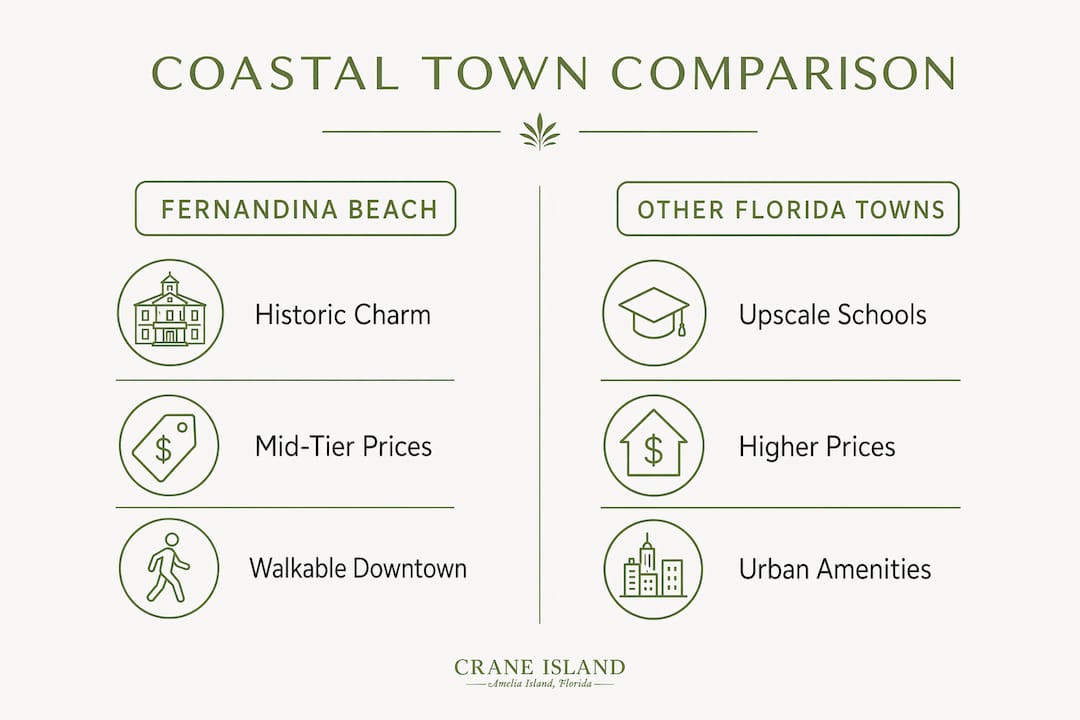
Fernandina Beach retains visible layers of colonial, industrial, and maritime history that more polished resort towns have smoothed over. That authenticity is a draw for buyers who want to live somewhere with a real story, not a brand identity. The contrast with Ponte Vedra Beach is instructive: Ponte Vedra offers manicured golf communities and top-ranked schools, while Fernandina Beach offers a messier, more genuine sense of place.
Seasonal tourism does create friction. Parking in the historic district tightens considerably from spring through summer, and vacation rental pressures add to traffic challenges during peak seasons. Residents who live year-round learn to plan around these rhythms, much as residents of any beloved small coastal town must.
"The fundamental lifestyle choice in Northeast Florida is often between urban connectivity and island seclusion, with Fernandina Beach representing the latter." — Amelia Island & Fernandina Beach Guide
To understand how the historic district shapes daily life in Fernandina Beach, it helps to walk Centre Street on a Tuesday morning in October, when the tourists have gone and the town belongs entirely to its residents.
How does Fernandina Beach's location compare with other Florida coastal towns?
Fernandina Beach sits on the northern tip of Amelia Island, 30 to 40 minutes north of Jacksonville via Interstate 95. That proximity to a major metro is a genuine advantage over more remote coastal towns like Apalachicola or Cedar Key, where the nearest hospital or major airport requires a longer drive. Jacksonville International Airport, major medical centers including UF Health Jacksonville, and large retail corridors are all accessible within the commute window.
The geographic character of Amelia Island itself sets Fernandina Beach apart from Gulf Coast towns in several important ways:
- The Atlantic Ocean side delivers stronger surf and wider, more dynamic beaches compared to the calmer Gulf waters of towns like Naples or Destin.
- Amelia Island offers more than 40 public beach accesses along 13 miles of coastline, meaning beach access is not gatekept by resort ownership or private development.
- Fort Clinch State Park, located at the island's northern tip, provides 1,400 acres of maritime forest, fishing piers, and Civil War-era fortifications that have no equivalent in most Florida coastal towns.
- The Timucuan Ecological and Historic Preserve, accessible from the island, protects one of the last unspoiled coastal marshes on the Atlantic seaboard.
- The Intracoastal Waterway runs along the island's western edge, giving waterfront residents direct boating access to a connected network stretching from Maine to Florida.
This combination of Atlantic exposure, preserved natural lands, and Intracoastal access creates an ecological richness that resort-heavy markets like Marco Island or Clearwater Beach simply cannot replicate. For buyers who want nature as a neighbor rather than a backdrop, Fernandina Beach's geography is a defining advantage. Craneisland's homesites are positioned directly on the Intracoastal, placing residents inside this natural system rather than adjacent to it.
How do amenities and services in Fernandina Beach compare to competing towns?
Fernandina Beach operates within Nassau County's school district, which offers solid public education options but does not match the top-ranked private and public school ecosystems found in Ponte Vedra Beach or Palm Beach. Families prioritizing elite K-12 education as a primary criterion will find Ponte Vedra or Delray Beach more competitive on that specific measure.
Healthcare access follows a similar pattern. The island itself has urgent care and outpatient facilities, but major hospital services require the drive to Jacksonville. UF Health Jacksonville and Baptist Health are both within reach, which is a meaningful advantage over truly remote coastal towns. Buyers coming from markets like Sarasota or Naples, which have robust local hospital systems, should factor this trade-off into their decision.
Where Fernandina Beach genuinely outperforms more urbanized coastal markets is in walkable, character-driven daily life. The historic downtown offers a concentration of independent restaurants, live music venues, coffee shops, and cultural events within easy walking distance of residential neighborhoods. Delray Beach has a comparable walkable downtown, but at significantly higher price points and with a more transient, tourist-facing energy.
Pro Tip: If walkability matters to you, map your prospective Fernandina Beach address against Centre Street before you buy. Homes within half a mile of the historic district command a lifestyle premium that shows up in resale value as well as daily convenience.
| Amenity category | Fernandina Beach | Ponte Vedra Beach | Delray Beach |
|---|---|---|---|
| Walkable downtown | Strong, historic | Limited | Strong, resort-facing |
| K-12 schools | Nassau County district | Top-ranked public/private | Palm Beach County district |
| Hospital access | Jacksonville (30-40 min) | Jacksonville (20-30 min) | Local system available |
| Beach access | 40+ public access points | Limited public access | Public, urban beach |
| Community character | Historic, authentic | Polished, gated | Upscale, tourist-driven |
The Amelia Island real estate market reflects these amenity trade-offs directly in pricing, with the historic district and Intracoastal-adjacent properties commanding the strongest long-term appreciation.
Key takeaways
Fernandina Beach occupies a distinct position among Florida coastal towns, offering authentic historic character, mid-tier pricing, and Atlantic barrier island ecology that resort-polished markets cannot replicate.
| Point | Details |
|---|---|
| Mid-tier pricing with real costs | Home prices of $400K to $550K are offset by mandatory flood insurance and rising homeowners' premiums. |
| Authentic community culture | A walkable historic downtown and heritage events distinguish Fernandina Beach from gated resort communities. |
| Geographic advantage | Forty-plus public beach accesses, Fort Clinch State Park, and Intracoastal access create rare natural richness. |
| Amenity trade-offs | Healthcare and elite schools require Jacksonville proximity; walkable daily life is a genuine local strength. |
| Lifestyle clarity matters | The choice between Fernandina Beach and towns like Ponte Vedra or Delray Beach comes down to authenticity versus polish. |
Why Fernandina Beach rewards buyers who know what they want
I have spent years watching buyers approach the Florida coastal market with a checklist and leave with something they did not expect: a feeling. Fernandina Beach is one of the few places that consistently delivers that feeling, but only to buyers who come prepared for what it actually is.
The town is not trying to be Ponte Vedra Beach. It is not trying to be 30A. It has its own identity, worn openly, and that identity includes some friction. The traffic in summer is real. The insurance costs are real. The school district is not going to win national rankings. These are not reasons to walk away. They are reasons to be honest with yourself about your priorities before you commit.
What I find genuinely rare about Fernandina Beach is the way history and nature coexist without either being curated for consumption. You can walk from a Victorian-era home to a working shrimp dock to a maritime forest trail within twenty minutes. That kind of layered experience does not exist in most coastal markets at any price point.
For buyers who want a legacy property, a place that will mean something to the next generation, Fernandina Beach and the broader Amelia Island market offer something that polished resort towns cannot manufacture. The distinction between Amelia Island and 30A is not just geographic. It is a difference in what coastal living is actually for.
— John Hillman
Discover your place on Amelia Island with Craneisland
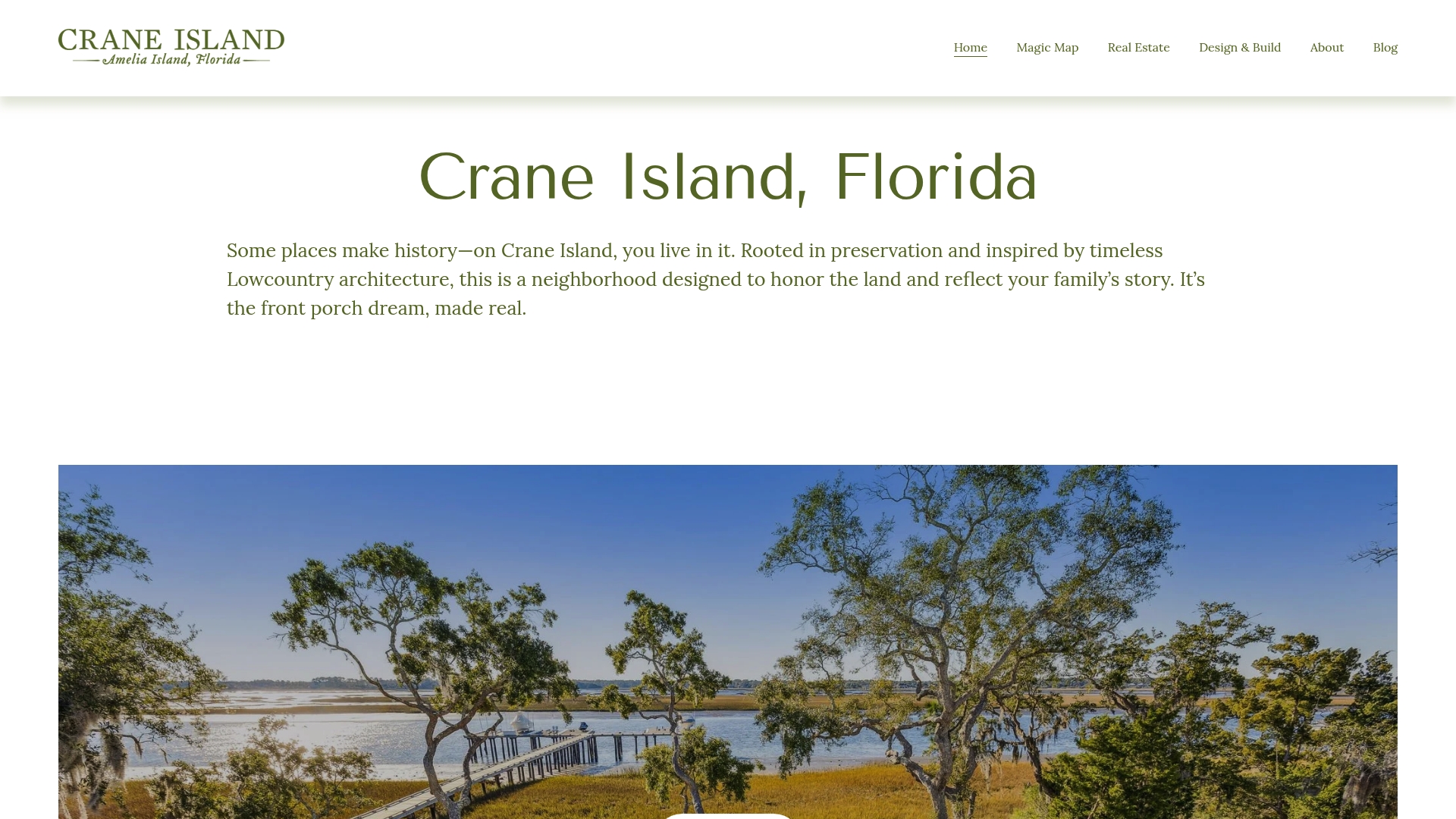
Craneisland offers one of the most considered approaches to coastal real estate on Amelia Island. With only 14 custom homesites positioned directly on the Intracoastal Waterway, each property is designed to honor the island's natural character through Lowcountry architecture and preserved marshland surroundings. Residents live inside the ecology rather than beside it, with porch living that frames tidal views and a community culture built around shared open spaces. If the comparison research in this article has pointed you toward Fernandina Beach and Amelia Island as the right fit, explore the available luxury homesites or learn more about custom design and build services tailored to this singular place.
FAQ
What is the median home price in Fernandina Beach?
Home prices in Fernandina Beach typically range from $400,000 to $550,000, placing it in the mid-tier of Florida coastal markets. Island historic district homes and Intracoastal-adjacent properties sit at the higher end of that range.
How does Fernandina Beach compare to Ponte Vedra Beach for families?
Ponte Vedra Beach offers top-ranked schools and polished gated communities, while Fernandina Beach appeals to families who prioritize historic character, outdoor access, and a more authentic small-town culture. The school district and hospital proximity are the primary practical trade-offs.
Is Fernandina Beach a good investment for real estate buyers?
Fernandina Beach offers solid long-term value for buyers who account for flood insurance costs, rental permit requirements, and the premium attached to historic district and waterfront locations. Address-level due diligence on flood zones and insurance is critical before purchasing.
What makes Fernandina Beach different from Gulf Coast towns?
Fernandina Beach sits on the Atlantic side of Florida, offering stronger surf, wider beaches, and a distinct barrier island ecology compared to the calmer Gulf Coast markets of Naples or Destin. Its proximity to Jacksonville also provides urban services that more remote Gulf towns cannot match.
How accessible is Fernandina Beach from major cities?
Fernandina Beach is located 30 to 40 minutes north of Jacksonville, providing access to Jacksonville International Airport, major hospitals, and large retail centers while maintaining the character of a small island town.
Recommended
- Fernandina Beach Historic District: What You Need to Know
- Custom Intracoastal Homes on Amelia Island: A Guide to Gated Waterfront Living in Fernandina Beach — craneisland
- Beyond 30A: Why Amelia Island and Crane Island Offer the Coastal Life You Were Actually Looking For — craneisland
- Benefits of Buying a Coastal Home on Amelia Island