
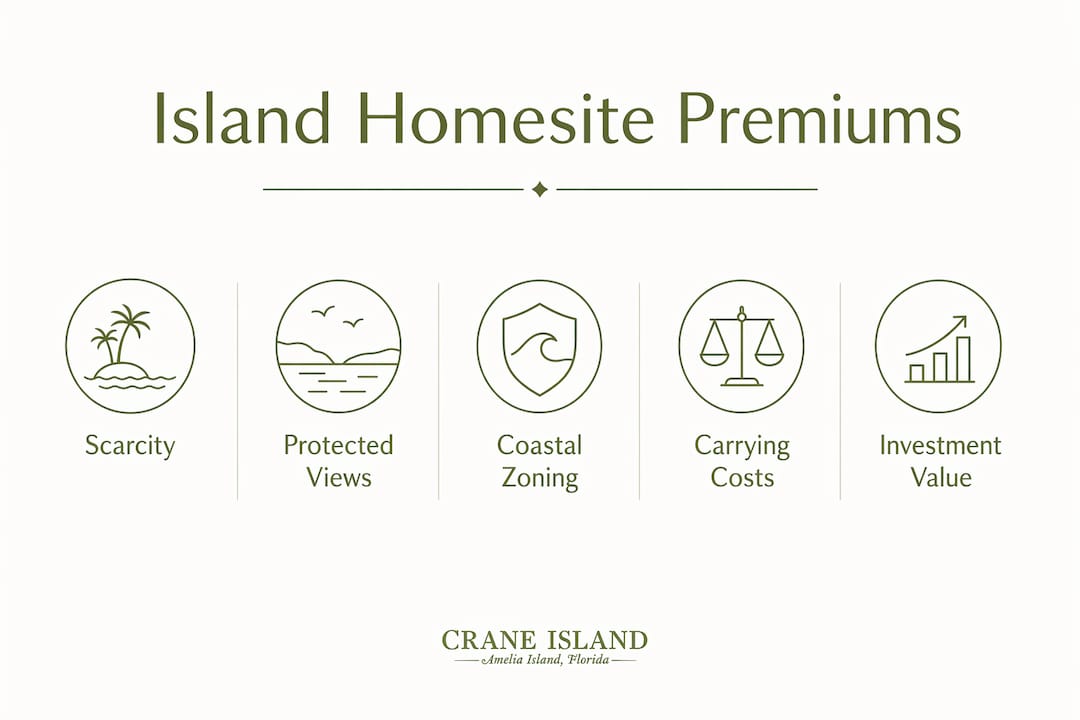
Private island homesites are defined by three compounding forces: scarcity of buildable land, protected water views, and coastal zoning that limits future supply. Together, these factors explain why private homesites command island premiums that consistently outpace mainland alternatives. Realtor.com reports oceanfront homes priced roughly 29% higher than landlocked equivalents in the same market. That gap is not arbitrary. It reflects a structural reality that the Federal Reserve Bank of Boston, Douglas Elliman, and hedonic valuation researchers have each documented from different angles. For buyers and investors, understanding these forces is the difference between paying a premium confidently and overpaying blindly.
Why private homesites command island premiums: the scarcity factor
Land scarcity is the foundational driver of island homesite pricing. The industry term for this dynamic is supply constraint, and on islands, it operates more severely than in any other residential market.
The Federal Reserve Bank of Boston found that markets with fewer large buildable parcels experience faster house price growth and reduced housing supply responsiveness. On islands, large contiguous parcels are rare by geography alone. Fragmented lots increase development costs and reduce construction efficiency, which discourages new supply even when demand is strong.
The Florida Keys illustrate this perfectly. Local growth ordinances cap the number of new residential allocations annually. When those allocations run out, demand does not stop. Prices rise instead. The result is a feedback loop: constrained supply meets persistent demand, and existing parcel values climb year after year.
This feedback loop is what separates island homesites from other luxury real estate categories. A developer cannot simply build more units to meet demand the way they might in a suburban market. The land is finite, the regulations are firm, and the pricing reflects both realities.
| Supply Constraint Factor | Effect on Island Homesite Pricing |
|---|---|
| Limited buildable parcels | Fewer options push buyers to compete on price |
| Fragmented lot ownership | Higher development costs reduce new supply |
| Growth ordinances (e.g., Florida Keys) | Annual caps create artificial scarcity |
| Island geography | Physical boundaries prevent outward expansion |
Pro Tip: When evaluating an island homesite, ask specifically how many buildable parcels remain in the community. A community with only a handful of lots left carries a fundamentally different scarcity profile than one with dozens still available.
What do protected water views actually add to property value?
Water views are not just a lifestyle amenity. They are a measurable financial attribute, and the research is specific about their worth.
A hedonic valuation study using 352 resale transactions found that partial water views add approximately 11% to property value, while full, unobstructed views add roughly 22%. These figures come from high-rise residential markets, but the principle applies directly to island homesites. The premium is real, it is quantifiable, and it persists across market cycles.
What makes private homesites particularly valuable is that they protect those views over time. On a private homesite with conservation land, preserved marshland, or regulated buffer zones surrounding it, the view you purchase today is the view you will have in twenty years. That guarantee is what transforms a view from an aesthetic pleasure into a durable financial asset.
Compare this to a condo tower where the unit directly in front of yours could be developed at any time. The view premium in that scenario is fragile. On a well-regulated private island homesite, protected views represent a structural component of value, anchored by conservation efforts and local ordinances that limit future development.
| View Type | Estimated Premium | Durability on Private Homesite |
|---|---|---|
| No water view | Baseline | N/A |
| Partial water view | ~11% above baseline | High, if buffer zones confirmed |
| Full, unobstructed view | ~22% above baseline | Highest, with conservation land adjacent |
Pro Tip: Before purchasing, verify that the views are legally protected, not just currently unobstructed. Ask your agent to confirm adjacent land designations and any conservation easements in place.
The island living advantages tied to water views go beyond the visual. Morning light on open water, the sound of tidal marshes, and direct access to the Intracoastal Waterway shape daily life in ways that no inland property can replicate.
How does coastal zoning sustain island homesite premiums?
Zoning in coastal markets functions as a two-stage constraint. It limits what you can build today, and it limits what your neighbors can build tomorrow. Both stages matter for long-term value.
Kiawah Island in South Carolina offers one of the clearest examples. New zoning ordinances there establish buffer zones that restrict construction scope and height near oceanfront properties. The ordinance was designed to protect dune systems and coastal habitats. The financial consequence is that it also reduces the buildability of remaining parcels and prevents encroachment on existing homes.
This is the mechanism buyers often overlook. Coastal regulation does not just preserve nature. It preserves exclusivity. When a zoning overlay prevents a neighboring parcel from being subdivided or developed to a higher density, your homesite retains its privacy, its views, and its character. The zoning buffers and overlays that feel like restrictions to developers are precisely what sustain premium pricing for existing parcel owners.
Key zoning factors that support island homesite premiums include:
- Buffer zone requirements that prevent construction within set distances of the shoreline or wetlands
- Height restrictions that protect sightlines and prevent overshadowing of existing homes
- Conservation overlays that permanently remove adjacent land from development consideration
- Density caps that limit the number of units per acre across the community
For buyers evaluating island property value factors, zoning documentation is as important as the site plan. A homesite with confirmed regulatory protection is worth more than an identical parcel without it, because its exclusivity is guaranteed rather than assumed.
What are the real carrying costs of island homesite ownership?
Island premiums price in more than lifestyle. They also price in risk, and buyers who understand this distinction make smarter decisions.
Realtor.com identifies insurance, flood risk, building reserves, and storm preparedness as significant cost drivers behind coastal home prices. These are not hidden fees. They are structural carrying costs that any serious buyer or investor must model before committing. Understanding Florida mortgage pitfalls related to flood zones and coastal insurance requirements is a practical first step in that modeling process.
Savvy investors underwrite the operating and risk load separately from the purchase price. Insurance premiums on coastal properties can run significantly higher than inland equivalents. Flood zone designations affect both insurance costs and financing terms. Storm preparedness, including impact windows, elevated foundations, and generator systems, adds to both build cost and ongoing maintenance.
The key insight is that buyer willingness-to-pay reflects both the romance of island living and a rational pricing of these operating risks. The premium is not irrational. It is a composite of lifestyle desirability and priced-in cost of ownership. Buyers who separate these two components make better comparisons across properties.
- Insurance costs: Coastal flood and wind policies can add thousands annually beyond standard homeowner coverage
- Flood zone designation: FEMA flood maps determine mandatory coverage requirements and affect resale financing
- Maintenance reserves: Saltwater environments accelerate wear on exteriors, HVAC systems, and landscaping
- Storm preparedness: Code-compliant construction in coastal zones often exceeds standard build specifications
Pro Tip: Request a full cost-of-ownership estimate from your agent before comparing island homesites to mainland luxury properties. The gross price comparison rarely tells the full story.
Key takeaways
Private island homesites command sustained premiums because scarcity, protected views, and coastal zoning work together as a self-reinforcing system that limits supply while preserving lifestyle exclusivity.
| Point | Details |
|---|---|
| Scarcity drives price growth | Markets with fewer buildable parcels see faster price appreciation and weaker supply response. |
| Water views carry measurable value | Full unobstructed views add roughly 22% to property value when legally protected. |
| Zoning preserves exclusivity | Buffer zones and conservation overlays prevent encroachment, sustaining both privacy and pricing. |
| Carrying costs are part of the premium | Insurance, flood risk, and maintenance must be modeled separately from purchase price. |
| View protection must be verified | Unconfirmed views carry encroachment risk that erodes premium value over time. |
The premium is real, but only if you verify it
I have spent years watching buyers fall in love with island homesites for the right reasons and then fail to protect that investment by skipping the verification steps that actually matter.
The premium is real. The research from the Federal Reserve Bank of Boston, the hedonic valuation studies, and the Realtor.com coastal data all confirm it. But the premium is not automatic. It attaches to specific conditions: confirmed scarcity, legally protected views, and zoning that limits future encroachment. Without those three elements verified in writing, you are paying a premium for a feeling rather than a financial reality.
The mistake I see most often is buyers comparing island homesites using price-per-square-foot comps that ignore view protection and zoning status. A parcel priced at a discount to its neighbors may look like value. It may simply be a parcel where the views are unprotected or where adjacent land could be developed. That discount is not a deal. It is a warning.
My honest advice: treat scarcity and view protection as non-negotiable due diligence items, not nice-to-haves. Ask for the zoning overlay maps. Confirm conservation easements. Review the community's remaining inventory. And model your carrying costs before you fall in love with the view. The buyers who do this work come away with properties that hold their value through market cycles. The ones who skip it often discover why the price was lower than it seemed.
The Amelia Island luxury buying checklist is a practical starting point for anyone working through this process on a specific property.
— John Hillman
Experience the Craneisland difference on amelia island
Craneisland on Amelia Island is one of the clearest living examples of why private homesites command island premiums. With only 14 homesites available, the community's scarcity is built into its foundation. Every homesite offers direct access to the Intracoastal Waterway, with views protected by preserved marshlands and conservation-minded community design rooted in Lowcountry architectural tradition.
The community's commitment to porch living, open natural spaces, and thoughtful site planning means that the exclusivity you purchase today is the exclusivity you will pass on. Craneisland's custom design and build services allow you to create a home woven into the land itself, honoring both your personal vision and the island's heritage. Explore the available homesites and discover what genuine island exclusivity looks and feels like.
FAQ
Why do island homesites cost more than mainland properties?
Island homesites command higher prices because of land scarcity, protected water views, and coastal zoning that limits new supply. Realtor.com reports oceanfront homes priced roughly 29% above inland equivalents in the same area.
How much value does a water view add to an island homesite?
A hedonic valuation study found partial water views add approximately 11% to property value and full unobstructed views add roughly 22%. Those premiums hold most reliably when the views are legally protected by conservation easements or zoning buffers.
What carrying costs should i expect with an island homesite?
Coastal flood and wind insurance, elevated maintenance costs from saltwater exposure, and storm-preparedness construction requirements are the primary carrying costs. Investors model these separately from the purchase price to understand true net returns.
Does coastal zoning actually protect my investment?
Yes. Zoning overlays and buffer zones, like those established on Kiawah Island, prevent neighboring parcels from being developed in ways that would encroach on your views or privacy. That regulatory protection is a core component of long-term premium durability.
How do i evaluate whether an island homesite premium is justified?
Verify three things: confirmed scarcity of remaining inventory, legally protected views through easements or conservation designations, and zoning documentation confirming buildability and neighbor restrictions. Without all three, the premium may not hold over time.