

Yes, a second home can qualify for a 1031 exchange, but only if you hold and document it as investment property under the IRS safe harbor in Rev. Proc. 2008-16. That means clearing two 24-month windows of qualifying use, renting at fair market value at least 14 days per year, capping personal use at the greater of 14 days or 10% of rental days, and still meeting the standard identification and closing deadlines within IRS rules using a qualified intermediary. Miss any piece, and the exchange collapses into a taxable sale.
TL;DR:
- To qualify for a 1031 exchange, a second home must be documented as investment property, meeting specific rental, personal use, and documentation requirements over two 24-month windows.
- Owners must rent their property at fair market value for at least 14 days per year and limit personal use to the greater of 14 days or 10% of rental days in each 12-month period.
- Properly tracking rental income, claiming depreciation, and maintaining organized records are crucial to demonstrate genuine investment intent and meet IRS safe harbor standards.
- Missing the strict timing, documentation, or personal-use limits can disqualify the property from 1031 treatment, resulting in immediate tax liability.
- State-specific rules and the need for a qualified intermediary also play a significant role in ensuring compliance and maximizing tax deferral benefits.
Table of Contents
- What Is Rev. Proc. 2008-16 and How Does the Safe Harbor Work?
- How Do You Convert a Second Home Into Qualifying Investment Property?
- What Deadlines and Filings Govern the Exchange Itself?
- What Happens When an Exchange Fails the Safe Harbor Test?
- What Should Luxury Second-Home Owners Document Before Exchanging?
- How Does the IRS Distinguish a Second Home From an Investment Property?
- Are There Exceptions to the Standard Second-Home Eligibility Rules?
- How Much Personal Use Is Too Much?
- Does Mixed Personal and Rental Use Disqualify a Property?
- Do State Laws Add Extra Requirements to a 1031 Exchange?
- The Safe Harbor Rewards Discipline, Not Cleverness
- Looking for a Replacement Property That Fits a 1031 Timeline?
- Sources
- FAQ
What Is Rev. Proc. 2008-16 and How Does the Safe Harbor Work?
The IRS never wrote a bright-line rule defining "investment property" for vacation homes. Instead, it gave owners a safe harbor, a set of tests that, if met, guarantee the agency will treat your second home as qualifying property under Section 1031 rather than arguing the point case by case.
A "dwelling unit" under the safe harbor is any real property with basic living amenities, a kitchen, bathroom, and sleeping space, whether it's a beach cottage, a mountain cabin, or a condo you visit twice a year. The safe harbor asks you to run the same test on both ends of your exchange: the property you're giving up (relinquished) and the one you're acquiring (replacement).
Here's what the two 24-month windows actually require, broken down by 12-month periods within each window:
- Rent the property to unrelated parties at fair market value for at least 14 days in each 12-month period.
- Limit personal use to the greater of 14 days or 10% of the days it was rented at fair market value during that same period.
- Repeat both tests for two consecutive 12-month periods, covering the full 24 months before you sell and the full 24 months after you buy.
Fair market value matters as much as the day count. A week rented to your cousin at half the going rate doesn't count toward your 14 days. It counts as personal use instead, which pushes you further from qualifying, not closer.
Rev. Proc. 2008-16 offers this safe harbor as an option, not a mandate. Some owners qualify under a broader facts-and-circumstances analysis without hitting every threshold exactly. But practitioners at LegalClarity consistently note that skipping the safe harbor means arguing your case to an examiner with no guaranteed outcome. If certainty matters to you, and for most owners it should, build your plan around the safe harbor from day one.
How Do You Convert a Second Home Into Qualifying Investment Property?
Converting a vacation home into exchange-eligible property is a documentation project as much as a rental one. Here's the sequence that holds up:
- Set your start date and write it down. Pick the day you begin renting at market rate and mark it as the start of your first 24-month window. Keep a simple log, dated entries, not a reconstruction six months later.
- Market the property like a business, not a favor. List it with a property manager or on platforms like Airbnb or Vrbo at rates comparable to similar units nearby. A rental cash flow and cap rate calculator can help you benchmark fair market rent before you list.
- Report every dollar on Schedule E. Rental income and expenses belong on your tax return every year you claim investment use, not just the year before the exchange.
- Claim depreciation. Investment property gets depreciated; a personal vacation home doesn't. Claiming it signals to the IRS that you're treating the asset as a business, not a retreat.
- Keep the paper trail organized. Leases, bank deposits matching rental income, cleaning and property-management invoices, and booking confirmations all corroborate your Schedule E numbers if questioned later.
Pro Tip: Start your rental clock the day you decide to exchange, not the month before you list the property for sale. The IRS looks at intent and pattern over time, and a rental history that begins two months before closing reads as a setup, not a genuine investment.
Avoid the shortcuts that sink exchanges: discounted rentals to relatives, converting use just weeks before a sale, and reporting rental income inconsistently across years. Each one undermines the very record you're trying to build.
What Deadlines and Filings Govern the Exchange Itself?
Meeting the safe harbor's use tests solves only half the problem. The exchange mechanics run on their own clock, and missing them kills the deferral regardless of how clean your rental history looks.
Once you close on the relinquished property, you have a set identification period to name replacement property and a limited exchange period to close on it, according to the IRS overview of like-kind exchanges. If your tax return is due before day 180, that earlier date controls, unless you file an extension, which restores your full 180-day window.
Identification follows one of three rules under Treasury Regulation 1.1031(k)-1-1):
- Three-property rule: identify up to three potential replacements regardless of value.
- 200% rule: identify any number of properties as long as their combined value doesn't exceed 200% of what you sold.
- 95% rule: identify unlimited properties, but you must actually acquire 95% of their total value.
You'll also need a qualified intermediary to hold sale proceeds. Touch the money yourself, even briefly, and the IRS treats the entire exchange as a taxable sale. Finally, Form 8824 reports the transaction: transfer dates, values, adjusted basis, and deferred gain. Keep leases, Schedule E filings, and closing statements for years afterward in case of audit.
What Happens When an Exchange Fails the Safe Harbor Test?
The safe harbor exists because of a real dispute. In Moore v. Commissioner, the Tax Court denied 1031 treatment for a vacation property with minimal rental history and heavy personal use, and that case shaped the framework the IRS eventually codified in Rev. Proc. 2008-16.
Renting to family at a discount is one of the most common ways owners accidentally disqualify themselves. Below-market family stays count as personal use, not rental use, unless the relative pays fair market rent and treats the home as a primary residence.
Auditors tend to flag the same patterns repeatedly:
- Rental activity that starts suspiciously close to the sale date.
- Family or friend stays priced well under market comparables.
- Schedule E filings that don't match claimed rental days or income.
Fail the safe harbor without a strong facts-and-circumstances case, and the consequences stack up fast: the deferred gain becomes taxable in the year of sale, depreciation recapture applies, and high earners may face the Net Investment Income Tax on top of ordinary capital gains. If your situation involves a recent conversion, multiple states, or an unusual ownership structure, that's the point to bring in tax counsel rather than proceed on assumptions.
What Should Luxury Second-Home Owners Document Before Exchanging?
At Craneisland, we work with buyers who think about real estate the way they think about legacy, not just location. A property on Amelia Island with direct access to the Intracoastal Waterway carries genuine rental demand, which makes the fair-market-rent test easier to satisfy honestly rather than by stretching the numbers.

If you're converting a high-end second home into exchange-eligible property, treat it as you would any serious investment. Hire a professional property manager who lists at documented market rates. Use formal leases, not handshake agreements with friends. Report rental income on Schedule E every year, consistently, well before you ever plan to sell. A community with only 14 homesites and steady buyer interest tends to hold marketability that supports both your rental case and your eventual exit.
How Does the IRS Distinguish a Second Home From an Investment Property?
The IRS doesn't classify property by what you call it. A "primary residence" is where you actually live most of the year, and it typically qualifies for the Section 121 exclusion on sale gains, not for a 1031 exchange. A "second home" or vacation home sits in a gray zone: you may use it occasionally, but you don't live there full time.
An "investment property" is one held for income production or appreciation, the only category Section 1031 was written for. The confusion happens because a single physical property can shift between these labels depending on how you use it and what you can prove.
This is exactly why Rev. Proc. 2008-16 matters so much for second-home owners. It replaces guesswork about intent with an objective test: hit the rental floor, stay under the personal-use ceiling, and the IRS treats your vacation home as investment property, regardless of whether you also enjoy a few weeks there each year. Skip the safe harbor, and you're arguing intent based on facts and circumstances, a fuzzier standard that depends on your specific rental history, marketing efforts, and how consistently you've reported income.
The practical takeaway: your deed doesn't determine eligibility. Your usage pattern and paper trail do.
Are There Exceptions to the Standard Second-Home Eligibility Rules?
Most owners who successfully exchange a vacation home follow the safe harbor precisely, but the IRS does leave room for a facts-and-circumstances argument when the safe harbor isn't a perfect fit.
Say you've rented a property consistently for three years but had one year where personal use exceeded the cap because of a family emergency. The safe harbor technically fails for that period, but a documented, otherwise-consistent rental history can still support a facts-and-circumstances case. Success here typically hinges on evidence like multi-year Schedule E filings, active marketing to unrelated renters, and professional property management, the same markers an examiner looks for regardless of which route you take.
One narrow exception involves related-party rentals: if a family member pays true fair market rent and uses the property as their actual primary residence, that use doesn't count against your personal-use cap the way a discounted family vacation would.
There's no exception, however, for timing shortcuts. Converting a property to rental use two months before listing it for sale almost never survives scrutiny, safe harbor or not. The IRS wants to see a genuine investment pattern, not a transaction dressed up at the last minute. If your history is mixed or unusual, that's a signal to get a tax professional's opinion before you rely on facts-and-circumstances rather than the safe harbor's clear thresholds.
How Much Personal Use Is Too Much?
Personal-use limits are where most second-home exchanges quietly fail, often because owners underestimate how strictly the cap applies. The rule is the greater of 14 days or 10% of the days the property was rented at fair market value, calculated separately for each 12-month period in both the relinquished and replacement 24-month windows.

Here's where the math surprises people: if you rented the property for 200 days in a given year, 10% of that is 20 days, higher than the flat 14-day floor. Your personal-use ceiling in that scenario is 20 days, not 14. But if you only rented for 60 days, 10% is just 6 days, so the 14-day floor governs instead, and you can use the property yourself for up to 14 days.
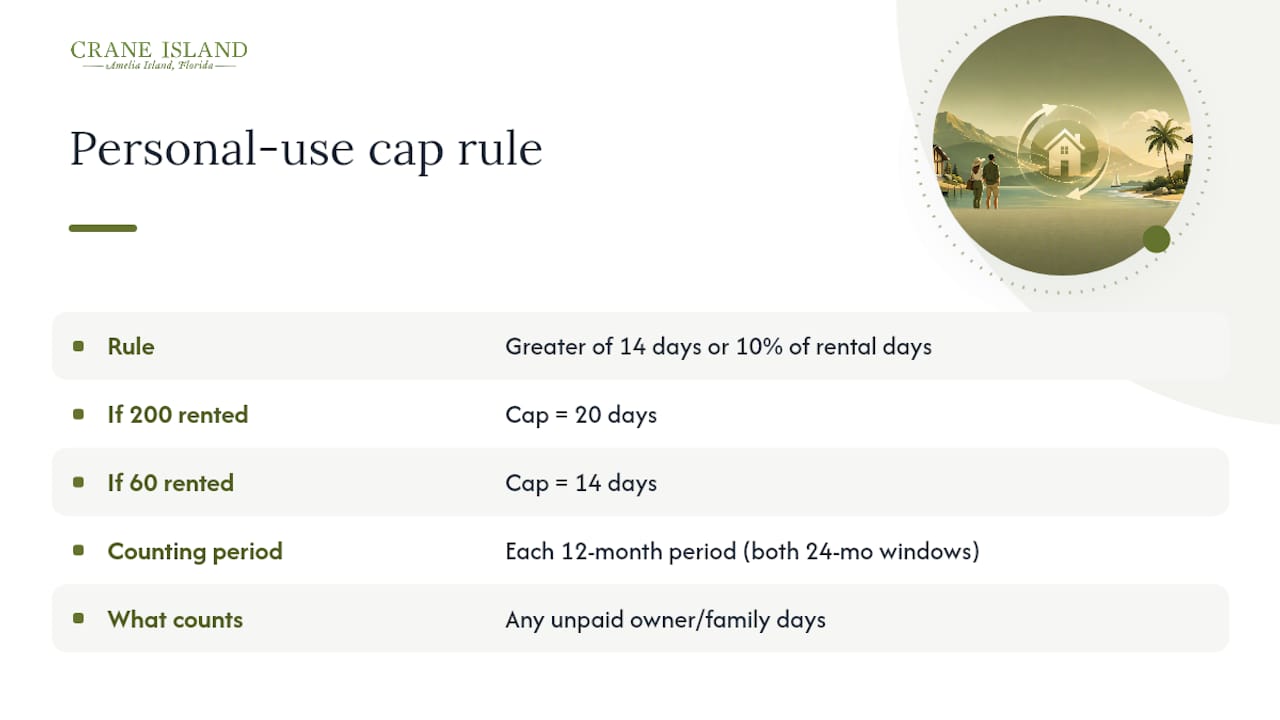
Every day you or an immediate family member stays without paying fair market rent counts against this cap, even if you're there doing maintenance or preparing the property for renters. The IRS doesn't carve out an exception for owner work days the way some state landlord-tenant laws do.
This is precisely why the two 24-month windows demand real planning rather than after-the-fact math. Track personal-use days in real time, in the same log where you record rental days, so you're never estimating months later when your accountant asks. A single overlooked long weekend can push you over the cap and outside the safe harbor entirely.
Does Mixed Personal and Rental Use Disqualify a Property?
Mixed use doesn't automatically disqualify a second home. In fact, the entire safe harbor framework assumes some personal use is normal for a vacation property, it just bounds how much. The question isn't whether you used the property personally, but whether your rental activity at fair market value clears the 14-day floor while personal use stays under the cap in every relevant 12-month period.
Where mixed-use properties run into trouble is consistency across years. A property that hit the rental threshold in year one but fell short in year two, because a family reunion ran long or a booking fell through, breaks the safe harbor's 24-month chain even if the average across both years looks fine on paper. The IRS tests each 12-month period independently, not the two-year average.
Owners who successfully exchange mixed-use vacation homes tend to treat rental income as the primary purpose and personal enjoyment as the byproduct, not the reverse. That distinction shows up in how you market the property (year-round listings versus blocking out prime weeks for yourself first), how you price it (market rate versus friends-and-family discounts), and how you report it (Schedule E every year, not selectively). Short-term rental platforms like Airbnb and Vrbo generate exactly the kind of dated, itemized booking records that make this case easier to document, since the IRS evaluates the substance of the rental activity rather than the channel you used to book it.
Do State Laws Add Extra Requirements to a 1031 Exchange?
Section 1031 is federal law, and the safe harbor tests apply identically no matter where the property sits. But state tax treatment of the deferred gain varies enough that it deserves its own line of planning, especially if your relinquished and replacement properties sit in different states.
Florida imposes no state income tax, which means a property owner exchanging within Florida faces no additional state-level capital gains exposure beyond the federal deferral, though Florida-specific filing and timing rules still apply to the transaction itself. Compare that to a state like California, which taxes deferred 1031 gains through a clawback mechanism if you eventually sell a replacement property while a California resident, even years after the original exchange.
Virginia and several other states have their own reporting nuances for out-of-state exchanges, including how deferred gain gets tracked if you later sell a Virginia property acquired through a 1031 swap, detailed in Virginia's state-specific exchange rules. If your exchange crosses state lines, which is common when a vacation home in one state gets swapped for a coastal property in another, loop in a tax professional licensed in both states before you finalize your identification.
The Safe Harbor Rewards Discipline, Not Cleverness
The biggest misconception about exchanging a second home is that it's a workaround, a clever reading of the tax code that lets you have your vacation cake and defer taxes on it too. It isn't. Rev. Proc. 2008-16 is a compliance framework, and the owners who succeed with it are the ones who treat their vacation home like a small business for two full years before they ever list it for sale.
Where conventional advice falls short is in treating the 14-day rental floor as the whole story. It's the minimum, not the target. Owners who rent consistently well above 14 days, price at genuine market rates, and file clean Schedule E returns year after year build a record that survives scrutiny even if a personal-use day gets miscounted somewhere along the way.
If you're weighing this path, prioritize the paper trail before you prioritize the timeline. A property with two imperfect years of honest rental documentation will outperform one with a technically perfect but thin history every time an examiner looks closely.
— John Hillman
Looking for a Replacement Property That Fits a 1031 Timeline?
If you're working through an exchange and need a replacement property that functions credibly as an investment, not just a retreat, a Crane Island homesite is worth a look. These are custom, like-kind dwelling units on Amelia Island with direct access to the Intracoastal Waterway, the kind of property that supports genuine market-rate rental activity rather than requiring you to manufacture a rental history from scratch.

With only 14 homesites in the community, buyers get a limited, high-demand asset that tends to hold its marketability, whether you're renting it out under the safe harbor's two-year window or eventually converting it to personal use once your exchange discipline period ends. Before you identify a Crane Island property as part of your exchange, talk with your qualified intermediary and a 1031-experienced tax advisor to confirm the timeline and use requirements fit your specific situation. If you're ready to explore availability, reach out to Crane Island to start that conversation.
This article is general information, not a substitute for advice from a qualified financial advisor. Consult a qualified financial professional about your own circumstances before acting on anything here.
Sources
FAQ
Can you 1031 exchange a second home?
Yes, if you meet the Rev. Proc. 2008-16 safe harbor: rent it at fair market value at least 14 days per year and keep personal use under the greater of 14 days or 10% of rental days, for two years before and after the exchange.
What is the two-year rule for a 1031 exchange?
It refers to the two 24-month qualifying-use windows under the safe harbor, one before you sell the relinquished property and one after you acquire the replacement, during which you must meet the rental and personal-use thresholds in each 12-month period.
How do you avoid capital gains tax on a second home?
A 1031 exchange defers, not eliminates, capital gains tax if the second home qualifies as investment property under the safe harbor; a 1031 exchange defers rather than erases the tax bill, so plan your eventual exit with a tax advisor.
What is better than a 1031 exchange for a second home?
For a true primary residence, the Section 121 exclusion may work better since it eliminates tax rather than deferring it, but it doesn't apply to vacation or investment property.