

Florida's absence of state income tax is the single most powerful financial driver behind the state's luxury real estate boom. The role of no state income tax in Florida luxury buying goes far beyond a headline benefit. For high-net-worth buyers relocating from New York or California, the savings compound year after year, reshaping net worth trajectories in ways that no lifestyle amenity alone could match. Florida also carries no state estate or inheritance tax, and its homestead exemption adds another layer of protection that buyers from high-tax states rarely enjoy at home.
How does Florida's no income tax compare to other states for luxury buyers?
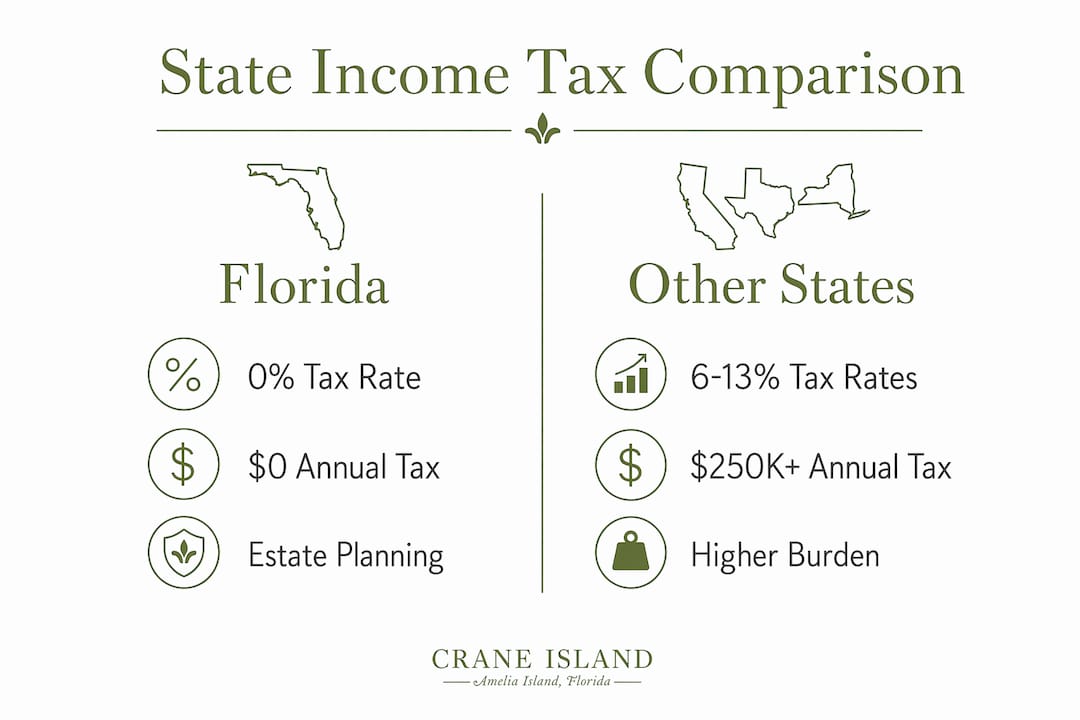
Florida's zero state income tax rate stands in sharp contrast to the rates buyers leave behind. New York imposes state income tax up to 10.9%, and New York City residents pay an additional local tax on top of that. California's top marginal rate reaches 13.3%. For a buyer earning $2 million annually, annual state tax savings in Florida range from $250,000 to over $300,000 compared to those states. That is not a one-time gain. It recurs every year, and it compounds when invested.
The table below shows how the tax burden differs across key states for a $2 million earner.
| State | Top state income tax rate | Estimated annual state tax on $2M income |
|---|---|---|
| Florida | 0% | $0 |
| New York (NYC) | 10.9% + local | $250,000+ |
| California | 13.3% | $266,000+ |
| Texas | 0% | $0 |
| Illinois | 4.95% | ~$99,000 |

Texas also has no state income tax, but Florida offers additional advantages in estate planning and property tax protections that Texas does not fully replicate. The no income tax benefits in Florida are most pronounced for buyers with high earned income, capital gains, or business distributions. For ultra-wealthy buyers, the math is not subtle. It is transformative.
What other taxes affect luxury buyers in Florida?
Florida's tax picture extends well beyond income tax, and buyers who focus only on that headline number miss the full story. The state imposes no estate or inheritance tax, which means generational wealth transfers face only federal estate tax exposure. That distinction matters enormously for buyers with complex family wealth structures.
Florida's homestead exemption reduces a primary residence's assessed value by $50,000, and the Save Our Homes cap limits annual assessment growth to 3% or the Consumer Price Index, whichever is lower. For a luxury home that appreciates significantly, this cap prevents property tax bills from spiraling upward year after year. Buyers who establish homestead status early lock in a compounding protection.
The tradeoffs are real, though. Florida's sales tax reaches up to 7.5% in some counties. Property tax rates run between 0.8% and 1.1%, which is moderate but not negligible on an $8 million home. Insurance costs on luxury properties present the most significant carrying cost variable, ranging from $3,000 to $10,000+ annually depending on location, construction, and coverage level. Coastal properties in hurricane-prone zones carry the highest premiums.
Key cost factors for luxury buyers to weigh:
- State income tax: Zero, with no scheduled changes for 2026
- State estate and inheritance tax: None
- Homestead exemption: $50,000 assessed value reduction for primary residences
- Save Our Homes cap: Annual assessment growth capped at 3% or CPI
- Property tax rate: 0.8%–1.1% depending on county
- Sales tax: Up to 7.5% in select counties
- Insurance: Highly variable; coastal luxury homes face the highest premiums
Pro Tip: Work with a Florida-licensed CPA before closing to model your full carrying cost picture, not just the income tax savings. Insurance, property tax, and HOA fees together can equal or exceed the cost of income taxes in some high-tax states for buyers at lower income levels.
How does no state income tax drive Florida's luxury real estate market?
Tax migration is not a trend. It is a structural force reshaping Florida's luxury real estate market from the ground up. Buyers relocating from New York, California, Illinois, and New Jersey arrive with substantial liquidity freed from state income tax obligations. Many pay cash, which compresses transaction timelines and pushes prices upward in the most desirable markets.
Port Royal in Naples is the clearest example of this dynamic at work. Median sales prices in Port Royal sit around $16.4 million, with trophy properties reaching $85 million to $225 million. That pricing reflects not just land and architecture but the concentrated demand from buyers who have done the tax math and chosen Florida as their permanent financial home. The North Florida coastal market is following a similar trajectory, with Amelia Island attracting buyers who want the tax advantages of Florida alongside a quieter, more intimate coastal setting.
"Tax-driven buyers seek stable legal and tax environments for long-term wealth preservation, preferring communities with peers who made similar moves, which enhances market stability and appreciation." — Miami Luxury Tax Migration Buyers Are Reshaping the Market
This peer effect is underappreciated. When a critical mass of high-net-worth buyers settles in a community, the local ecosystem deepens. Private banking, estate law, family office services, and luxury retail follow. That ecosystem makes the community more attractive to the next wave of buyers, which sustains demand and supports long-term appreciation. Buyers who arrive early in that cycle capture the greatest benefit.
How do you establish Florida domicile to maximize tax benefits?
Establishing Florida domicile is a legal process, not a casual relocation. The steps are specific, and incomplete execution invites scrutiny from the tax authorities of your former state.
- File a Declaration of Domicile with the clerk of the circuit court in your Florida county. This is the foundational legal document.
- Obtain a Florida driver's license and surrender your out-of-state license within 30 days of establishing residency.
- Register to vote in Florida and update your voter registration to reflect your Florida address.
- Update all legal and financial documents, including wills, trusts, bank accounts, brokerage accounts, and insurance policies, to reflect your Florida address.
- Spend the majority of your time in Florida. Most states use a 183-day rule to determine residency. Document your presence carefully.
- Align your estate plan with Florida law. Florida has specific rules around homestead and inheritance that differ from many other states.
Failure to establish bona fide domicile properly exposes buyers to multi-state tax claims. New York and California are particularly aggressive in auditing high-income individuals who claim to have relocated. They will examine credit card records, phone location data, and social media activity to challenge a domicile claim.
Timing is the most overlooked element of domicile planning. Establishing true Florida domicile before a major liquidity event, such as a business sale or large capital gain realization, is critical. Buyers who complete a transaction before their domicile is fully established may owe their former state taxes on the entire gain. That error can cost millions and is entirely avoidable with proper planning.
Multi-state tax exposure requires coordinated planning with a specialized CPA and estate attorney who understand both Florida law and the laws of your former state. This is not a task for a generalist accountant.
Pro Tip: If you are planning a business exit or large liquidity event, begin the domicile process at least 12 months in advance. Document every step with dated records. Your CPA and estate attorney should be coordinating together, not working in silos.
Key Takeaways
Florida's no state income tax creates compounding annual savings of $250,000 to over $300,000 for $2 million earners, making it the most financially significant driver of luxury property demand in the state.
| Point | Details |
|---|---|
| Annual income tax savings | Buyers from NY or CA save $250,000 to $300,000+ annually by establishing Florida domicile. |
| No estate or inheritance tax | Florida imposes no state-level estate tax, protecting generational wealth transfers. |
| Homestead protection | A $50,000 exemption and 3% assessment cap limit property tax growth on primary residences. |
| Domicile requires formal steps | Filing a Declaration of Domicile, updating licenses, and spending 183+ days in Florida are all required. |
| Timing domicile matters | Establish residency before major liquidity events to avoid trailing tax liabilities from former states. |
Florida's tax advantages deserve a more complete conversation
Florida's tax environment is genuinely exceptional, and I have watched it reshape buying decisions for clients who once thought lifestyle was the primary driver of their relocation. The income tax savings are real and large. But the buyers who benefit most are the ones who treat this as a wealth planning decision, not just a real estate transaction.
The biggest mistake I see is buyers who move to Florida, buy a beautiful home, and assume the tax benefits follow automatically. They do not. Former states, particularly New York and California, have dedicated audit units focused on high-income individuals who claim to have relocated. The holistic tax planning approach that coordinates a CPA, estate attorney, and financial advisor is not optional for buyers at the $5 million and above level. It is the cost of capturing the benefit.
What I find most compelling about Florida's market is the compounding nature of the advantage. The income tax savings fund investment. The investment grows. The estate tax exemption protects the transfer of that growth to the next generation. Over 20 years, a buyer who establishes proper Florida domicile at age 55 may preserve several million dollars more than a peer who stayed in a high-tax state. That is a legacy, not just a tax strategy. Communities like Crane Island on Amelia Island, with their Fernandina Beach property benefits and Intracoastal access, are exactly the kind of place where that long-term vision takes root.
— John Hillman
Crane Island: where Florida's tax advantages meet coastal heritage
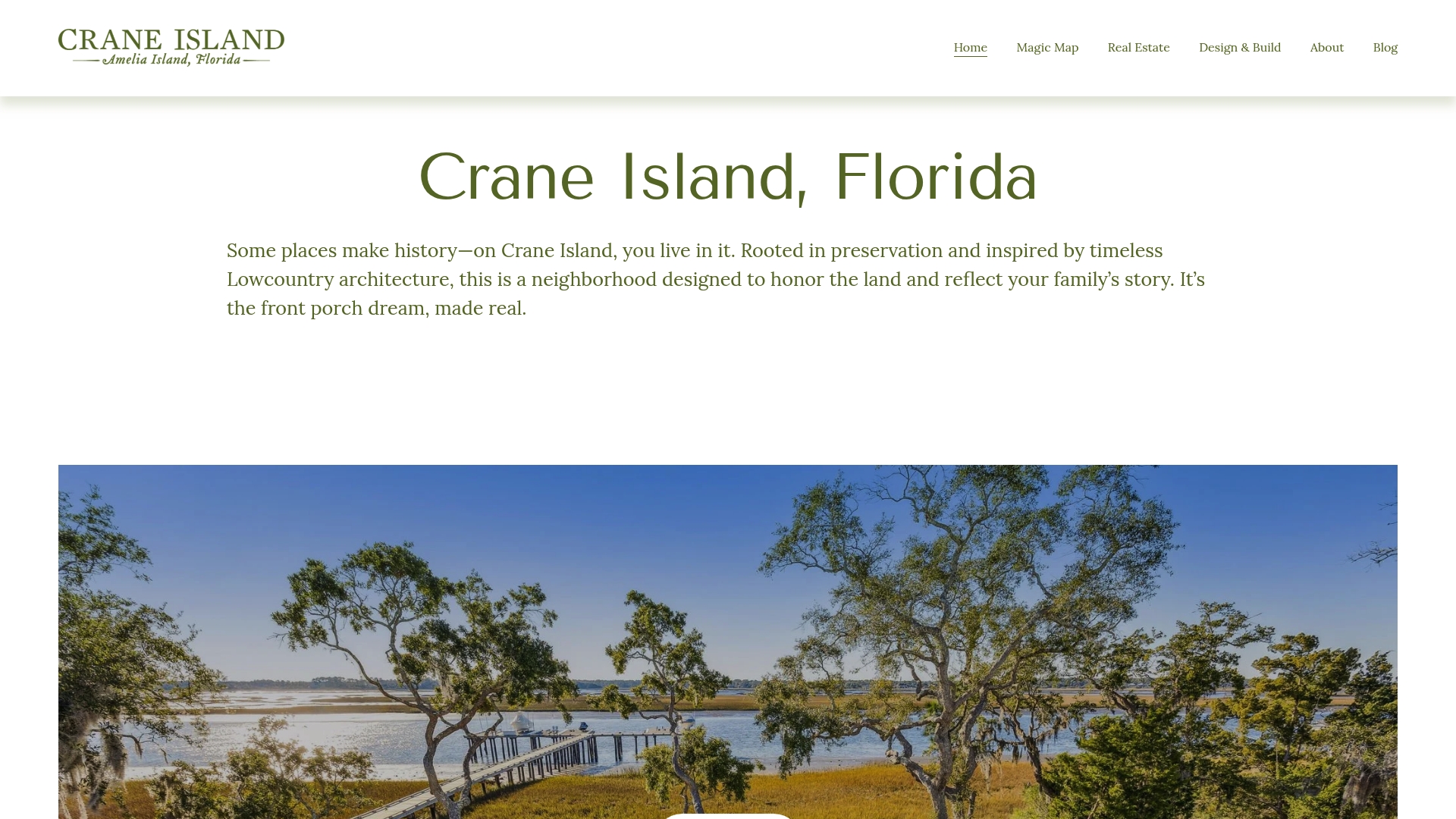
Craneisland sits on Amelia Island in Nassau County, one of Florida's most quietly compelling luxury markets. With only 14 custom homesites available along the Intracoastal Waterway, each property is woven into the land with the care and intention that defines Lowcountry architecture at its finest.
For high-net-worth buyers who have done the tax planning work and chosen Florida as their permanent home, Craneisland offers something rare: a community where the financial logic of relocation and the emotional pull of place arrive together. Nassau County's favorable tax environment for luxury buyers pairs naturally with the privacy, craftsmanship, and natural beauty that define life here. Explore the available homesites at Crane Island and speak with our team about how this community fits your vision for what comes next.
FAQ
Does Florida really have zero state income tax?
Florida has no state income tax and has not had one since 1855. The Florida Constitution prohibits the legislature from imposing a personal income tax.
How much can a high-net-worth buyer save by moving to Florida?
A buyer earning $2 million annually saves $250,000 to over $300,000 in state and local income taxes each year compared to living in New York or California.
What is the homestead exemption in Florida?
Florida's homestead exemption reduces a primary residence's assessed value by $50,000, and the Save Our Homes cap limits annual assessment increases to 3% or the Consumer Price Index, whichever is lower.
Can my former state still tax me after I move to Florida?
Yes. States like New York and California audit high-income individuals who claim relocation. Maintaining financial ties to a former state can create taxable obligations despite Florida residency, which is why coordinated CPA guidance is essential.
When should I establish Florida domicile before a business sale?
Establish full Florida domicile at least 12 months before any major liquidity event. Timing domicile before taxable events is the most effective way to protect gains from trailing tax claims by your former state.