
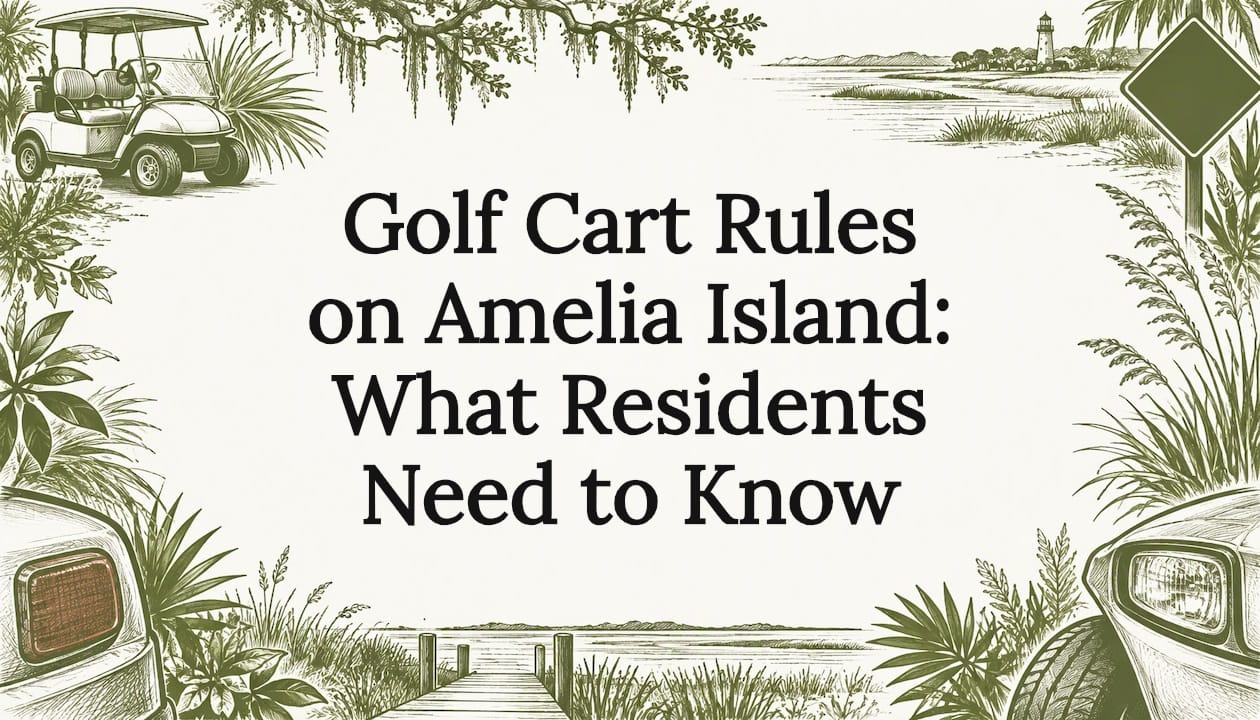
On Amelia Island, the golf cart rules come from three layers: Florida law, the local government that owns the road (the City of Fernandina Beach or unincorporated Nassau County), and the posted signs on the street itself. A true golf cart tops out at 20 mph, may use only roads a local government has designated for carts, and needs a licensed or ID-carrying driver. A low-speed vehicle (LSV), the plated, insured cousin that goes up to 25 mph, plays by different rules. Know which one you own, and most of the island's questions answer themselves.
We live and build here, and we know that a porch-first, slow-paced island invites exactly this kind of ride: a quiet cart to a neighbor's porch, the marsh edge at sunset, the village for supper. This guide walks through the rules as they stand in 2026 so you can enjoy it with confidence.
TL;DR
- A golf cart is capped at 20 mph and is not titled or registered. An LSV tops out at 25 mph and must be titled, registered and insured.
- Carts may use only roads a local government has designated and posted, generally those at 30 mph or less. Posted signs always win.
- Since October 1, 2023, drivers under 18 need a learner's or driver license. Drivers 18 and older need government-issued photo ID.
- Daytime use is the default. Night use requires local permission plus headlights, brake lights, turn signals and a windshield.
- Beach driving is limited to designated areas, and rules differ by jurisdiction. Check before you roll toward the sand.
Table of Contents
- Golf cart or low-speed vehicle: the distinction that drives everything
- Where a golf cart may go on Amelia Island
- Who may drive
- Equipment your cart needs
- Fines and etiquette
- Golf carts and the beach
- A quick checklist before you drive
- Our perspective
- Living here: where the rules meet the lifestyle
- Build your Amelia Island home with us
- FAQ
- Sources
Golf cart or low-speed vehicle: the distinction that drives everything
Most confusion on the island starts with a vocabulary problem. People say "golf cart" for anything small, electric and street-friendly. Florida law does not.
Per the Florida Department of Highway Safety and Motor Vehicles, a golf cart is a motor vehicle designed for golf-course use that cannot exceed 20 mph, while an LSV is a four-wheeled vehicle with a top speed above 20 but not more than 25 mph. That five-mile-per-hour gap changes your legal category, your paperwork, your insurance and the streets you may use.
| Golf cart | Low-speed vehicle (LSV) | |
|---|---|---|
| Top speed | 20 mph | 25 mph |
| Title and registration | Not allowed | Required |
| Insurance | Not mandated by the golf cart statute | Personal injury protection and property damage liability required |
| Roads | Designated roads, generally posted 30 mph or less | Streets posted 35 mph or less |
| Driver | Photo ID (18+) or learner's/driver license (under 18) | Valid driver license |
The Florida DOT's 2024 golf cart brochure lays out the same split and advises never driving a golf cart over 20 mph.
Is 25 mph too fast?
For a golf cart, yes: the legal cap is 20 mph. For an LSV, 25 mph is exactly the legal maximum. If your cart was modified to go faster, it may no longer meet the golf cart definition at all.
Converting a cart into an LSV
Florida's DHSMV guidance in form TL-63 notes that golf carts cannot be titled or registered, but a cart can be converted to an LSV. The conversion must be complete before you apply for a title, and an LSV must weigh under 3,000 pounds gross vehicle weight rating. If you want to drive beyond designated cart roads, this is the route, and it comes with plates, insurance and seat belts.
Where a golf cart may go on Amelia Island
Florida does not hand carts the whole road network. Under Section 316.212 of the Florida Statutes, a golf cart may be operated only on roads that the responsible local government has designated: county roads, municipal streets, certain two-lane county roads inside a municipality, and water-control-district roads with county approval. Before designating, the local government must determine that carts can safely travel or cross, weighing the speed, volume and character of traffic. Signs must then be posted.
DHSMV's plain-language version is that carts may use designated roadways posted at 30 mph or less, and may cross a portion of a county road that intersects an approved cart roadway, golf course or mobile home park where signs show carts share the roadway.

Two jurisdictions, one island
Amelia Island is not governed by one body. The historic town of Fernandina Beach has its own city streets, and the rest of the island sits in unincorporated Nassau County. A road that is open to carts in one place may not be in another. The state also lets local governments go further: they can adopt more restrictive golf cart ordinances and, in some cases, allow cart use on sidewalks at 15 mph or less, with sidewalks beside state highways needing to be at least 8 feet wide.
Our practical advice: before you drive anywhere new, look for the signs. A designated route is marked, and the sign is the final word.
Crossing a busy road
Crossing is a different matter from traveling along. A cart may cross a faster road at an approved intersection, but it does not get to drive down it. An LSV has a similar allowance: it may be operated only on streets posted 35 mph or less, though it may cross a faster road at an intersection. A county or municipality may also prohibit LSVs on any road under its jurisdiction for safety, per DHSMV's TL-63 summary.
Municipal carts
Cities have a separate allowance. Section 316.2126 lets municipalities use golf carts and utility vehicles on roads within city limits for municipal purposes only, and state roads used this way must be posted at 30 mph or less. That is about city business, not about private carts.
Who may drive
This is where the rule changed most recently. Florida's 2023 law (chapter 2023-67), effective October 1, 2023, replaced the old rule that allowed 14-year-olds to drive carts on public roads without a license.
Today, according to Florida DHSMV:
- A driver under 18 on public roads must hold a valid learner's driver license or driver license.
- A driver 18 or older must hold a valid government-issued photo ID.
- An LSV driver must hold a valid driver license.
So can a 12-year-old drive a golf cart on a public Amelia Island road? Not legally. Without a learner's or driver license, a child that age does not meet the requirement. Many families still let children steer on private property, and whether that is appropriate is a household decision, but the public road requirement is clear.
The Florida DOT adds sensible habits: the vision standards for a driver license apply to cart drivers too, never drive impaired, keep passengers to the seats available, and put small children in approved child restraint seats.
Equipment your cart needs
Florida's statute requires every golf cart to be equipped with efficient brakes, reliable steering, safe tires, a rearview mirror, and red reflectorized warning devices on the front and rear. These are the basics, and they are worth checking before the first spring ride.
Night driving
By default, golf cart operation is limited to the hours between sunrise and sunset. A local government may allow night operation, and then the cart must also have headlights, brake lights, turn signals and a windshield. If your evening plan includes dinner in town after dark, confirm that the road you plan to take allows it and that your cart is equipped.
LSV equipment
An LSV carries a longer list, per DHSMV: headlamps, front and rear turn signals, stop lamps, tail lamps, red reflectors (one on each side and one at the rear), a driver-side exterior mirror plus an interior rearview or passenger-side mirror, a parking brake, a windshield, a seat belt for each designated seat, and a vehicle identification number.
If you plan to charge an electric cart or LSV at home, the design rules for EV charging accessibility are a useful starting point when you plan a garage or outbuilding charging spot.
Fines and etiquette
Violations of the golf cart section are noncriminal traffic infractions. Under the same statute, breaking subsections (1) through (5), or the matching local ordinance, is treated as a moving violation. Other infractions are nonmoving violations.
Beyond the law, the Florida DOT advises never parking a cart in fire lanes, in front of building entrances, or in accessible parking spaces and access aisles. On a small island where everyone knows everyone, courtesy goes a long way: wave, slow down for walkers and cyclists, and keep the volume down on quiet streets.
Golf carts and the beach
The beach is the question visitors ask most, and it deserves care. The ocean shoreline is divided among the City of Fernandina Beach, unincorporated Nassau County and the state parks, which keep their own rules.
In unincorporated Nassau County, Ordinance 2021-001 designates the areas where motorized vehicles may park and drive on the Atlantic beaches: Peters Point Road to the Fernandina Beach city limits, the Lewis Street beach access, the southern end of the island from the Nassau Sound side to the developed resort parcel, and the Scott Road beach intersection. Restrictions can apply each year in front of Peters Point Park and Burney Park.
That ordinance addresses motorized vehicles generally. It does not say a street-legal cart may roll onto the sand anywhere. If you want to use a cart near the beach, contact Nassau County or the City of Fernandina Beach about your exact access point, and follow the posted signs. Most of us simply park by the dunes and walk over the boardwalk.
A quick checklist before you drive
- Identify your vehicle: golf cart (20 mph or less) or LSV (up to 25 mph, plated).
- Confirm the driver: ID or license as above.
- Check the equipment list for your category.
- Plan a route on designated roads, and look for the signs.
- Stay within daylight hours unless night use is permitted and your cart is equipped.
- Check rules at the beach access point before you go.
Our perspective
Porches are the true living rooms of Crane Island, and we have always believed a community feels most like itself at walking pace. The best part of an island life like ours is not how fast you get anywhere. It is the neighbor on the next porch, the marsh opening up at the end of the lane, the evening bicycle ride.
We built around that idea. Nearly half of our land is preserved as open space, our architecture follows Lowcountry tradition, and with only 14 homesites available, each home is designed to be woven into the land rather than set on top of it. Quiet, slow-moving ways of getting around fit this kind of place, and we have long celebrated that in our bicycle friendly community.
Florida's rules are simple once you know them: the right vehicle, the right driver, the right road. We encourage everyone who joins our community to learn them well, because a gentle island stays gentle when its neighbors take care of it.
John Hillman
Living here: where the rules meet the lifestyle
If you are weighing a move to Amelia Island, local mobility rules are part of the picture, alongside how you will spend your days. The island pairs quiet streets with the culture of historic Fernandina Beach, and much of what residents love sits close at hand, from courses, courts and club access to the town's restaurants and shops. If boating is part of your plan, our guide to deepwater access on the Intracoastal explains what the water offers. For a broader view of the island's neighborhoods, see our look at Amelia Island neighborhoods for custom homes.
Build your Amelia Island home with us
Crane Island is a private, environmentally preserved, Lowcountry-inspired community on Amelia Island, with direct Intracoastal Waterway access and a limited number of custom homesites, along with move-in ready homes through The Crane Island Portfolio Homes Program. If you are imagining a porch, a marsh view and a quiet way to get around, we would be glad to show you the island from the ground.
Explore our homes and homesites, or learn about The Crane Island Portfolio Homes Program.
FAQ
Do I need a license to drive a golf cart on Amelia Island?
Drivers 18 and older need a valid government-issued photo ID, and drivers under 18 need a learner's driver license or driver license. Since October 1, 2023, the old rule letting 14-year-olds drive without a license no longer applies. LSV drivers need a valid driver license.
Can I drive a golf cart on any road on Amelia Island?
No. Carts may use only roads designated by the local government and marked with signs, generally those posted at 30 mph or less. Whether a street is open to carts depends on whether it is under the City of Fernandina Beach or Nassau County, so look for the signs.
Do golf carts have to be registered or insured?
A golf cart cannot be titled or registered in Florida, and the golf cart statute does not mandate insurance. An LSV must be titled, registered and insured with personal injury protection and property damage liability coverage. Your own insurer can advise on coverage for your cart.
Can I drive a golf cart on the beach?
Only in areas where motorized vehicles are designated, and rules differ among the city, the county and the state parks. Nassau County's ordinance lists specific access areas. Check with the county or city about your access point before driving.
Sources
- Low Speed Vehicles, Florida Department of Highway Safety and Motor Vehicles
- Florida Statutes, Section 316.212 (2026)
- Florida Statutes, Section 316.2122 (2025)
- Florida Statutes, Section 316.2126 (2026)
- TL-63 Low-Speed Vehicles and Mini-Trucks, FLHSMV
- How to Use Transportation Options in Florida, Florida DOT (2024)
- Florida Senate bill analysis, 2023 golf cart law
- Nassau County Ordinance 2021-001, motorized vehicles on the Atlantic beaches
- Amelia Island beach ordinances, Amelia Island Living