
For most homeowners who need a dependable baseline, the National Flood Insurance Program is the right starting point. For those whose rebuild cost outpaces its caps, or who want replacement-cost contents and broader basement coverage, private flood insurance is often the better fit. Before choosing either, check your true rebuild cost against NFIP limits, and confirm your lender will accept the policy you pick.
TL;DR:
- Private flood insurance can offer significantly higher dwelling coverage limits, up to $15 million, compared to the NFIP's cap of $250,000.
- Private policies often include extras like replacement-cost contents, broader basement coverage, and additional living expense protection that the NFIP typically excludes or limits.
- When comparing quotes, it is crucial to request the declaration page to verify coverage details, exclusions, and to ensure exact matching of limits and deductibles.
- Private flood insurance may be declined or limited by carriers for properties with high flood risk or previous losses, making NFIP the fallback for those homes.
- Policy costs vary greatly depending on whether the insurer uses risk models, but saving money with private insurance can come with narrower coverage and exclusions.
Table of Contents
- Private Flood vs. NFIP: The Key Differences at a Glance
- What's Actually Covered: Building, Contents, and Basements
- Why Do NFIP and Private Flood Quotes Vary So Much?
- Who Can Actually Buy Each Type of Policy?
- How Long Do You Wait, and What Happens When You File a Claim?
- How to Decide: A Homeowner's Checklist
- A Publisher's Perspective on Coastal Coverage
- Sources
- FAQ
Private Flood vs. NFIP: The Key Differences at a Glance
The NFIP is a federally backed program administered by FEMA. It sells one standardized contract, the Standard Flood Insurance Policy (SFIP), through Write-Your-Own insurers and NFIP Direct, and that contract carries statutory caps no participating community can exceed. Private flood insurance works differently. Carriers and their reinsurers set their own limits, their own underwriting rules, and often their own definition of what counts as a covered loss, which is why two private quotes on the same house can look nothing alike.
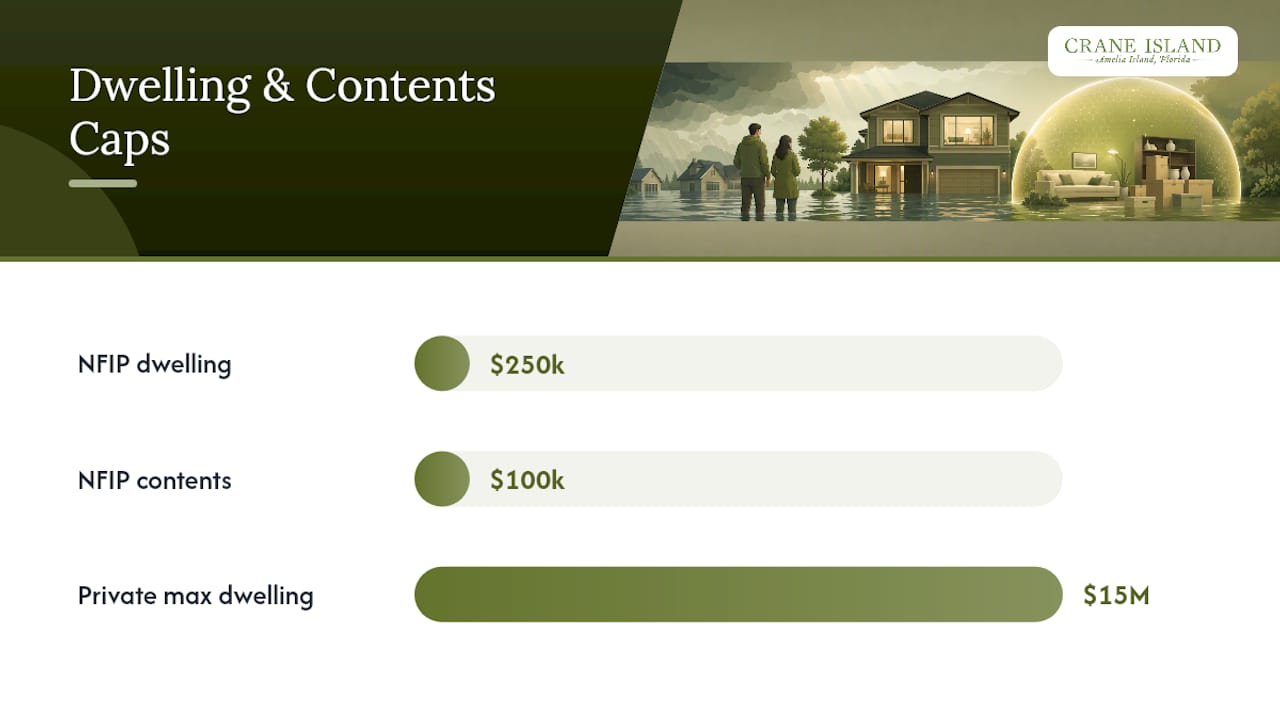
The cap gap is the detail that surprises most buyers. NFIP dwelling coverage tops out at $250,000 for the building and $100,000 for contents, no matter what the home is actually worth. Private insurers, by contrast, have reportedly offered dwelling limits as high as $15 million depending on the carrier and the property. That difference alone decides which program makes sense for a lot of coastal homeowners before cost ever enters the conversation.
Private policies also tend to bundle in extras the NFIP either restricts or skips entirely:
- Replacement-cost coverage for contents, instead of actual cash value
- Additional living expense (ALE) coverage if you're displaced during repairs
- Broader coverage for finished basements and detached structures
If your rebuild cost is realistically under $250,000, the NFIP baseline may cover you fully. If it's not, and for many architect-built coastal homes it isn't, private coverage stops being optional and starts being the only way to insure the full value of what you're rebuilding.
What's Actually Covered: Building, Contents, and Basements
Coverage language is where NFIP flood coverage and private policies diverge in ways that only show up when you actually read the declarations page. The SFIP splits every policy into building coverage and contents coverage, and it spells out, line by line, what gets paid and what doesn't. Basements are the classic trap: the SFIP limits coverage for items in basements and finished lower levels to a short list of essential equipment, not the finished living space itself, even if you paid a premium for that walkout basement suite.
Private carriers frequently write around that gap, offering coverage for finished basements, better contents replacement terms, and options the SFIP simply doesn't sell. Coverage design and additional living-expense features vary carrier to carrier, according to industry comparisons of private and NFIP policies, so "private" isn't one product, it's a category.
Before signing anything, compare these line items side by side:
- Building and contents coverage amounts
- Replacement cost vs. actual cash value settlement
- Additional living expense coverage
- Detached structure and basement terms
Pro Tip: Ask for the declarations page, not just a quote summary. The dec page is the only place that shows you exactly what's excluded, and it's the document your lender will actually review.
Why Do NFIP and Private Flood Quotes Vary So Much?
Pricing differences come down to two separate math problems being solved for the same address. The NFIP prices policies under Risk Rating 2.0, an address-based model that factors in a property's specific flood risk rather than a flat flood-zone rate. Private carriers run their own proprietary models, and because both approaches price by address, the only real way to compare cost is to request quotes from both for the exact property, not the neighborhood.
Two traps catch buyers off guard here:
- Losing a legacy rate. If your NFIP policy predates Risk Rating 2.0 and carries a grandfathered discount, switching to private can forfeit that discount permanently if you ever want to return.
- Cheap-but-thin coverage. A private quote that undercuts the NFIP significantly is worth a second look. It may be pricing a policy with narrower coverage, higher deductibles, or exclusions the summary page doesn't highlight.
Pro Tip: Never compare a private quote to an NFIP quote from a different year or a different address. Pull both for the current address, the current year, and matching coverage limits.
Who Can Actually Buy Each Type of Policy?
NFIP flood coverage is sold nationwide, but only inside communities that participate in the program, through WYO insurers or NFIP Direct. Because FloodSmart, FEMA's consumer resource, notes flood claims regularly occur outside mapped high-risk zones, this coverage remains available to a very broad set of properties, not just ones in a designated flood zone.
Private market appetite is narrower. Carriers can decline or limit coverage on properties with repeated flood losses or extreme risk profiles, which is part of why the NFIP still functions as the fallback for the hardest-to-insure homes.
- NFIP: available in any participating community, regardless of risk tier
- Private: subject to each carrier's own risk appetite, and can be declined
- Lender acceptance: private policies qualify if they meet federal criteria, but confirm this with your lender before you count on it
How Long Do You Wait, and What Happens When You File a Claim?
Timing is where escrow deadlines and insurance rules collide. NFIP policies carry a standard 30-day waiting period before coverage takes effect, with narrow exceptions such as certain loan closings. Private insurers frequently move faster, with effective periods reported as short as 10 days in some cases, though this varies by carrier and isn't universal.
Once a loss happens, the process looks similar on both sides:
- Pull your declarations page and confirm your coverage amounts and deductible.
- Document the damage thoroughly with photos and a detailed inventory before cleanup begins.
- File a proof of loss within your policy's required window.
- Track your adjuster's timeline and follow up if it stalls.
How to Decide: A Homeowner's Checklist
Work through this in order, and don't skip step one just because it feels like the boring part.
- Calculate your realistic rebuild cost. Use current local construction costs, not your purchase price, and compare that number to the NFIP's $250,000 building cap.
- List the coverages you actually need. ALE, replacement-cost contents, and finished basement coverage are the three that most often push buyers toward private.
- Request quotes from both for the specific address, not a general estimate, and check the waiting period against your closing date.
- Confirm lender requirements before you commit to either policy.
When you're on the phone with an agent or loan officer, ask these four questions directly: "Is this NFIP or private?" "Will my lender accept this exact policy?" "What's paid at actual cash value versus replacement cost?" And, if you're leaving an existing NFIP policy, "Will switching to private erase any legacy discount permanently?"
Pro Tip: A buying checklist built around Amelia Island luxury purchases is a useful companion here. Insurance placement moves faster when it's treated as a line item in your closing timeline, not an afterthought after you've already signed a contract.
A Publisher's Perspective on Coastal Coverage
Some brokers work with buyers whose rebuild costs routinely exceed NFIP caps, so they push insurance conversations into escrow early, not after closing. An elevation certificate and a clear rebuild estimate, informed by resources like our look at why private homesites command island premiums, tend to speed up placement on both sides of this decision.
— John Hillman
Sources
For the underlying rules, start with FEMA's NFIP overview, the SFIP dwelling form, and the Congressional Research Service's flood insurance report. For lender-side logistics during a purchase, mortgage tools and calculators can help you sort out documentation timing.
This article is general information, not a substitute for advice from a qualified financial advisor. Consult a qualified financial professional about your own circumstances before acting on anything here.
- Congressional Research Service: Flood Insurance issues (R45242)
- FEMA: Standard Flood Insurance Policy (SFIP) Dwelling form
FAQ
Should I Get NFIP or Private Flood Insurance?
Get NFIP if your rebuild cost fits comfortably under its $250,000 building cap and you want a stable, federally backed policy. Choose private if you need higher limits, replacement-cost contents, or broader basement coverage, and always quote both for your specific address before deciding.
How Can I Tell If My Flood Insurance Is Private or NFIP?
Check the declarations page: if it references the NFIP or the Standard Flood Insurance Policy, it's NFIP coverage, even when sold under a familiar private insurance brand through the Write-Your-Own program. A true private policy will name its own carrier terms, not the SFIP.
Is Selective Flood Insurance Private or NFIP?
Selective Insurance, like many WYO carriers, sells NFIP-backed policies under its own name alongside separate private flood products. The only way to know which one you have is to read the declarations page for SFIP or NFIP references.
Is There Such a Thing as Private Flood Insurance?
Yes. Private flood insurance is underwritten by insurance carriers and their reinsurers rather than the federal government, and it can offer dwelling limits far above the NFIP's $250,000 cap depending on the insurer and the property.