
If your property sits in FEMA Zone A or Zone V, or you're building new or substantially improving an existing structure, Florida will likely require an elevation certificate florida for permitting, and you'll want one for flood insurance rating and potential LOMA relief. The document confirms your home's lowest floor height against the flood datum, and it feeds three practical outcomes: permit sign off, an accurate National Flood Insurance Program premium, and support for a Letter of Map Amendment if your land was mapped incorrectly. Start by checking the state portal and calling your local floodplain manager before you spend a dollar.
TL;DR:
- A licensed surveyor, engineer, or architect must prepare and digitally submit a Florida elevation certificate within 30 days of completion for legal validity.
- Getting an existing certificate from the state or county records can save time, especially if your home was recently built or previously surveyed.
- The cost of an elevation certificate varies based on foundation complexity, benchmark availability, and travel distance, typically ranging from a few hundred dollars upward.
- A new certificate usually involves a one to two-hour field visit and can take days to weeks for office processing, depending on workload and research needs.
- Regularly reviewing and updating the elevation certificate helps catch mapping errors and supports future LOMA or insurance premium reassessments.
Table of Contents
- What an Elevation Certificate Is and When Florida Requires One
- Who Can Prepare an EC and Florida's Submission Rule
- How to Get an Elevation Certificate in Florida: A Step-by-Step Checklist
- Where to Find Existing Elevation Certificates in Florida
- Elevation Certificate Cost and Timing in Florida
- Practical Tips for Owners, Builders, and Local Officials
- Why the Paperwork Matters More Than People Admit
- How Crane Island Handles Elevation Documentation for You
- Sources
- FAQ
What an Elevation Certificate Is and When Florida Requires One
An elevation certificate is a standardized FEMA form that records how high your home's lowest floor sits above the base flood elevation, along with the lowest adjacent grade and the vertical datum used for measurement, almost always NAVD88 in Florida. Insurers and local officials use it as a factual snapshot rather than a guess, and that distinction is what makes it valuable.
Florida requires one, or strongly recommends one, in several situations:
- New construction in a Special Flood Hazard Area, particularly Zones A and V, where flood risk is highest.
- Substantial improvement projects, meaning renovation costs exceed 50% of the structure's market value, a threshold Miami-Dade County has enforced since 1995.
- Post-damage repairs following flooding, where the county needs to confirm the rebuilt structure meets current elevation standards.
- Properties changing insurance carriers or seeking a premium reassessment under current NFIP rating rules.
FEMA's Risk Rating 2.0 shifted how premiums get calculated, weighing more building-specific variables than the old system did. That change didn't retire the elevation certificate. Measured data still replaces an insurer's worst-case assumptions with your home's actual numbers, which is often the difference between a manageable premium and a punishing one, according to FloodSmart's guidance for agents.
Who Can Prepare an EC and Florida's Submission Rule
Only a licensed land surveyor, professional engineer, or registered architect can sign and seal a Florida elevation certificate. This isn't a paperwork formality. FEMA's form asks for precise vertical measurements, and an unlicensed estimate carries no legal weight with your insurer or building department.
Florida Statute 472.0366 adds a wrinkle many out-of-state buyers never anticipate: preparers must submit completed ECs digitally to the Florida Division of Emergency Management within 30 days of completion. The certificate must remain unaltered once submitted, and the preparer keeps the original signed and sealed copy on file.
Pro Tip: Before hiring anyone, ask for their license number and confirm they'll tie your elevation to NAVD88 using a documented benchmark. Request the PID (Point Identifier) or an OPUS report as proof, since jurisdictions increasingly expect that paper trail for LOMA submissions.
- Surveyors are the most common preparers for standalone ECs.
- Engineers often handle certificates tied to structural or foundation work.
- Architects may complete ECs bundled into new construction documentation.
How to Get an Elevation Certificate in Florida: A Step-by-Step Checklist
Getting a Florida flood elevation certificate doesn't have to feel like a mystery, but skipping steps costs time and money. Work through this order:
- Search before you spend. Check the FDEM portal and your county's building department. If the home already has a compliant EC, you may not need a new one.
- Ask the seller, builder, or permit office directly. Many existing certificates sit in a closing file or permit record nobody thought to mention.
- Call your local floodplain manager. Confirm whether your specific permit, insurance renewal, or LOMA request actually requires a new certificate, and what version of the form they expect.
- Vet your preparer. Confirm license status, ask how they'll establish the benchmark tie, and get a written quote covering the sealed form, digital delivery, and FDEM submission.
- Expect a field visit. A surveyor typically spends one to two hours on site measuring the lowest floor, adjacent grades, and any mechanical equipment elevations.
- Wait on office processing. Turnaround runs anywhere from a few days to several weeks depending on the surveyor's workload and how much research the benchmark tie requires.
- Collect your deliverables. You should receive the completed FEMA form, a sealed copy for your records, and confirmation of digital submission where the county or state requires it.
Pro Tip: If you're mid-transaction on a home purchase, request the elevation certificate as early as possible. Sellers or builders often already have one, and chasing it down after the inspection period closes creates unnecessary pressure on your closing date. For buyers weighing flood exposure alongside other due diligence, our Amelia Island luxury home buying checklist covers what else deserves attention before you sign.
Where to Find Existing Elevation Certificates in Florida
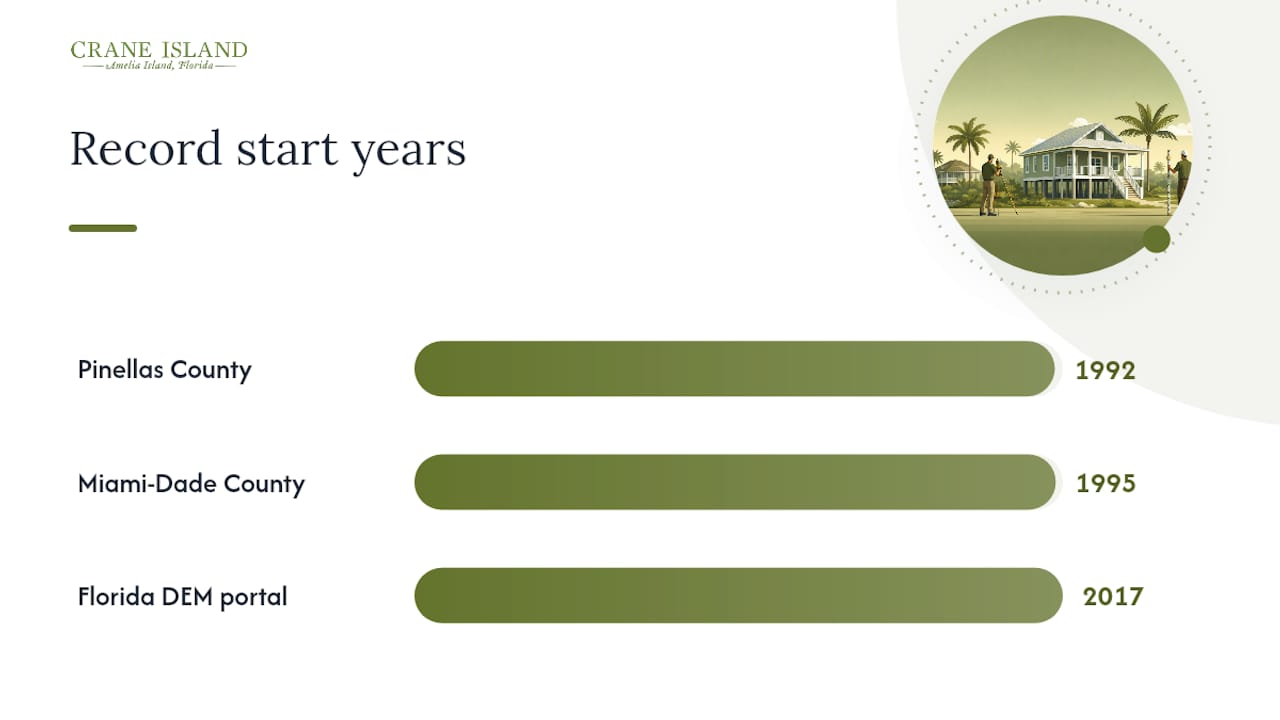
Before ordering a new survey, check what already exists. The Florida Division of Emergency Management maintains a public portal covering certificates submitted since 2017, and it partners with private platforms like Forerunner to accept uploads and surface property profiles that include National Flood Hazard Layer data. It's a genuinely useful starting point, but it isn't complete, especially for older homes.
County-level records often fill that gap:
- Pinellas County has kept elevation certificates for buildings in unincorporated areas since 1992.
- Miami-Dade has required ECs from builders and developers since 1995, with records tied directly to permitting.
- Sarasota County maintains its own floodplain records accessible through its building division.
If neither source turns up your certificate, call the county floodplain manager. They frequently hold older or permit-specific files the state portal never received, and they can tell you whether a map change means your existing EC needs updating anyway.
Elevation Certificate Cost and Timing in Florida
Pricing swings more than most homeowners expect, and the reason usually comes down to three things: how far the surveyor has to travel to tie into a benchmark, how complicated your foundation is, and how fast you need the finished form.
Cost snapshot: according to Apex Survey's Florida pricing data, a straightforward slab-on-grade home typically lands at the low end of the range, while homes on pilings, multi-story structures, and commercial buildings run higher because of the added measurement points and access challenges.
Before you accept a quote, confirm it includes:
- A sealed FEMA elevation certificate form, not just field notes.
- A digital file formatted for FDEM submission or your county's system.
- An OPUS report or benchmark documentation, if your site lacks a nearby published reference point.
Expect the field visit itself to take one to two hours. Office processing, including the benchmark research and form preparation, usually takes anywhere from a few days to a few weeks depending on the surveyor's backlog.
Practical Tips for Owners, Builders, and Local Officials
A few habits separate a smooth elevation certificate process from a frustrating one.
- Always request the benchmark PID or OPUS output up front, and confirm the NAVD88 datum before fieldwork begins, not after.
- Insist your preparer submit the EC digitally to FDEM, or in whatever format your county requires, and confirm they'll retain the signed and sealed original.
- If you're buying a home, ask for the existing elevation certificate and compare its numbers against the property's actual current condition. Renovations sometimes outpace paperwork.
- Keep a copy with your closing documents and property file. You'll need it again for insurance renewals or a future LOMA request.
Pro Tip: If storm activity has recently reshaped drainage or grading near your property, a certificate from several years ago may no longer reflect the ground you're standing on. It's worth a quick reassessment before you rely on old data for an insurance appeal. Coastal conditions shift, as recent flood watch reporting around Palm Beach and neighboring counties illustrates.
Why the Paperwork Matters More Than People Admit
Most guidance on elevation certificates treats them as a bureaucratic checkbox, something you get because a permit office demands it and then forget. That framing undersells what the document actually does. A well-prepared EC is leverage. It's the difference between an insurer guessing at your risk and an insurer pricing your actual elevation, and in a state where flood premiums have climbed under Risk Rating 2.0, that leverage carries real dollar value year after year.
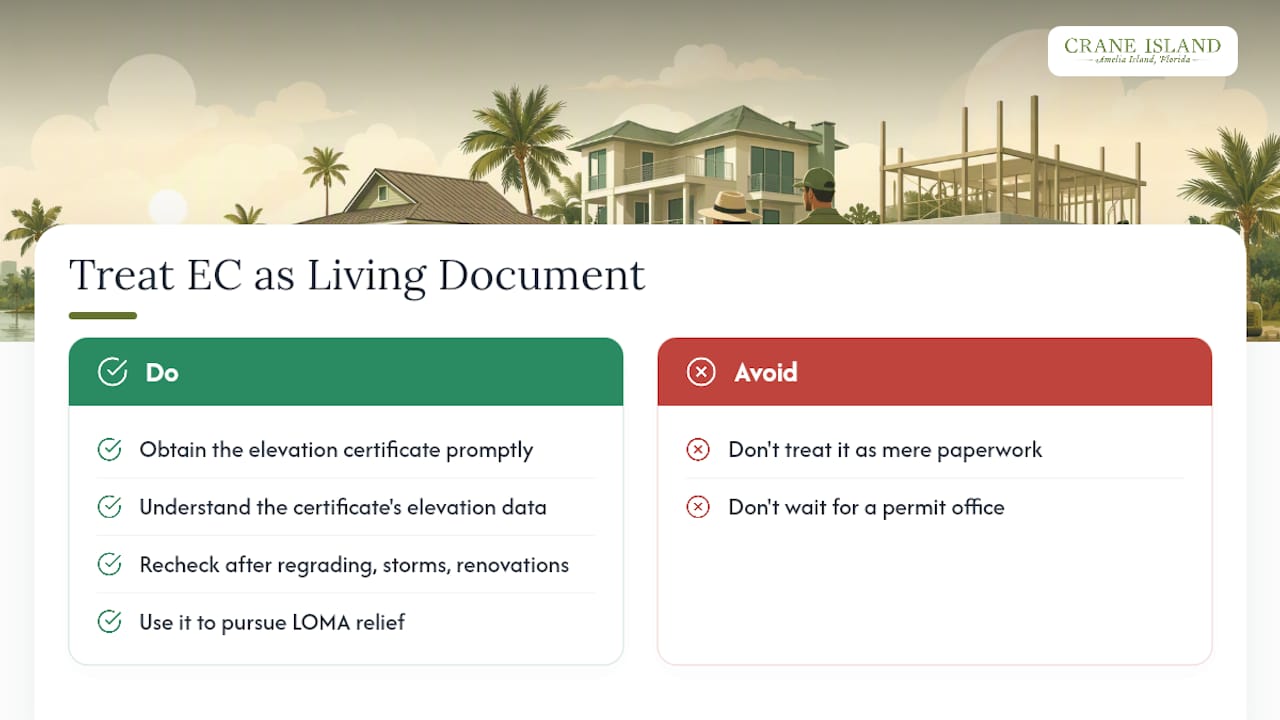
The conventional advice, get an EC when required and file it away, misses the bigger opportunity. Owners who treat the certificate as a living document, rechecking it after regrading, after storms, after renovations, are the ones who catch mapping errors and pursue LOMA relief before their neighbors do. Local officials should prioritize that same mindset: consistent NAVD88 benchmark documentation across a county prevents disputes years later.
If you take one thing from this guide, let it be this: don't wait for a permit office to force the issue. Get the certificate, understand what it says, and revisit it whenever your property or its flood zone changes.
— John Hillman
How Crane Island Handles Elevation Documentation for You
Building on Amelia Island means building in a flood zone conversation, and Craneisland doesn't leave that conversation to chance. Every homesite in our 14-lot community comes with coordinated surveys and the compliance records required for permitting and closing, handled alongside our architects and builders rather than left for buyers to chase down after the fact.
That means when you're ready to build your porch-centered home along the Intracoastal Waterway, the elevation documentation, benchmark ties, and submission paperwork are already part of the process, not a separate errand competing with your moving timeline. If Amelia Island's blend of preserved marshland and Lowcountry architecture fits the life you're picturing, reach out to Craneisland to talk through available homesites and what compliance support looks like for your specific lot.
Sources
- Elevation Certificates | Florida Division of Emergency Management
- Elevation Certificate Cost in Florida (2026 Guide) | Apex Survey
- Flood Elevation Certificate | Pinellas County
FAQ
How Do I Get an Elevation Certificate in Florida?
Start by searching the FDEM portal and your county building department for an existing certificate, then contact your local floodplain manager to confirm requirements before hiring a licensed surveyor, engineer, or architect to complete a new one.
How Much Does an Elevation Certificate Cost in Florida?
Cost depends on benchmark availability, foundation complexity, and travel distance, with simple slab homes typically costing less than homes on pilings or multi-story structures, according to Apex Survey's Florida cost breakdown.
What Is an Elevation Certificate in Florida?
It's a FEMA form documenting your home's lowest floor height and adjacent grade elevations relative to the NAVD88 datum, used for floodplain permit compliance, NFIP insurance rating, and LOMA support.
Can You Get Flood Insurance Without an Elevation Certificate?
Yes, but insurers will typically rate your policy using conservative default assumptions rather than your home's actual elevation, which usually means a higher premium than a documented certificate would produce, per FloodSmart's agent guidance.
Where Can I Find My Home's Existing Elevation Certificate?
Check the Florida Division of Emergency Management portal first, then your county building or floodplain office, since counties like Pinellas and Miami-Dade often hold older or permit-specific records the state database doesn't have.