
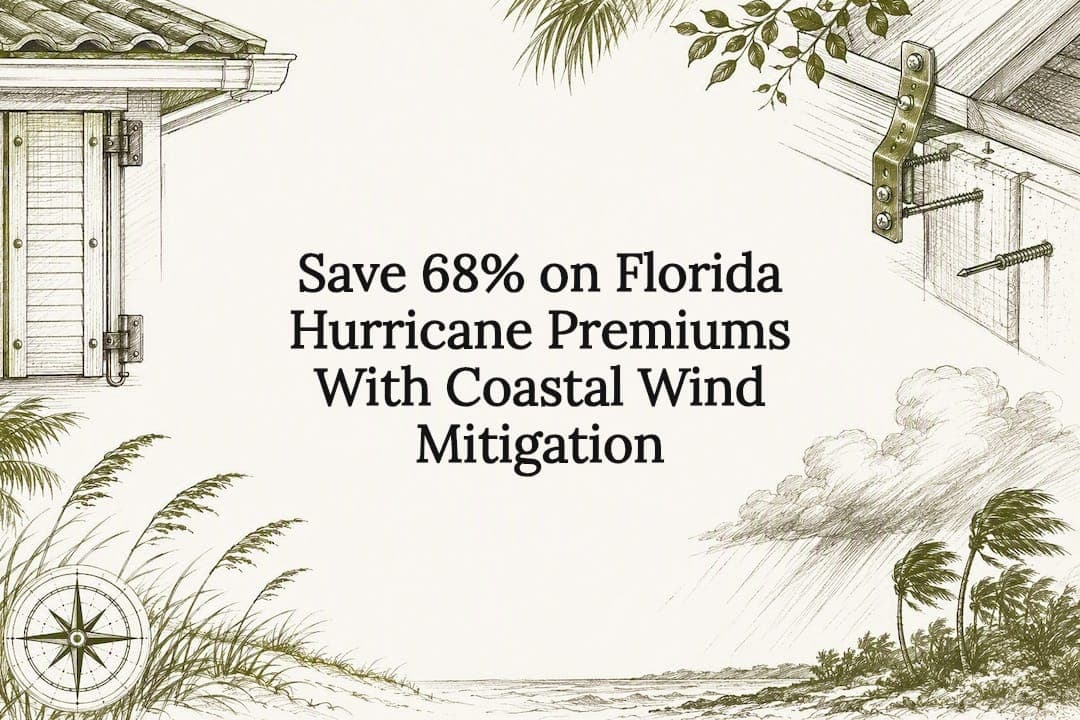
Yes, proper wind mitigation and a certified OIR-B1-1802 inspection can meaningfully reduce your Florida hurricane-wind premium and shrink the odds of a devastating out-of-pocket loss after a storm. The path is straightforward: check your roof and opening protection, schedule a certified inspection using the state's uniform form, and see what free help you qualify for through My Safe Florida Home before you spend a dollar on upgrades.
TL;DR:
- Homeowners should prioritize impact-rated windows or shutters, as they directly impact the overall wind mitigation score and insurance discounts.
- The updated OIR-B1-1802 form, effective April 2026, includes new data fields that could delay credit application until properly documented.
- Inspection accuracy is crucial, with only authorized professionals able to sign off; inaccurate forms can lead to rejected credits or delays.
- Mitigation upgrades like sealed roof decks and garage door reinforcement offer high value and can significantly reduce out-of-pocket expenses after storms.
- Regular reinspection or updating documentation every five years ensures continued access to insurance discounts and protection benefits.
Table of Contents
- What Wind Mitigation Means for Florida Homeowners
- The OIR-B1-1802 Form: The Document That Decides Your Discount
- Getting the Inspection Right: Who Can Sign and What It Costs
- Which Upgrades Actually Move Your Premium
- Your 30 to 180 Day Mitigation Checklist
- Design Notes From Crane Island on Coastal Resilience
- Why Mitigation Deserves a Homeowner's Full Attention
- How Crane Island Approaches Coastal Resilience
- Where to Verify the Details Yourself
- Sources
- FAQ
What Wind Mitigation Means for Florida Homeowners
Wind mitigation, sometimes called hardening, refers to construction features that help a home resist hurricane-force wind: reinforced roof-to-wall connections, sealed roof decking, impact-rated windows, and reinforced garage doors among them. Each feature does double duty. It reduces the physical damage a storm can inflict, and it lowers what an insurer charges to cover that risk.
Florida law doesn't leave this to chance or marketing. Under state statute, insurers must offer discounts, credits, or rate differentials to homeowners whose homes have verified mitigation features, and homes meeting minimum 2001 Florida Building Code standards can qualify for a minimum 68% discount on the hurricane-wind portion of the premium. That last phrase matters: the discount applies only to the wind portion of your policy, not your flood coverage, liability, or personal property limits.
A few practical implications follow from that legal framework:
- Insurers are required to notify policyholders of available mitigation discounts, so you can ask directly what credits apply to your policy.
- A documented mitigation rating can influence resale value, since buyers and their lenders increasingly ask for the inspection report during due diligence.
- Mitigation work adds resilience that outlasts any single policy term or insurer, which matters given how often Florida homeowners shop coverage after renewal surprises.
None of this replaces flood insurance or general maintenance. It sits alongside those protections as one more lever a homeowner can pull.
The OIR-B1-1802 Form: The Document That Decides Your Discount
Every Florida insurer that offers a wind mitigation credit relies on the same document: the OIR-B1-1802 Uniform Mitigation Verification Inspection Form. It's the common language between your roof and your premium, and it has to be completed and signed by an authorized inspector before an insurer will apply a single credit.
The form walks through several construction categories, and starting April 1, 2026, a revised version (Rev. 04/26) adds new fields for design wind speed region, roof slope, and FORTIFIED designation, along with tighter photo and documentation standards. That's a meaningful shift: the older, looser paperwork that satisfied insurers for years won't pass muster once the new form takes over statewide.
Some features on the form are fixed by how the house was built and can't be changed without major construction, like roof-to-wall connection type or roof shape. Others are homeowner-upgradeable, chiefly:
- Section 7, opening protection (windows, doors, skylights, garage doors)
- Roof covering and its compliance status
- Secondary water resistance, better known as a sealed roof deck
Section 7 carries outsized weight because of how it's scored. Every opening gets a rating code, and the weakest protected opening sets the credit for the entire house. One unprotected window or a damaged shutter marked "X" can zero out an opening-protection credit that would otherwise apply to every other window in the house. That single detail explains why so many homeowners who assume they qualify for a discount get a smaller one than expected.
Getting the Inspection Right: Who Can Sign and What It Costs
Not just anyone can complete your mitigation form, and insurers know the difference. Florida statute limits who qualifies as an authorized signer to a licensed general, building, or residential contractor, a professional engineer, an architect, a certified building code inspector, or a home inspector who has completed the required mitigation training.
Here's a practical sequence for getting it done right:
- Check eligibility for a free inspection. The My Safe Florida Home program offers no-cost inspections to many homeowners, along with matching grants for approved mitigation work.
- Book a private inspection if you don't qualify. Expect to pay roughly $75 to $150 for a standard visit.
- Gather your documentation before the inspector arrives: permits, product approval numbers, and any receipts from prior roof or window work speed things along.
- Submit the completed form to your insurer and confirm in writing that the credit has been applied to your renewal.
Insurers retain the right to independently verify anything on the form, so accuracy matters more than optimism. Also budget for some lag: as insurers transition to the 2026 form, applying new credits based on region and roof slope data may take longer than the instant turnaround homeowners are used to.
Pro Tip: Mark your inspection date on your calendar for four and a half years out. Most mitigation forms are treated as valid for five years, and letting yours lapse quietly can cost you the discount at renewal without any warning from your insurer.
Which Upgrades Actually Move Your Premium
Not every mitigation project delivers the same return. If you're deciding where to spend money first, prioritize by credit impact and by how disruptive the work is to your household.
Opening protection tops the list. Because the weakest opening determines the whole-house rating, replacing old aluminum single-pane windows or unrated sliders with impact-rated systems, or adding code-compliant shutters, is usually the fastest way to raise your score. This is also the debate every Florida homeowner eventually has: impact windows vs. shutters. Shutters cost less upfront and can be removed for maintenance, but they require action before every storm and can be overlooked in a fast-moving evacuation. Impact glass costs more initially but stays in place permanently and tends to score more favorably on inspection since there's no human step required to activate the protection. For most primary residences, impact windows edge out shutters on convenience and consistency, though shutters remain a reasonable, lower-cost option for secondary structures or budget-constrained projects.
Sealed roof decking (secondary water resistance) comes next. It's often the single highest-value item to add during a roof replacement, since the incremental labor cost is small compared to the premium impact and the protection against water intrusion during a roof failure.
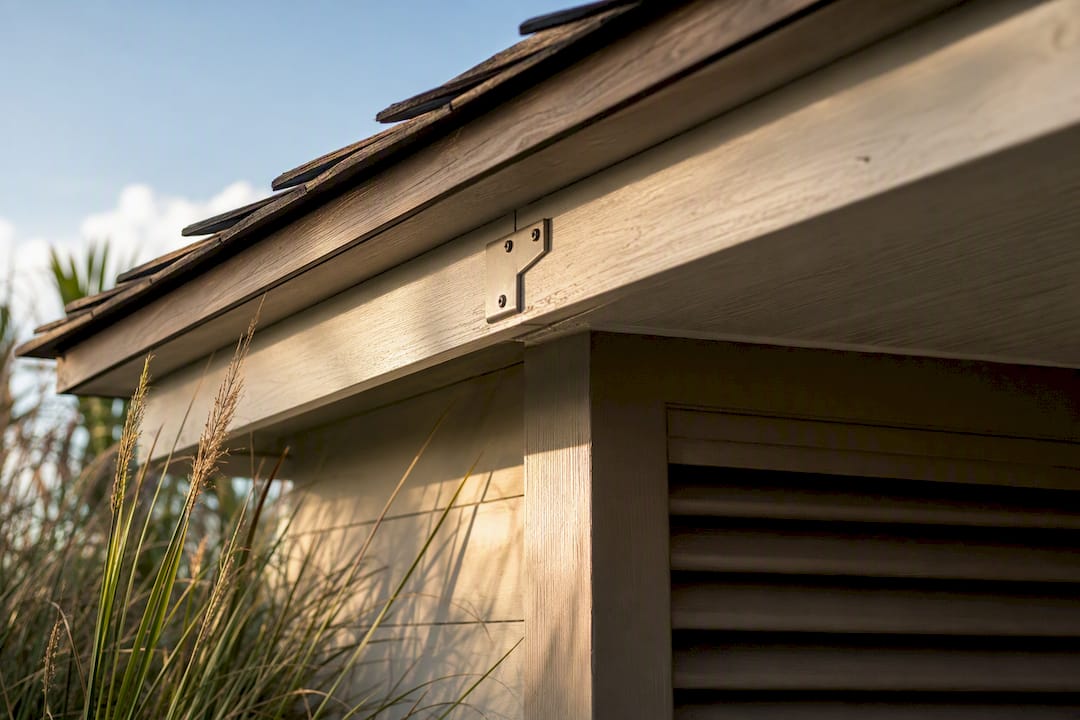
- Roof-to-wall connectors (clips and straps) matter enormously but usually require an engineer's assessment and can't be retrofitted without opening up the structure.
- Garage door reinforcement is comparatively cheap and fast, and an unrated double garage door is a common, overlooked weak point.
- Roof covering and its attachment method affect scoring but typically only change with full replacement.
Pro Tip: Before buying any window, door, or shutter system, confirm it carries a Miami-Dade or Florida Product Approval number and meets ASTM or TAS testing standards. An inspector can't credit a product they can't verify, no matter how sturdy it looks.
Your 30 to 180 Day Mitigation Checklist
Here's a sequence that works whether you're starting from scratch or picking up mid-project:
- This week: Pull your current OIR mitigation form, if one exists, and check its issue date against the five-year validity window.
- Within 30 days: Schedule a certified inspection, prioritizing a review of opening protection and roof condition first.
- Before major work: Pull permits for any roof or window replacement; skipping this step can invalidate the credit later.
- During construction: Photograph installation details, product labels, and approval numbers as the work happens, not after drywall or trim covers them up.
- After closeout: Schedule a fresh inspection to capture the new features on a current OIR-B1-1802 form.
- At submission: Send the updated form to your insurer and confirm the new credit in writing before your next renewal.
Track the expiration date going forward. Insurers can require reinspection after any major renovation, and a rating tied to a home that no longer matches its own paperwork does nobody any favors.
Design Notes From Crane Island on Coastal Resilience
Coastal architecture and mitigation aren't in tension. A deep, shaded porch and a raised foundation, hallmarks of the Lowcountry style, can coexist with fully protected openings and a properly detailed roof-to-wall connection. When selecting window and roof systems for salt-air exposure, we weigh sealed roof decking and documented product approvals as heavily as the finish. Permits and elevation certificates belong in the same file as your mitigation paperwork.
Why Mitigation Deserves a Homeowner's Full Attention
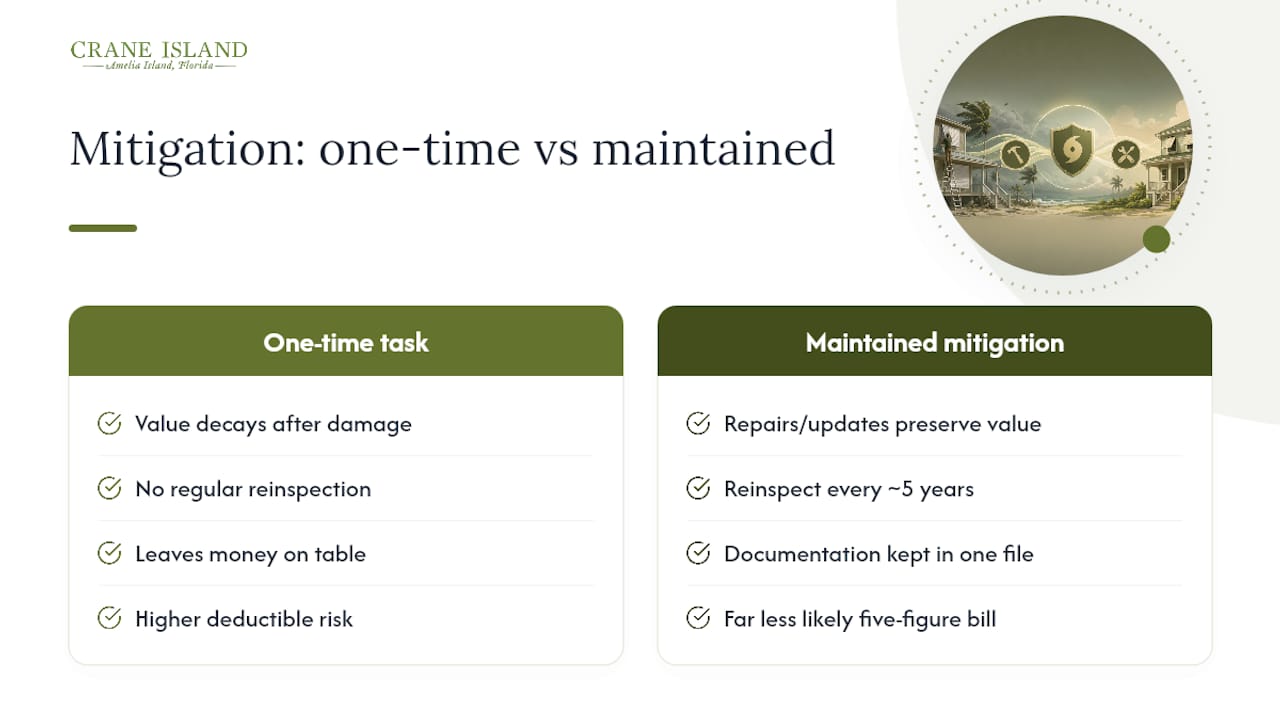
Most people treat wind mitigation as a paperwork chore that happens once, at closing, and never gets revisited. That's the mistake. The form is a snapshot, and the value it captures decays the moment a shutter cracks, a garage door goes unrated, or five years pass without reinspection. Florida homeowners who treat mitigation as a one-time errand are leaving money and protection on the table year after year.
The bigger blind spot is that people fixate on the premium line and ignore the deductible exposure underneath it. A well-mitigated home doesn't just cost less to insure. It's far less likely to produce a five-figure out-of-pocket bill after a storm that a lesser home down the street doesn't survive as cleanly. Pair a certified inspection with design choices that respect coastal character, keep your documentation organized in one file, and use My Safe Florida Home if you're eligible. It's the rare home improvement that pays for itself twice: once at renewal, and once when the wind actually blows.
— John Hillman
How Crane Island Approaches Coastal Resilience
This community is built for homeowners who want hurricane-ready construction without giving up the character that makes coastal living worth it in the first place. The design approach coordinates permits, product approvals, and elevation documentation from the start, so mitigation credits and Lowcountry porches aren't competing priorities on a build.
Available homesites come with access to architects who consider roof-to-wall connections and sealed decking as part of the design process, not as an afterthought bolted onto a finished design. If you're weighing a custom build against retrofitting an older coastal property, it's worth seeing what a resilience-first design process looks like from day one. Visit Crane Island to explore available homesites and talk with our team about building a home that's protected and beautiful from the first plan sheet.
Where to Verify the Details Yourself
Before you sign anything or spend a dollar on upgrades, these are the primary sources worth bookmarking:
- FLOIR wind mitigation resources: the state's official hub for mitigation credits and the OIR-B1-1802 form itself.
- Florida Statute §627.711: the legal basis for mandatory discounts and the list of who's authorized to sign your inspection.
- Insurance Consumer Advocate mitigation resources: details on My Safe Florida Home eligibility, grants, and program updates.
Sources
- Wind mitigation resources — Florida Office of Insurance Regulation
- Florida Statute §627.711 — Notice of premium discounts for hurricane loss mitigation; uniform mitigation verification inspection form
- Mitigation resources — Florida Office of Insurance, Insurance Consumer Advocate
FAQ
What Is Wind Mitigation in Florida?
Wind mitigation refers to home construction features, like reinforced roofs, sealed decking, and impact-rated openings, that resist hurricane wind damage and qualify homeowners for insurance discounts under Florida law.
How Much Can a Wind Mitigation Inspection Save Me?
Savings vary by home and insurer, but homes meeting minimum 2001 Florida Building Code standards can receive a minimum 68% discount on the hurricane-wind portion of the premium specifically.
Is Impact Glass Better Than Hurricane Shutters?
Impact windows generally score more consistently on inspections since protection is permanent, while shutters cost less but require action before every storm; either can qualify for opening-protection credit if properly rated.
Who Can Sign My OIR-B1-1802 Inspection Form?
Only a licensed general, building, or residential contractor, a professional engineer, an architect, a certified building code inspector, or a trained home inspector can sign the form under Florida statute.
How Long Does a Wind Mitigation Report Stay Valid?
Mitigation forms are commonly treated as valid for about five years, though insurers can require a new inspection after major roof, window, or door replacements.
Does My Safe Florida Home Really Offer Free Inspections?
Yes, eligible homeowners can receive a free wind mitigation inspection and matching grant funds for approved upgrades through the My Safe Florida Home program.