
Make your property sea turtle friendly tonight by following one rule: Low, Shielded, Long. Switch every fixture visible from the beach to a long-wavelength bulb of 560 nanometers or greater, shield it so the bulb itself is never visible from the sand, and mount it as low and as dim as the job allows. Nesting season runs during the warmer months around spring through fall, so the sooner you act, the sooner your porch light stops working against the very turtles it was never meant to bother.
TL;DR:
- Using long-wavelength bulbs of 560 nanometers or greater, mounted low and shielded, is essential to prevent disorienting sea turtles during nesting season.
- Installing motion sensors, lowering fixture heights, and removing uplights significantly reduce artificial light impact on nesting habitats within the month-long peak season.
- Proper fixtures should have zero uplight, specific high-angle output caps, and emission spectra verified to avoid short-wavelength leaks, not just marketing claims.
- Interior lighting and window glare can disrupt turtles as much as exterior lights, so dark curtains, window films, and turning off interior lamps facing the beach are vital steps.
- Communities like Crane Island incorporate wildlife-friendly lighting into their designs, emphasizing shielded, low-mounted fixtures as a standard for environmentally conscious homes.
Table of Contents
- Quick Checklist: What to Do Tonight, This Week, and This Season
- Why Artificial Light Disorients Sea Turtles
- Fixture and Bulb Specs Worth Demanding
- Interior Light, Flashlights, and Community Skyglow
- Reading the Standards: LUNA, FWC, and What Certification Actually Means
- How Crane Island Approaches Wildlife-Friendly Lighting
- A Homeowner's Case for Getting This Right
- Crane Island: A Community Built Around the Dark
- Where to Verify These Specs
- Sources
- FAQ
Quick Checklist: What to Do Tonight, This Week, and This Season
Coastal properties do not need a renovation to make a real difference. They need a sequence, starting with the fastest fixes and working toward permanent upgrades.
- Tonight: Turn off every nonessential fixture visible from the beach. Close curtains, pull blinds, and move lamps back from windows facing the water.
- This week: Test your remaining bulbs against a 560 nm threshold and swap any that fall short for long-wavelength LEDs. Add shields to any fixture where the bulb itself is visible from a beach vantage point.
- This month: Install motion sensors on security lights and lower mounting heights wherever fixtures sit above eye level. Pull decorative uplighting and string lights entirely during nesting season.
- This season: Coordinate with neighbors, your HOA, or the local utility on shared pole lights. A single unshielded streetlamp can undo a whole block's worth of careful retrofits.
Safety lighting does not have to disappear. The Florida Fish and Wildlife Conservation Commission advises modifying rather than eliminating it, since motion sensors, shields, and long-wavelength bulbs preserve visibility for people while keeping the beach dark for turtles.
Pro Tip: Walk your own beachfront at night, at eye level with the sand, before you buy a single bulb. Anything you can see glowing from that angle is exactly what a nesting turtle sees too.
Why Artificial Light Disorients Sea Turtles
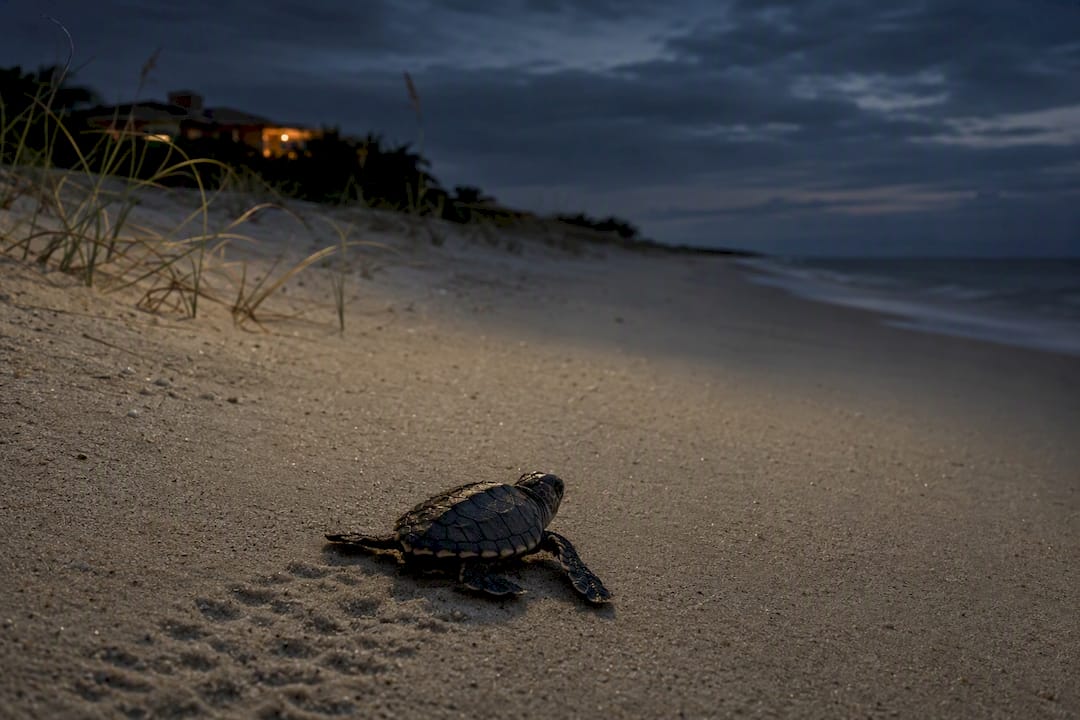
Sea turtles navigate by natural light cues that have guided their species for millions of years. Nesting females crawl toward the darkest, lowest horizon, historically the open ocean reflecting starlight and moonlight. Hatchlings do the same the moment they emerge from the sand. Artificial light reverses that instinct, pulling turtles toward houses, roads, and parking lots instead of the water.
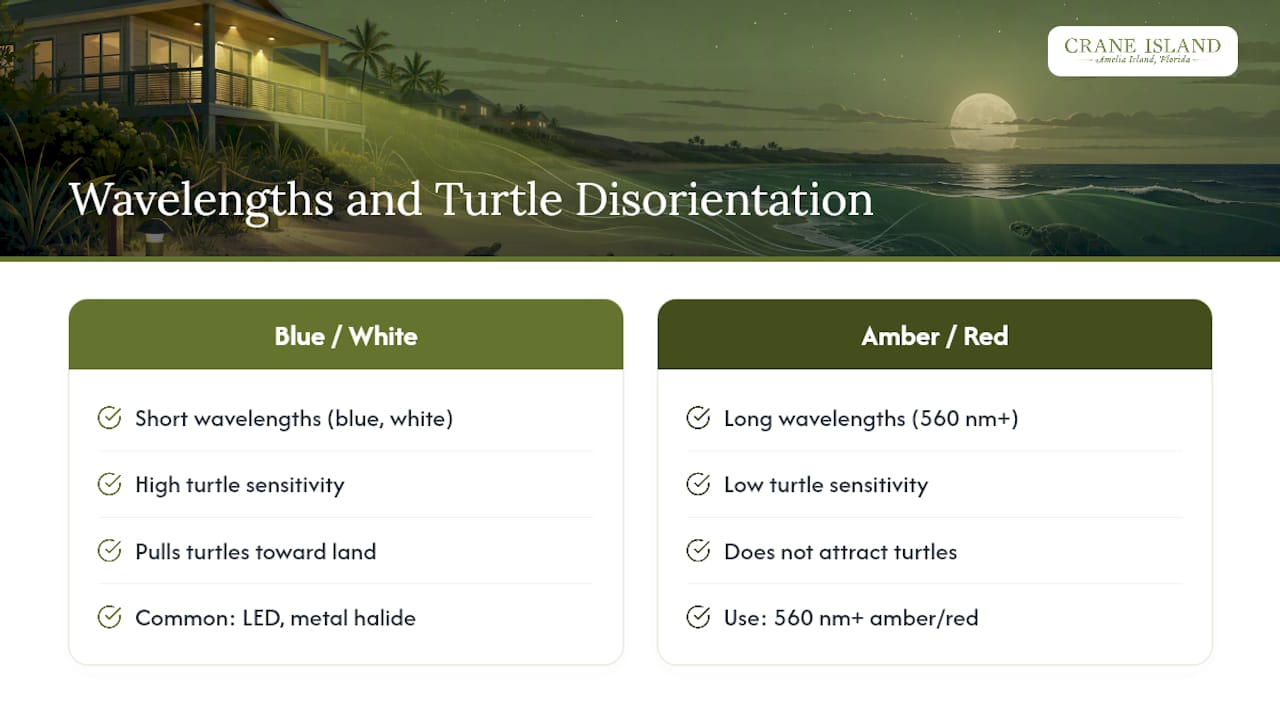
Wildlife lighting research also points to a wavelength problem, not just a brightness problem. Turtle eyes are especially sensitive to short wavelengths, the blues and whites that dominate standard LED and metal halide fixtures. Long-wavelength light, amber and red in the 560 nm-plus range, sits largely outside that sensitivity. The Sea Turtle Conservancy documents how shoreline lighting causes both nest-site disorientation in adult females and fatal wrong-turn wandering in hatchlings, sometimes called false crawls. Cumulative glow matters as much as any single bulb. A property that only fixes one floodlight while leaving five smaller lights burning has not solved the problem.
Timing sharpens the stakes considerably. Nesting season runs May 1 through October 31 across most of the southeastern coast, meaning your lighting choices carry real consequences for roughly half the calendar year.
Fixture and Bulb Specs Worth Demanding
Buying "turtle-friendly" lighting on the strength of a marketing label is a common and expensive mistake. Ask for numbers instead.
- Wavelength: Require a spectral distribution graph showing emission at 560 nm or greater. Direct-emission "de-Amber" LEDs are preferred over filtered white LEDs, since filters and phosphor conversion can let short-wavelength light leak through.
- Zero uplight: Look for full-cutoff fixtures rated U0, meaning no light escapes above the horizontal plane. Opaque shields, not tinted lenses, achieve this.
- High-angle limits: Ask about the fixture's G rating, which caps light emitted at high horizontal angles, exactly the angles most visible from a beach.
- Output caps: Lower lumens and wattage beat a "better" bulb every time. Reducing fixture count and total output often does more for beach darkness than any single spec upgrade.
De-Amber LEDs, defined by DesignLights Consortium's LUNA Turtle Lighting specification, must keep blue and short-wavelength energy below 560 nm to roughly 1 to 2 percent of total output. That is a strict bar, and it is why a bulb that merely looks amber often fails it.
For installation, mount fixtures as low as the application allows, aim them away from the water, and favor shielded bollards and recessed step lights over pole-mounted floods. Motion sensors with short timers cut total nighttime output dramatically without sacrificing security.
Interior Light, Flashlights, and Community Skyglow
Exterior fixtures get most of the attention, but interior light through an uncovered window can be just as disruptive to a nesting turtle looking landward from the surf.
- Use dark curtains or blinds on any window facing the beach, and move lamps and televisions away from those windows entirely.
- Consider window film. FWC guidance recommends visible light transmittance of 45 percent or lower, with 15 to 30 percent preferred where practical, and it is worth documenting whatever VLT you choose in case a permit reviewer asks.
- Leave flashlights and phone lights off nesting beaches altogether. Even red-filtered flashlights often fail to change the wavelength enough to prevent disruption, according to the Clearwater Marine Aquarium's sea turtle safe lighting guide.
- Push for community-scale fixes: vegetation buffers between homes and dunes, house-side shields on utility pole fixtures, and a direct line to your utility company when a shared streetlight needs adjusting.
None of this requires a single household to solve skyglow alone. It requires enough households doing their part that the cumulative glow drops below the threshold that confuses a nesting female or a hatchling scrambling for the surf.
Reading the Standards: LUNA, FWC, and What Certification Actually Means
Marketing copy calls plenty of bulbs "turtle-friendly." Third-party verification is the only way to know if that claim holds up.
- LUNA Turtle Lighting requires de-Amber direct emission (not filtered), zero direct uplight, capped high-angle output, and maximum total light levels by product type, according to the DLC LUNA specification.
- Direct emission beats filtration. A true amber LED emits its narrow wavelength band natively; a filtered or phosphor-converted "amber" bulb depends on a coating that can degrade or transmit unwanted short wavelengths over time.
- Use the LUNA Qualified Products List or your local FWC-approved fixture list rather than trusting a product page's claims at face value.
- For permits, keep records. Save spec sheets, spectral distribution graphs, and any written vendor confirmation of U and G ratings. Reviewers increasingly ask for this documentation rather than accepting a product name alone.
How Crane Island Approaches Wildlife-Friendly Lighting
This Lowcountry-inspired community leans on porches, not floodlights, as the gathering point after dark. Outdoor lighting throughout the area favors recessed step lights and shielded path fixtures over uplighting, keeping the marshlands and forest edges dark the way they have always been. Homeowners and contractors work from shared dark-sky lighting guidance during design review, and nesting-season expectations are part of how the community talks to guests and builders alike, not an afterthought bolted on in summer.
A Homeowner's Case for Getting This Right
Dark-sky lighting is not a sacrifice dressed up as conservation. Lower wattage and fewer fixtures cut electric bills. Downward-directed, shielded lighting reads as more intentional and more architecturally considered than a floodlit facade, and it is measurably safer underfoot than glare that blinds rather than guides. Getting your lighting right also gives you something to hand your guests and your landscaper: a simple, defensible standard for the whole property.
— John Hillman
Crane Island: A Community Built Around the Dark
Crane Island treats sea turtle friendly lighting as part of the architecture, not an add-on required by a permit reviewer. Homesite design and outdoor lighting are considered together from the start, so shielded, low-mounted fixtures feel like a design choice rather than a compromise.
If you are weighing a homesite purchase on Amelia Island and want a community where dark-sky principles are already built into the covenants and the culture, this community is worth a direct look. The wildlife-friendly neighborhood approach extends beyond lighting into preserved marshlands, forested buffers, and porch-centered gathering spaces that never needed a floodlight to feel welcoming. Homeowners planning exterior upgrades elsewhere can also find practical, lumen-conscious fixture ideas in resources like this coastal home lighting guide. Visit Craneisland to explore the available homesites and see how dark-sky design shows up in a finished home, not just a checklist.
Where to Verify These Specs
Cross-check any product or renovation plan against the FWC lighting guidelines, the LUNA Qualified Products List, and Sea Turtle Conservancy resources. For coastal construction permitting context, see FDEP approval requirements.
Sources
- Sea Turtles and Lights | Florida Fish and Wildlife Conservation Commission (FWC)
- Wildlife Lighting - Sea Turtle Conservancy
- Sea Turtle Safe Lighting Guide | Clearwater Marine Aquarium
FAQ
What kind of lighting is turtle-friendly?
Long-wavelength light of 560 nanometers or greater, in a fully shielded, low-mounted fixture with the lowest lumen output that still meets your safety needs. True amber or red LEDs with direct emission, not filtered white bulbs, meet this standard most reliably.
Are LED lights okay for turtles?
Only if they emit at 560 nm or greater and come from direct-emission "de-Amber" LEDs rather than filtered or phosphor-converted amber products, which can still leak short-wavelength light. A standard white or blue-heavy LED is one of the worst choices you can make near a nesting beach.
What is the best type of lighting for aquatic turtles near a home pond or water feature?
The same Low, Shielded, Long principles apply: minimal wattage, full-cutoff fixtures with zero uplight, and long-wavelength bulbs positioned away from the water's edge.
Why turn off lights for sea turtles?
Artificial light disorients nesting females searching for a dark horizon and pulls hatchlings away from the ocean toward land, according to Sea Turtle Conservancy field documentation. Turning off nonessential lights during nesting season, May 1 through October 31, removes that risk entirely rather than just reducing it.