
Dark sky outdoor lighting means fixtures engineered to send light only where it is needed, not upward into the atmosphere or sideways into a neighbor's window. The standard to check against comes from DarkSky International, whose approved luminaires program sets the technical bar. The single best first move is simple: replace any exposed or upward-facing bulb with a fully shielded, warm-toned fixture rated at 3000K or below, ideally with dimming built in.
TL;DR:
- Most residential fixtures should use low-lumen, fully shielded, downward-only fixtures with a maximum color temperature of 3000K or lower.
- Check the model against the DarkSky Approved database, ensuring it meets the 95% light output below an 80 degree angle requirement to prevent skyglow.
- Use timers, motion sensors, and dimming controls to reduce unnecessary night-time lighting and avoid full brightness all night.
- Install fixtures at proper heights and angles, focusing on layered, low-output lighting for better aesthetics and ecological impact.
- Always verify product specifications and approved status before purchasing to ensure compliance with dark sky standards.
Table of Contents
- What Are the Six Steps to Dark Sky Outdoor Lighting?
- What Makes a Fixture Dark-Sky Friendly?
- How Do You Choose and Install Outdoor Lighting Without Overdoing It?
- How Should You Schedule and Control Outdoor Lights?
- Where Can You Verify a Fixture Is Actually Dark-Sky Approved?
- A Coastal Community's View on Responsible Lighting
- Sources
- FAQ
What Are the Six Steps to Dark Sky Outdoor Lighting?
You don't need to overhaul your whole property in one weekend. Start with the fixtures that cause the most trouble and work outward from there.
- Swap exposed bulbs for shielded fixtures. Any lamp you can see the bulb of, from the street or your own yard, is sending light where it shouldn't go.
- Cap your color temperature at 3000K. Near marshland, dunes, or other wildlife-sensitive ground, drop to an amber spectrum instead of standard warm white.
- Pick fixtures with modest lumen output and dimming. A porch light does not need the punch of a parking-lot fixture.
- Add timers, motion sensors, or a lighting curfew. Full brightness all night rarely earns its keep in security or ambiance.
- Aim every fixture downward and mount it at the right height. A few inches of angle is the difference between a lit path and a glare source aimed at your neighbor's bedroom.
- Check the model against the DarkSky Approved luminaires list, or read the datasheet yourself, before you trust a "dark sky friendly" label on a box.
Each step builds on the last. Shielding solves the biggest problem. Color temperature and controls refine it. Placement is where a technically good fixture can still go wrong if it's installed carelessly.
What Makes a Fixture Dark-Sky Friendly?
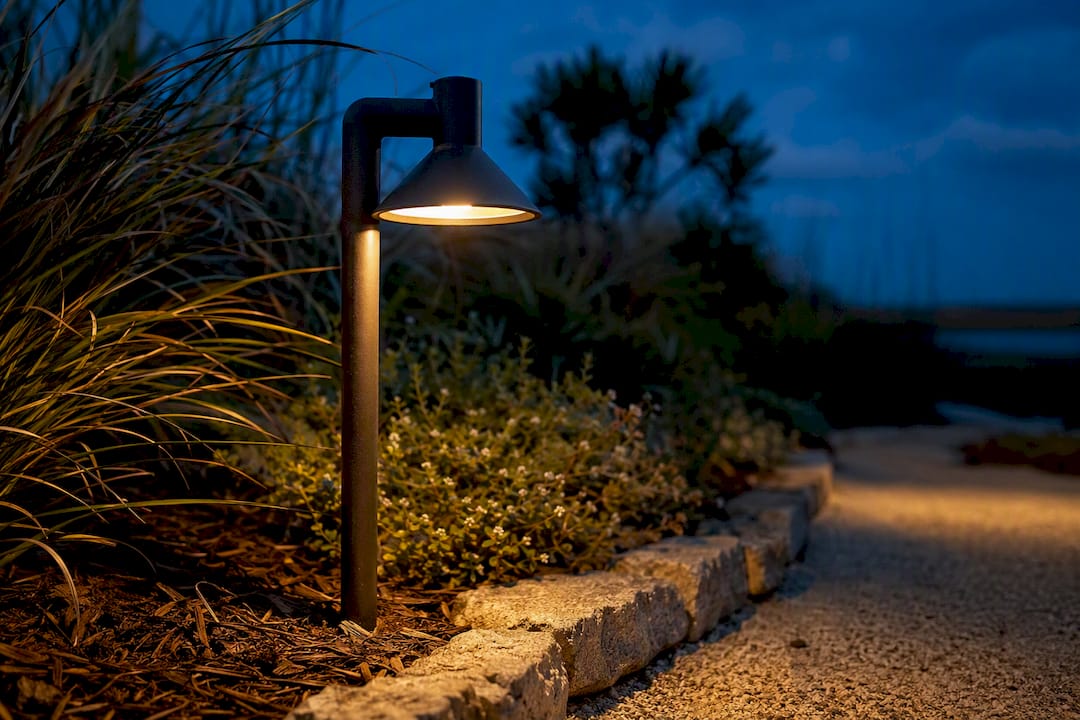
DarkSky's own criteria are specific enough to check against a spec sheet, not just a marketing claim. The 2025 update to the DarkSky Approved luminaires program requires that 95% of a fixture's light output stay below an 80 degree angle, meaning almost none of it escapes toward the sky. That single number does more to fight light pollution than any other spec on the sheet.
Beyond the angle requirement, the program packet lays out thresholds by category:
- Uplight is limited to very low levels for fixtures producing lower lumen outputs, with stricter proportional limits for brighter fixtures.
- Color temperature capped at a nominal 3000K, with wildlife-tuned variants dropping to amber spectra near 560 nanometers for sea-turtle-sensitive coastal sites.
- Dimming capability down to 10% of full output or lower.
- Full-cutoff optics that direct light downward only, with no side-spill above the horizontal plane.
| Criterion | DarkSky threshold |
|---|---|
| Uplight (light above 80°) | 5% or less of total output |
| Color temperature (standard) | 3000K or lower |
| Color temperature (wildlife zones) | Amber, near 560 nm |
| Dimming range | Down to 10% or below |
| Optic design | Full cutoff, downward distribution |
Residential fixtures generally sit at the lower end of lumen output; larger area or pedestrian fixtures follow separate caps built into the same program documentation. If a product page doesn't mention any of these numbers, that's a gap worth asking about before you buy.
How Do You Choose and Install Outdoor Lighting Without Overdoing It?
Matching the fixture to the task is where most residential lighting plans go wrong. A path doesn't need the same output as an entryway, and an entryway doesn't need what a driveway gate does.
- Path and step lights should sit low, aimed down, with modest lumen output. Anything you can read a book by is too much.
- Entry lights belong at a mounting height that lights the door and steps, not the street.
- Accent lighting on architectural features works best pointed downward from above, rather than uplit from ground fixtures.
- Area lighting for larger yards or driveways should use full-cutoff fixtures mounted higher, angled so the beam stops at the property line.
- Before ordering, check the manufacturer's SKU matrix. Many fixture families sell both compliant and non-compliant versions under similar names, and a slight suffix on the model number is often the only difference.
Layering several low-output fixtures across a space almost always looks better and does less ecological damage than one bright fixture trying to do everything. A wildlife-friendly approach to landscape lighting leans on exactly this kind of layering, especially near marsh edges or dune grass.
Pro Tip: Install your fixtures on dimmers, then walk the property after dark at 20 to 30 percent output before deciding on final placement. It's far easier to raise the light where you actually need more than to discover, weeks later, that a fixture is throwing glare into a neighbor's porch. Testing at low output first also matches how DarkSky recommends checking for trespass before finalizing any installation.
How Should You Schedule and Control Outdoor Lights?
Good fixtures still need good habits. A timer or curfew that cuts lighting back after 10 or 11 p.m. does more for both your energy bill and the surrounding night sky than any single fixture upgrade.
- Set a curfew or timer so lights dim or shut off after peak evening hours rather than running at full output until dawn.
- Use motion sensors to bring light up only when someone is actually present, with a dim baseline the rest of the time.
- Don't treat a dusk-to-dawn sensor as a substitute for shielding. A poorly shielded fixture that only runs at night is still a poorly shielded fixture; controls work best paired with proper optics, not instead of them.
- Check sensor alignment every few months, and replace any bulb that drifts toward a cooler color temperature than your original 3000K spec.
Property managers overseeing several units benefit here too. A property management guide built around consistent scheduling and maintenance routines applies just as well to lighting curfews as it does to any other recurring property task.
Where Can You Verify a Fixture Is Actually Dark-Sky Approved?
Marketing copy calling a fixture "dark sky friendly" isn't the same as certification. The only reliable check is the DarkSky Approved luminaires database, searchable by exact model number.
- Search the database directly rather than trusting a retailer's product description.
- Confirm the datasheet includes a DarkSky-approved ordering matrix, since manufacturers sometimes swap internal components between production runs.
- Look for a recognized electrical safety certification, UL, ETL, or CSA, alongside the dimming specs.
- If anything looks inconsistent, contact the manufacturer directly and ask for the spec sheet revision number tied to your exact SKU.
Local codes matter here too. DarkSky's municipal code templates and Recognized Codes program exist precisely because "dark sky friendly" isn't a protected legal term everywhere, so your town's own ordinance may set requirements beyond the manufacturer's claims.
A Coastal Community's View on Responsible Lighting
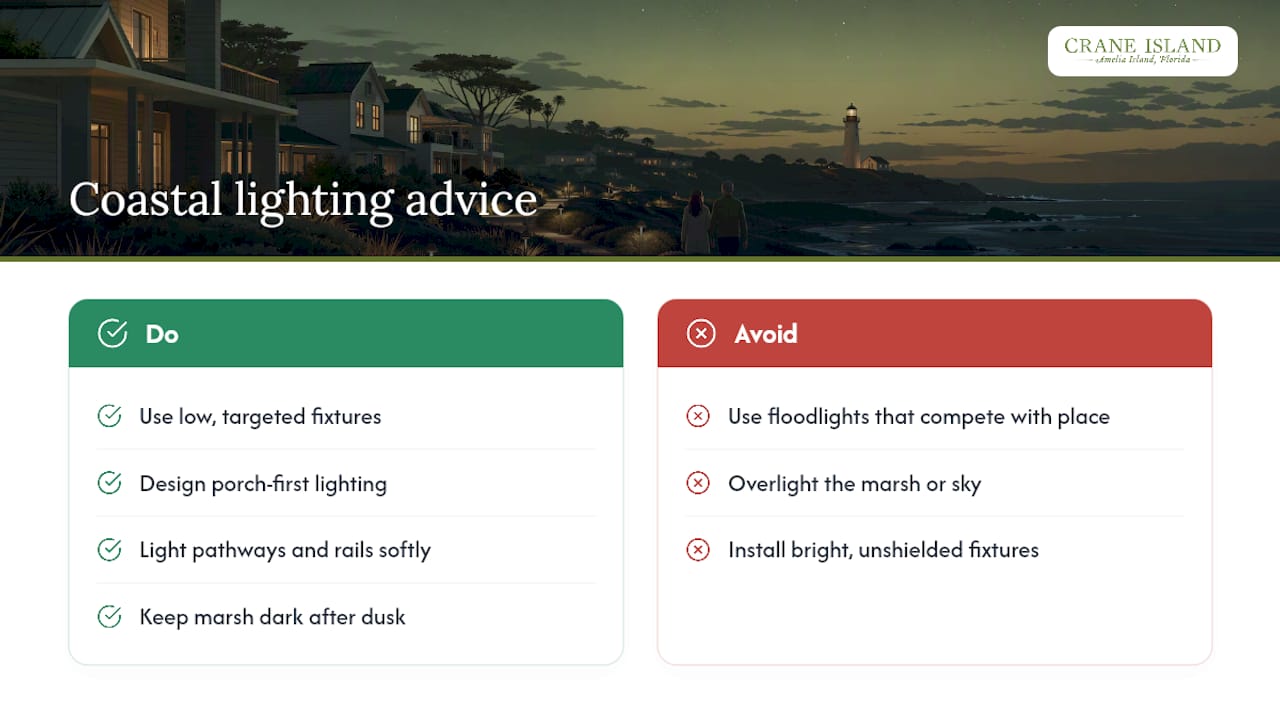
We think about light the same way we think about a porch: as something that should draw people outward into a place, not compete with it. Low, targeted fixtures along a pathway or beneath a live oak do more for a Lowcountry evening than a floodlight ever could, and they leave the marsh and its wildlife undisturbed after dusk.
A porch-first design naturally leans on this instinct. A softly lit stair rail or a low pathway fixture can help neighbors get home safely, while leaving the sky dark enough to actually see. That balance, useful light without waste, is part of what a thoughtfully designed home community should offer its residents from the start. If you're weighing what a custom homesite along the marsh could look like after dark, Crane Island is worth a visit.
— John Hillman
FAQ
What Does "Dark Sky" Mean in Outdoor Lighting?
It refers to fixtures and practices designed to minimize light pollution, mainly by shielding bulbs so light points downward instead of escaping upward or sideways, following criteria set by DarkSky International.
What Are the Best DarkSky Approved Outdoor Lights?
The safest way to answer that for your own property is to search the model number directly in the DarkSky Approved luminaires database rather than trust a retailer label, since fixture families often mix compliant and non-compliant versions.
What Lighting Trends Should I Avoid, and What Should I Do Instead?
Avoid bright, cool-white floodlights left on dusk to dawn with no shielding. Choose fully shielded, dimmable fixtures at 3000K or lower, paired with motion sensors or a curfew, following the Five Principles for Responsible Outdoor Lighting.
What Kind of Lights Are Dark-Sky Friendly?
Fixtures with full-cutoff optics that send at least 95% of light below an 80 degree angle, a color temperature at or under 3000K, and dimming capability down to 10% or less all meet the core DarkSky luminaires criteria.