
A truly sustainable coastal community combines science-based resilience planning, integrated marine and terrestrial habitat restoration, and funded long-term maintenance while delivering the luxury amenities discerning buyers expect. NOAA's coastal risk frameworks, Dynamic Adaptive Policy Pathways (DAPPs), and standards like LEED and the Florida Green Building Coalition (FGBC) give you the vocabulary to evaluate any developer's claims. Craneisland on Amelia Island is one community that weaves these principles into its founding design.
Your first-visit checklist:
- Science-based master plan with documented adaptive management triggers
- Integrated habitat suite (marsh, living shoreline, upland forest) rather than a single sea wall
- Active ecological monitoring program with published data
- Funded maintenance endowment or resilience reserve embedded in HOA governance
- Third-party certification (LEED, FGBC, SITES, or equivalent)
- Luxury amenity integration that does not compromise habitat corridors
- Developer track record with named conservation partners
Table of Contents
- What does a sustainable luxury coastal community actually include?
- Why integrated habitats protect your asset better than a sea wall
- How to evaluate any coastal community before you buy
- Craneisland: how one community lives the checklist
- Design and amenity features that protect value over time
- Regulatory and funding hurdles, and how credible developers solve them
- What development and maintenance realistically cost
- What discerning buyers should do next
- Key Takeaways
- Why Craneisland's approach to sustainable luxury matters
- Craneisland: where to go from here
- Useful sources for deeper due diligence
- FAQ
What does a sustainable luxury coastal community actually include?
Sustainability in high-end coastal real estate covers five interlocking pillars, not just solar panels and recycled materials.
1. Science-based resilience planning. Expect a written adaptive management plan that names specific monitoring triggers and staged responses. DAPPs, a planning framework that maps decision pathways against future sea-level and storm scenarios, are the current gold standard for communities serious about long-term asset protection.
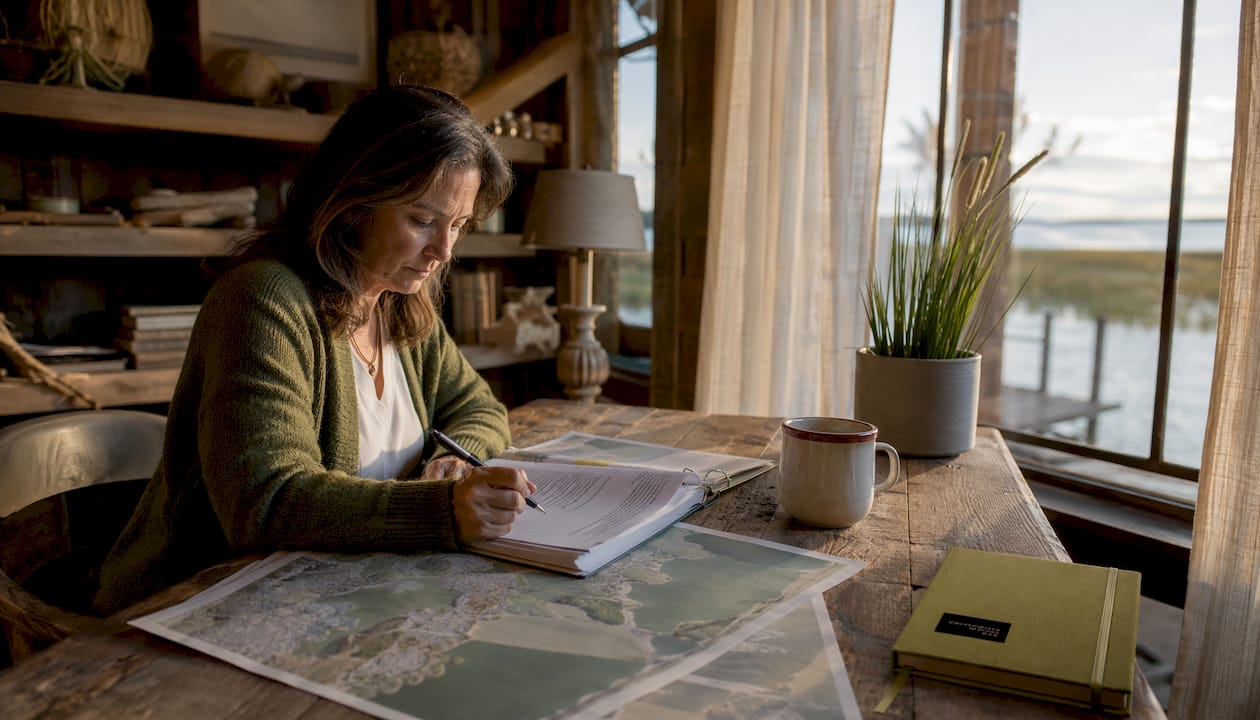
2. Integrated marine-terrestrial ecosystem design. Seascape-scale habitat management that connects upland forests, tidal marshes, living shorelines, and open water outperforms any single engineered defense. Ask for a habitat map and a restoration timeline.
3. Durable building and infrastructure standards. Regional certifications like FGBC and LEED signal that homes meet hurricane-hardening, energy efficiency, and materials standards. Luxury coastal enclaves in hurricane-prone Florida increasingly treat these certifications as a baseline buyer expectation, not a premium add-on.
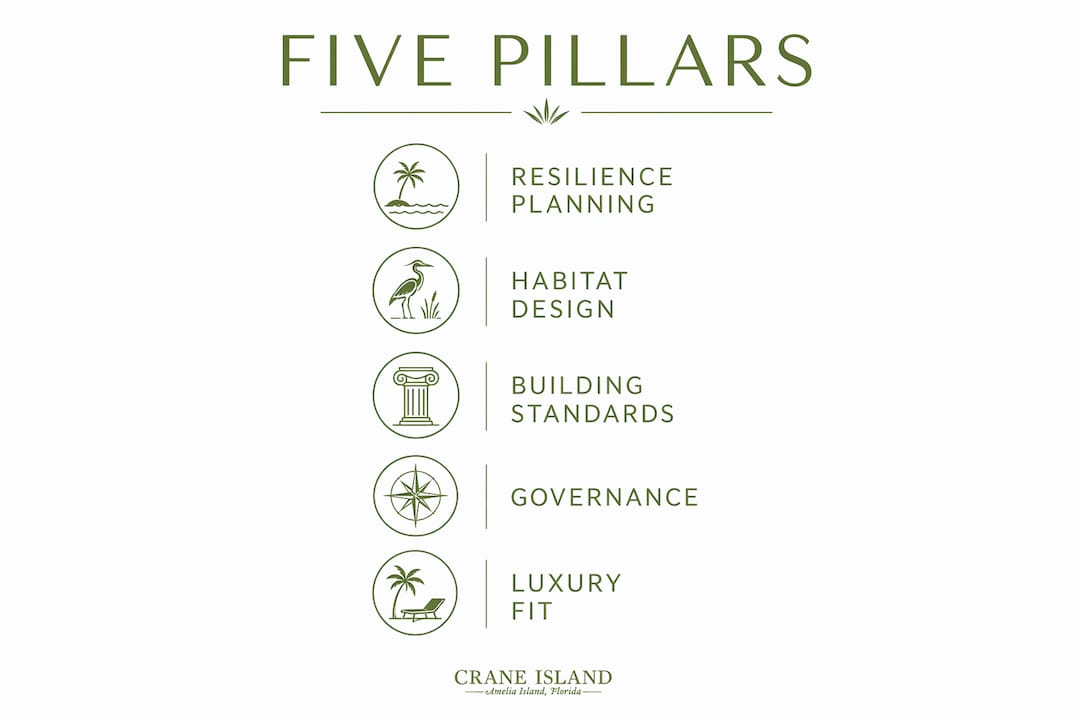
4. Governance and finance for long-term maintenance. A resilience endowment recorded in HOA bylaws or community covenants is the difference between a community that maintains its habitat and one that lets it degrade after the developer exits.
5. Luxury lifestyle fit. Preserved views, walkable paths through natural corridors, private water access, and thoughtfully sited homesites are not in tension with sustainability. The best communities prove they are the same thing.
Pro Tip: Watch for these red flags: sole reliance on a concrete sea wall with no habitat buffer; no published monitoring data; a maintenance fund described as "planned" rather than funded and recorded; and certifications promised but not yet awarded.
Why integrated habitats protect your asset better than a sea wall
Single hard defenses fail over time. Research modeling coral reefs, seagrasses, and mangroves together shows that combined habitats reduce wave height, inundation, and erosion more effectively than any single-habitat approach. Mangroves perform well across many conditions, but their protection is strongest when paired with seagrass meadows that stabilize sediment and coral or oyster reefs that break wave energy offshore.
The "Power of Three": coral reefs, seagrasses, and mangroves working together supply coastal protection services that no single habitat can replicate alone.
This matters for property values. A community whose shoreline relies entirely on a hardened wall faces escalating repair costs and eventual failure as sea levels rise. One with a living marsh that can migrate inland as conditions change, backed by a seagrass meadow and an oyster reef, has a self-reinforcing system that adapts over time. DAPPs translate that ecological science into staged interventions with clear decision points, so the community acts before a threshold is crossed rather than after damage occurs. The ResilientWoodsHole model demonstrates exactly this: phased, science-based planning with community engagement moves a neighborhood from awareness to action on a documented timeline.
Pro Tip: On a site visit, look for active seagrass meadows visible at low tide and living marsh grass with healthy root structure at the waterline. Dead or sparse marsh edge is an early warning of sediment stress or blocked migration.
How to evaluate any coastal community before you buy
Ask to see the master plan, monitoring data, endowment documents, and certification records. If a developer cannot produce them, treat that as a disqualifying signal.
Questions to ask:
- What adaptive management triggers are written into the plan, and who monitors them?
- Which scientific institution or agency partners with the community on ecological monitoring?
- Is the maintenance endowment funded and recorded, or aspirational?
- What third-party certifications have been awarded (not just applied for)?
- How does the community engage residents in ongoing stewardship decisions?
Documents to request: DAPPs or adaptive plan summary; ecological monitoring protocols and recent data; third-party certification records; HOA/endowment fund agreements; flood elevation studies and current insurance structure.
| What to look for | Craneisland |
|---|---|
| Science-based master plan | Founding design integrates preserved marsh, upland forest, and Intracoastal access within a conservation-first framework |
| Certifications and third-party verification | Commitment to green building standards aligned with regional Florida expectations |
| Developer track record and local partnerships | Conservation partnerships embedded in community governance; Amelia Island regional context |
| Ownership and maintenance model | Small-scale (14 homesites) HOA structure designed for long-term stewardship |
| Luxury amenities and lifestyle fit | Custom homesites, porch living, Intracoastal Waterway access, proximity to Fernandina Beach |
| Resilience costs and timeline | Nature-based site design reduces long-term maintenance exposure relative to hardened alternatives |
For a deeper look at how conservation-focused developers structure these commitments, the track record and governance model are the most revealing documents to compare.
Craneisland: how one community lives the checklist
Craneisland sits on Amelia Island, Florida, where the Intracoastal Waterway, preserved tidal marshlands, and maritime forest create a layered natural buffer that mirrors the integrated habitat approach the science recommends. With only 14 private homesites, the community's scale is itself a conservation strategy: less impervious surface, more preserved corridor, and a governance structure small enough to hold every owner accountable to the same stewardship values.
What the community offers buyers:
- Custom homesites sited to preserve marsh and forest views, with Lowcountry architecture that honors the land's character
- Direct Intracoastal Waterway access for residents
- Preserved marshlands and upland forest woven through the community rather than cleared for amenity space
- Porch-centered design that makes outdoor gathering a daily habit, deepening residents' connection to the natural setting
- Proximity to historic Fernandina Beach, giving residents cultural richness alongside ecological integrity
The North Florida coastal market brings its own resilience advantages: a relatively low-density coastline, strong regional conservation culture, and a regulatory environment that rewards thoughtful, habitat-preserving development.
Design and amenity features that protect value over time
The most durable luxury coastal communities place homesites above established flood thresholds, use native landscaping that requires no irrigation and stabilizes soil, and cluster development to preserve unbroken habitat corridors between the built environment and the water's edge.
- Elevated siting and hurricane-hardy construction reduce insurance exposure and structural risk without sacrificing views
- Native plant buffers between homesites and marsh edges filter stormwater and slow erosion naturally
- EV charging infrastructure and low-imprint marina design reduce the community's carbon footprint while meeting the lifestyle expectations of today's affluent buyer
- Walkable paths through preserved habitat replace car-dependent amenity loops, creating daily contact with the natural environment that residents consistently cite as a primary quality-of-life driver
- Community education and stewardship programming keep residents engaged with monitoring results and adaptive management decisions
Walkable community design and habitat integration are not aesthetic choices alone. They are the structural features that keep a coastal community's ecological systems functioning, which in turn keeps the asset values of every homesite intact. For inspiration on how sustainable building techniques translate into livable luxury at scale, international examples confirm that green certification and refined design reinforce each other rather than compete.
Regulatory and funding hurdles, and how credible developers solve them
Robust developments anticipate regulatory friction and fund maintenance from day one. Coastal projects in the U.S. typically navigate tidal wetland permitting under the Clean Water Act, state coastal zone management requirements, and sign-offs from multiple agencies including the Army Corps of Engineers and state environmental departments. Governance complexity across jurisdictions is one of the most common barriers to effective nature-based solutions at the community scale.
Practical solutions buyers should expect to see:
- Phased permitting strategies that sequence habitat restoration before construction, building regulatory goodwill
- Public-private partnerships that share monitoring costs with conservation organizations or research institutions
- Resilience endowments funded at closing and recorded as covenants, not left as HOA line items subject to future board votes
- Grant leveraging through NOAA coastal resilience programs and state blue infrastructure funds
Pro Tip: Ask for the escrowed endowment agreement and the recorded covenant language before signing a purchase contract. A maintenance fund described in marketing materials but not yet recorded is not a fund.
What development and maintenance realistically cost
Higher upfront investment in nature-based protection and ecological monitoring typically lowers lifecycle costs and insurance exposure over time. Nature-based coastal protection can be cost-effective when planned at scale, but only when governance and reliable funding are in place from the start.
| Cost component | What to expect |
|---|---|
| Development premium for nature-based design | Higher land and planning costs offset by reduced hardscape and long-term repair exposure |
| Annual HOA/endowment contribution | Varies by community size; small communities like Craneisland carry lower per-homesite overhead |
| Insurance implications | Elevated siting, certified construction, and living shorelines typically improve flood insurance ratings |
| Monitoring and adaptive management | Ongoing cost; credible communities budget this explicitly rather than treating it as optional |
| Long-term resilience upgrades | Phased under DAPPs; staged costs are more manageable than emergency responses |
Planning to permitting typically runs 18–36 months for a well-prepared coastal project. Construction follows, with ecological monitoring beginning at groundbreaking and continuing indefinitely. Communities that skip the monitoring phase discover problems only after they become expensive.
What discerning buyers should do next
For affluent buyers focused on long-term asset security, a community with integrated habitat protection, funded governance, and a science-based adaptive plan is worth the premium over a conventional coastal development. The ecological systems that protect your investment are the same ones that make the place worth living in.
Prioritized next steps:
- Request the DAPPs or adaptive management plan summary from any community you are seriously considering
- Verify that ecological monitoring is active and that data is available to prospective buyers
- Review the maintenance endowment documents and confirm they are recorded, not aspirational
- Schedule a site visit timed to low tide so you can assess the health of the marsh and shoreline directly
- Contact a community representative to ask about conservation partnerships and resident stewardship programs
Quick red flags to avoid:
- No written adaptive management plan
- Monitoring described as "planned" with no current data
- Maintenance fund not yet recorded in community covenants
- Single hard defense (sea wall only) with no habitat buffer
- Certifications promised but not yet awarded
Key Takeaways
Integrated habitat suites, funded governance, and science-based adaptive planning are the three non-negotiable foundations of a coastal community that protects both its ecology and its asset values over time.
| Point | Details |
|---|---|
| Integrated habitats outperform sea walls | Combined marsh, seagrass, and reef systems reduce wave energy and erosion more effectively than single hard defenses. |
| Funded endowment is non-negotiable | A maintenance reserve recorded in community covenants protects long-term resilience when developer involvement ends. |
| DAPPs provide decision clarity | Adaptive planning frameworks set clear monitoring triggers so communities act before damage occurs, not after. |
| Certifications signal baseline quality | LEED, FGBC, and SITES certifications confirm that building and habitat standards have been independently verified. |
| Craneisland exemplifies the model | With 14 homesites, preserved marsh and forest, and Intracoastal access on Amelia Island, Craneisland maps directly to the checklist above. |
Why Craneisland's approach to sustainable luxury matters
We believe the most enduring coastal communities are the ones that treat the land as a partner, not a backdrop. Craneisland's decision to limit development to 14 homesites on Amelia Island is not a marketing constraint. It is a deliberate act of stewardship, one that preserves the marshlands, forest corridors, and waterway access that give the community its character and its resilience.
What strikes us most about this approach is how it aligns with what the science actually recommends: small-scale, habitat-preserving development with strong resident governance produces better long-term outcomes than large-scale projects that treat nature as an amenity layer. Porch living, shared open spaces, and direct connection to the Intracoastal Waterway are not incidental features. They are the architecture of a community that stays invested in its place across generations.
For buyers who want their investment to hold its value and its meaning, that kind of long-term stewardship is the most honest signal a developer can offer.
Craneisland: where to go from here
Craneisland offers something genuinely rare on the U.S. Atlantic coast: a conservation-first community where the number of homesites was limited by design, the marshlands are preserved by covenant, and the lifestyle is built around lasting connection to the natural world.
Prospective buyers can contact the Craneisland team to request the community's adaptive management documentation, HOA and endowment structure, and site visit scheduling. With only 14 homesites available, availability is limited by the community's founding commitment to preservation, not by market timing.
Visit Craneisland to learn more, review available homesites, and arrange a conversation with the development team about what sustainable luxury on Amelia Island looks like in practice.
Useful sources for deeper due diligence
- ResilientWoodsHole: private-public coastal resilience model — Demonstrates DAPPs and phased community engagement in a real U.S. coastal setting; essential reading for buyers evaluating adaptive planning claims.
- The Power of Three: coral reefs, seagrasses, and mangroves — Scientific basis for preferring integrated habitat suites over single-habitat or hard defenses.
- Marine and coastal nature-based solutions review (ScienceDirect) — Covers governance, seascape-scale design, and hybrid grey-green infrastructure; useful for evaluating developer governance claims.
- Coastal wetland resilience (Nature Reviews) — Explains how sea-level rise and blocked wetland migration threaten long-term resilience; relevant for assessing site topography and setback decisions.
- Coastal wetland conservation and restoration strategy — Integrated conservation-restoration framework applicable to community-scale planning decisions.
- FGBC and luxury coastal development (BBC Travel) — Documents how regional green building certifications function as buyer expectations in Florida's luxury coastal market.
- NOAA Coastal Resilience Program (noaa.gov) — Primary federal resource for flood risk data, coastal zone guidance, and resilience funding programs relevant to U.S. buyers.
- IUCN Global Standard for Nature-Based Solutions (iucn.org) — The international benchmark for evaluating whether a developer's NBS claims meet recognized criteria.
FAQ
What makes a coastal community truly sustainable?
A truly sustainable coastal community combines a science-based adaptive management plan, an integrated habitat suite (marsh, seagrass, reef or living shoreline), funded long-term maintenance, and third-party certification. Communities that rely on a single sea wall without habitat buffers or a funded maintenance endowment do not meet this standard.
How does Craneisland demonstrate sustainable coastal design?
Craneisland preserves tidal marshlands, upland forest, and Intracoastal Waterway access within a 14-homesite community on Amelia Island, Florida, with a governance structure designed for long-term stewardship rather than short-term development returns.
Why do integrated habitats outperform sea walls for property protection?
Research modeling coral reefs, seagrasses, and mangroves together shows that combined habitats reduce wave height, inundation, and erosion more effectively than any single hard defense, and they adapt naturally as sea levels rise rather than requiring escalating repair costs.
What documents should I request before buying in a coastal community?
Request the adaptive management plan or DAPPs summary, current ecological monitoring data, recorded endowment or maintenance fund agreements, third-party certification records, and the community's flood elevation study and current insurance structure.
What certifications should a luxury coastal community carry?
LEED, FGBC (Florida Green Building Coalition), and SITES are the most recognized standards in the U.S. luxury coastal market. Each verifies different aspects of building performance, habitat integration, and site design; a credible community will have at least one awarded (not merely applied for) before marketing to buyers.