
A coastal summer kitchen is an outdoor cooking and gathering space built around three priorities: a light, airy palette drawn from sand and sea, materials tough enough to survive salt air, and layouts that dissolve the line between indoors and out. The single prescription that matters most is treating all three as one decision, not three separate ones. What follows covers the palettes, the materials, the layouts, the lighting, the budgets, and the maintenance that make it hold up on Amelia Island or anywhere else the Atlantic reaches.
TL;DR:
- Marine-grade stainless steel hardware and fasteners greatly extend material life in coastal conditions, reducing maintenance costs over time.
- Quartz countertops and powder-coated cabinetry outperform marble and painted wood, resisting salt spray, stains, and humidity for decades.
- Proper layout separates cooking, prep, and entertaining zones, with island sizing tailored to group size to facilitate indoor-outdoor flow and socializing.
- Light bulbs between 2700K and 3000K create warm, inviting atmospheres, while fixture placement enhances task and ambient lighting effectively.
- A focus on foundational elements like anchoring, drainage, and hardware grade prevents rapid deterioration, ensuring longevity despite salt air exposure.
Table of Contents
- Coastal Summer Kitchen Ideas Worth Copying
- Materials and Durability for Salt Air
- How Do You Lay Out an Indoor-Outdoor Summer Kitchen?
- Getting the Lighting Right in a Coastal Kitchen
- What Does a Coastal Summer Kitchen Cost?
- Maintenance, Storms, and Permitting
- The Crane Island Approach to Coastal Kitchens
- Landscaping Around a Coastal Summer Kitchen
- An Editorial Take on Coastal Kitchen Design
- Sources
- FAQ
Coastal Summer Kitchen Ideas Worth Copying
Modern coastal design leans on restraint more than nautical clichés. Designers now favor light, texture, and a handful of well-chosen accents over anchors and rope trim, and the results feel calmer and more livable than the beach-themed kitchens of a decade ago. A palette of white cabinetry, driftwood-toned open shelving, and sea-glass green accent tile reads coastal without a single starfish in sight. Swap the greens for a soft, chalky blue island against white perimeter cabinets, and you get the same effect with more contrast.
Texture does the heavy lifting once color is settled. Rattan pendants over a beadboard-paneled island, paired with woven counter stools, give a summer kitchen the tactile warmth that flat white surfaces alone can't deliver.
A few feature pairings consistently earn their square footage:
- An island with bar seating on one long side, built for standing conversation as much as eating
- A compact wet bar tucked near the entertaining zone, so guests never cross into the cook's workspace
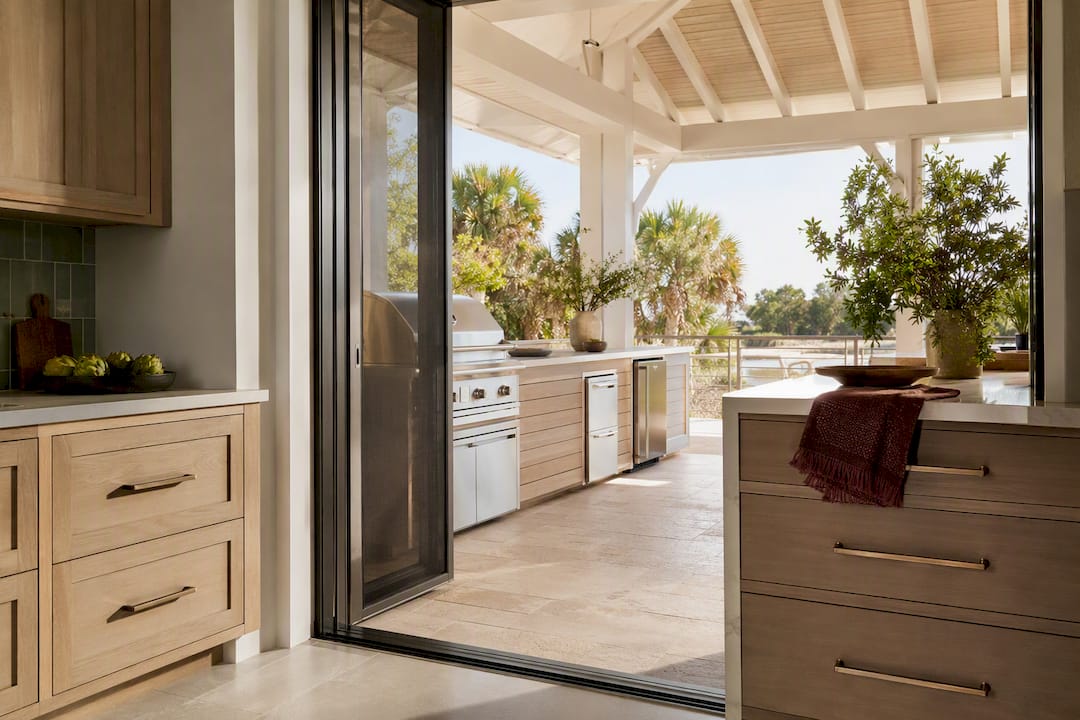
- Retractable glass or screen doors that fully open the kitchen to a porch or pool deck
- A wood-fired or gas pizza oven as the visual anchor for larger builds
- A covered prep counter that keeps cutting boards dry during sudden coastal showers
Smaller budgets and rental properties don't need to sit this out. A painted island (rather than a full cabinetry swap), a peel-and-stick tile backsplash, and outdoor-rated cushions and curtains deliver the same light, indoor-outdoor feel at a fraction of the cost, and everything can be replaced or updated without touching plumbing or electrical.
Materials and Durability for Salt Air
The look is only half the job. Salt air corrodes ordinary materials fast, and the wrong choices can undo a beautiful design within a couple of seasons.
For any exposed metal, hinges, and cabinetry hardware, specify 316-grade marine stainless steel. The molybdenum content in 316 gives it meaningfully better resistance to salt-air corrosion than standard 304-grade stainless, which is the grade most big-box grills and hardware default to. Standard hardware in coastal conditions commonly fails within two to three years; marine-grade hardware extends that service life substantially and lowers lifetime maintenance cost even though it costs more upfront.
Countertops follow the same logic. Quartz or sealed granite now outperform honed marble for coastal use, since quartz mimics marble's veined look while resisting stains, salt spray, and humidity far better. For cabinetry, powder-coated stainless boxes or CMU (concrete masonry unit) bases clad in stone or stucco both shrug off moisture better than painted wood.
| Material | Best Use | Salt-Air Performance |
|---|---|---|
| 316 stainless steel | Hardware, appliance panels, fasteners | Excellent |
| 304 stainless steel | Interior, non-exposed components | Fair, corrodes faster near coast |
| Quartz | Countertops | Excellent, low maintenance |
| Honed marble | Interior kitchens only | Poor outdoors, stains and etches |
| Powder-coated aluminum | Cabinet boxes, trim | Very good |
Pro Tip: Rinse metal surfaces with fresh water every one to two weeks during peak humidity months, and reseal stone counters annually. That single habit does more to extend a coastal kitchen's life than any upgrade in materials.
How Do You Lay Out an Indoor-Outdoor Summer Kitchen?
Coastal outdoor kitchens work best when they're planned around three distinct zones rather than one long counter run:
- Cooking zone — the grill, pizza oven, or built-in range, positioned with enough clearance for smoke and heat to vent away from seating.
- Prep and cleanup zone — a sink, counter space, and covered storage close to the cooking zone but out of the main traffic path.
- Entertaining and serving zone — island seating or a bar area, positioned to catch views and breezes rather than smoke.
Island sizing should match how you actually entertain. A gathering of two to six people works comfortably with a 6 to 8-foot island offering three or four stools; groups of six to ten need an L-shaped or double-island layout to keep the cook from getting boxed in.
Retractable glass or screen doors extend the interior kitchen outward on good days and seal it off during storms. Open-concept layouts with a clear circulation path from pool or beach access to an outdoor sink also cut down on how much sand actually makes it into the house. In tight footprints, a multi-function island with a built-in wet bar and deep drawer storage often replaces three separate pieces of furniture.
Getting the Lighting Right in a Coastal Kitchen
White cabinets and stone counters can turn stark and unwelcoming under the wrong bulb. Coastal kitchens read warmest under 2700K to 3000K light. 4000K bulbs, by contrast, tend to feel cold and clinical against white coastal palettes, closer to a hospital hallway than a beach house porch.
A few placement rules keep the layering right:
- Hang island pendants 30 to 36 inches above the counter, spaced 24 to 30 inches apart
- Layer task lighting over prep areas, ambient light for general use, and accent lighting on architectural details or landscaping
- Choose powder-coated or solid-brass fixtures, since raw unfinished metal fixtures corrode fastest in salt air
- Use glossy tile backsplashes or polished counters to bounce daylight deeper into the space
Skipping the color-temperature detail is one of the most common mistakes homeowners make, and it's an easy one to avoid before fixtures are ordered.
What Does a Coastal Summer Kitchen Cost?
Budgets for coastal outdoor kitchens run wide, and the spread comes down almost entirely to material grade and how much structural work the site needs.
- Modest builds ($5,000 to $15,000): a quality grill, basic counters, and simple storage, often without a full roof structure
- Mid-range builds ($15,000 to $40,000): integrated appliances, marine-grade cabinetry, stone counters, and a covered structure
- High-end builds ($40,000 and up): custom stone, a built-in pizza oven, full weatherproof cabinetry, and structural engineering for permanence
Marine-grade materials, built-in appliances, and any structural or electrical work tied to permits are the biggest cost drivers, more than finish choices or decor. Phasing a build, starting with the grill and counter run, then adding a pizza oven or wet bar a season later, spreads that cost without leaving the space looking unfinished in the meantime.
For vacation rental owners, the investment can pay for itself. One Gulf Coast outdoor kitchen provider reports nightly rate increases of $75 to $200 during peak season tied directly to outdoor kitchen upgrades, with payback in as little as two to three seasons in that market. Results vary by location and rental demand, but the pattern holds: guests pay more for a real outdoor cooking and dining experience.
Maintenance, Storms, and Permitting
Salt air rewards consistency, not effort in bursts. A light rinse of metal surfaces every week or two, a resealed stone counter each year, and a check of hinges and hardware each spring will catch corrosion before it spreads.
Permanent structures in coastal jurisdictions typically need hurricane-rated engineering and proper anchoring, which affects everything from roof design to footing depth. Architectural Review Board or HOA approval, common in managed coastal communities, along with county permitting, commonly adds two to twelve weeks to a project timeline, so build that window into any schedule from the start.
- Rinse and inspect metal hardware every one to two weeks in humid months
- Reseal stone counters and grout annually
- Cover or store small appliances ahead of named storms
- Submit ARB/HOA documentation early since reviews can shape material and color choices before construction begins
Pro Tip: Ask your contractor for the anchoring specifications in writing before permitting begins. It's far easier to adjust a design on paper than after concrete footings are poured.
The Crane Island Approach to Coastal Kitchens
We think of the summer kitchen as an extension of porch living rather than a separate project bolted onto a home. A well-placed outdoor kitchen turns a porch from a place you sit into a place where neighbors actually gather, cook, and stay through the evening.
We encourage homesite owners to plan cooking and entertaining zones alongside the porch itself, not after the fact. The material choices that hold up against salt air, marine-grade hardware, quartz counters, powder-coated fixtures, are the same choices that keep a home looking rooted in this landscape for decades rather than a handful of seasons.
Community review adds real time to any build here, as it does across most managed coastal developments, so we walk owners through material and color guidance early. That coordination between homeowner, architect, and the community's design standards is what keeps the Lowcountry character consistent from one custom home to the next.
Landscaping Around a Coastal Summer Kitchen
The plants around a summer kitchen do as much design work as the cabinetry inside it. Coastal landscaping succeeds by working with salt tolerance and wind exposure rather than fighting them, which rules out a lot of conventional ornamental planting.
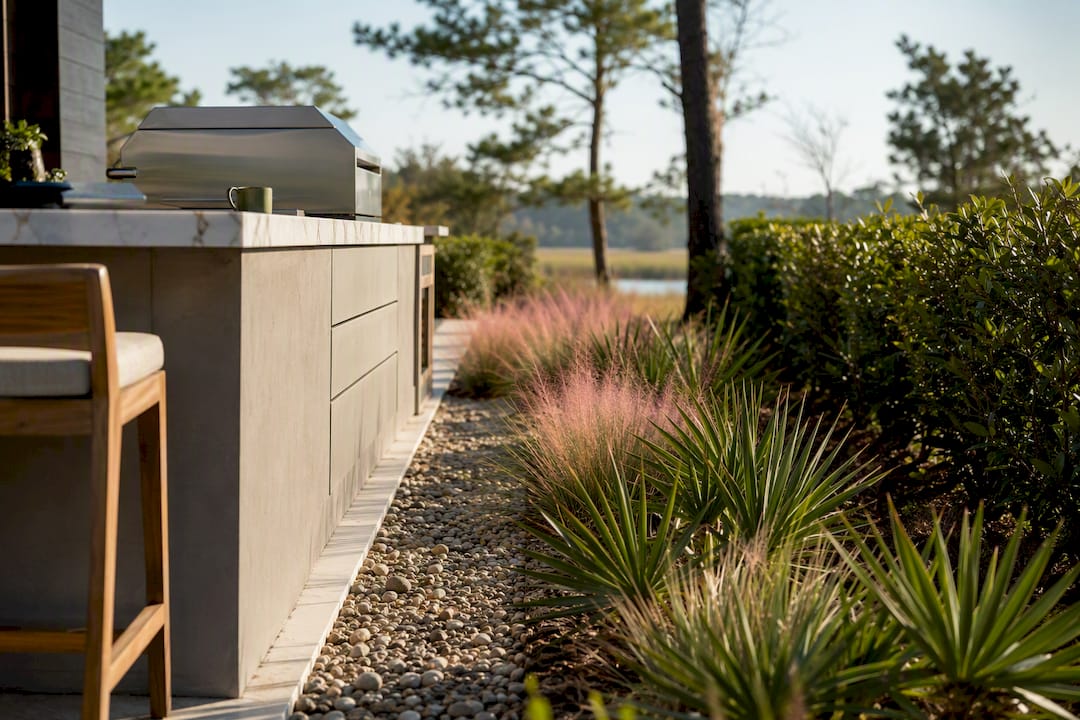
Sea grasses, muhly grass, and dwarf palmettos hold up against salt spray and give a kitchen area movement and softness without demanding much water or care. Low hedges of yaupon holly or wax myrtle work well as a windbreak along an exposed edge, cutting gusts before they reach a dining table without blocking the view entirely.
For structure closer to the kitchen itself, potted rosemary, bay laurel, or citrus trees pull double duty: they tolerate salt-tinged air reasonably well and put fresh herbs and fruit within reach of the grill. Climbing jasmine or coral honeysuckle trained along a pergola post softens hard edges and adds fragrance to evening gatherings without requiring a full garden bed.
Keep planting beds slightly elevated or well-drained near any structure, since standing water after a coastal downpour is as damaging to landscaping as it is to cabinetry. A gravel or paver border between planting beds and the kitchen footprint also keeps mulch and soil from washing onto counters and flooring during heavy rain.
An Editorial Take on Coastal Kitchen Design
The advice you'll find most often treats coastal kitchen design as a decorating problem: pick the right white, add some rattan, done. That undersells what actually separates a coastal summer kitchen that lasts from one that needs rebuilding in five years. The finish is the easy part. The engineering underneath it, the grade of stainless, the anchoring, the drainage, is where most projects quietly fail.
Homeowners consistently underestimate how much salt air erodes ordinary materials, and they overestimate how much a beautiful photo tells them about a product's coastal performance. A gorgeous island photographed inland tells you nothing about how its hardware behaves eighteen months into salt exposure.
Prioritize the boring decisions first: hardware grade, structural anchoring, drainage slope, permit timeline. Once those are locked in, the palette and styling choices become low-stakes and genuinely fun. Get the sequence backward, and you're refinishing hardware while the paint is still fresh.
For a distinctive coastal look inside the home that flows naturally into an outdoor kitchen, door and finish choices matter more than most homeowners initially expect, since they're what visually connects indoor and outdoor spaces once the doors are open.
Ready to see how this plays out on an actual homesite? Crane Island's custom homesites on Amelia Island are designed with this indoor-outdoor, porch-centered lifestyle built in from the start, not added on afterward.
— John Hillman
Sources
- 20 Coastal Kitchen Ideas to Bring the Beach Inside — BHG
- Coastal Kitchen Co. | Outdoor Kitchens Destin & 30A Florida
- Coastal hardware corrosion resistance — Titon blog
- 2700K vs 3000K vs 4000K — which color temperature is best? — DycoDecor
- Hurricane-rated outdoor structures — Classic Metals
FAQ
What Are Some Ideas for a Beachy, Coastal Kitchen?
Pair a white or soft blue base with driftwood tones and one accent color like sea glass green, then add texture through rattan pendants, woven stools, and beadboard paneling rather than literal beach decor.
What Is the Average Cost of a Summer Kitchen?
Costs typically range from $5,000 for a modest grill-and-counter setup to $40,000 or more for a full build with marine-grade cabinetry, custom stone, and a pizza oven, with mid-range projects landing between $15,000 and $40,000.
What Are Some Trendy Coastal Kitchen Ideas for 2026?
Open-concept layouts with retractable doors, mixed wood tones, and restrained accent colors are leading the trend, along with quartz counters replacing honed marble for better durability without losing the marble look.
What Is the New Kitchen Trend for 2026?
Indoor-outdoor flow continues to lead, with homeowners favoring light, textured coastal palettes and durable materials like quartz and marine-grade stainless over heavier traditional finishes.