
A conservation easement in Florida is a voluntary, perpetual legal interest that limits specified uses of your land while you keep title. Landowners use one to protect natural, scenic, agricultural, or historic values, and often to secure federal tax benefits along the way. Section 704.06 of the Florida Statutes governs how these agreements are created, recorded, and enforced, with major partners including Florida DEP and the NRCS ACEP program.
TL;DR:
- Most conservation easements in Florida allow the landowner to retain the deed, taxes, and home, while restricting development and subdivision rights permanently.
- The legality of extinguishing or modifying a recorded easement is highly rigorous, requiring court approval or legislative action, and cannot be renegotiated unilaterally.
- Tax benefits depend on whether the easement qualifies for federal deductions and whether it overlaps with existing agricultural assessments, which may reduce potential tax savings.
- Funding options include federal programs like NRCS ACEP and state initiatives such as Florida Forever, each targeting different land types and conservation goals.
- Disputes often stem from vague reserved rights or baseline documentation issues, highlighting the importance of precise language, thorough appraisal, and detailed initial documentation.
Table of Contents
- What Is a Conservation Easement in Florida?
- How Does Florida Law Define a Conservation Easement?
- What Tax Benefits Come With a Conservation Easement?
- Which Florida Programs Fund Conservation Easements?
- How Do You Place a Conservation Easement on Your Land?
- Can You Still Build or Farm on Easement Land?
- How Are Conservation Easements Monitored and Enforced?
- How Do You Vet a Conservation Easement Holder?
- Does a Conservation Easement Affect Property Value in Florida?
- What Disputes Come Up Most Often With Florida Easements?
- How Does Community Input Shape Florida Conservation Easements?
- Balancing Private Legacy Goals With Public Conservation
- An Adjacent Path: Living Within Protected Land at Crane Island
- Sources
- FAQ
What Is a Conservation Easement in Florida?
A conservation easement is not a sale. You keep the deed, the taxes, and the right to live on the land. What changes is a specific bundle of rights, usually the right to subdivide, develop, or clear in ways that would damage the conservation values you and the holder agree to protect. The word "perpetual" means exactly that: the restriction binds every future owner, because the easement "runs with the land" under Florida law, not with the person who signed it.
Holders fall into a few categories:
- Qualified land trusts, often regional nonprofits with a conservation mission
- State and local government agencies, including Florida DEP
- Federal partners working through programs like NRCS ACEP
A holder accepts real responsibility: monitoring the property, defending the terms in court if needed, and maintaining records for decades. Easements arrive three ways: outright donation (the most common route for a full tax deduction), bargain sale (part gift, part purchase), or a straight purchase, typically through a state or federal program with conservation funding.
How Does Florida Law Define a Conservation Easement?
Florida's framework rests almost entirely on one statute. Section 704.06 defines a conservation easement as a voluntary, perpetual, legally binding interest that limits or prohibits activities to keep land in a natural, scenic, open, agricultural, or wooded condition. The statute spells out how these interests are created (in writing, executed with the same formalities as a deed), how they're recorded in the county's official records, and, notably, who can enforce them.
A conservation easement under Florida law may be enforced not only by the holder, but potentially by third parties granted enforcement rights in the instrument itself. Extinguishment or release of a perpetual easement generally requires a court proceeding or specific legislative authority, not a private agreement between landowner and holder.
That last point matters more than most landowners realize going in. Once recorded, an easement is not something you can simply renegotiate away if your plans change. Courts have treated release or extinguishment as a rare, legally rigorous event, which is precisely the point: permanence is the product.
What Tax Benefits Come With a Conservation Easement?
The federal charitable deduction under IRC §170(h) is the benefit most landowners hear about first. To qualify, the easement must serve a recognized conservation purpose, run in perpetuity, and go to a qualified holder, typically a government agency or a 501(c)(3) land trust with the resources to enforce it. Donated easements can also reduce the taxable value of an estate, which matters for families trying to pass working land to the next generation without a forced sale to cover estate taxes.
Florida-specific paperwork includes forms like DR-418C and DR-482C, tied to conservation and agricultural assessments at the county level. Here's the catch many landowners miss:
- If your land already qualifies for agricultural current-use assessment, adding an easement may not lower your property tax bill much further
- The Pension Protection Act expanded deduction limits for qualifying farmers and ranchers, but eligibility tests are specific
- Estate tax benefits depend on the easement meeting federal qualification tests at the time of donation, not after the fact
Pro Tip: Run a full pro-forma with a tax professional before you assume an easement will lower your bill. In many Florida counties, the agricultural assessment you already have may be doing more work than a new easement would.
Which Florida Programs Fund Conservation Easements?
Florida landowners have real funding options beyond a pure donation, and matching your property to the right program saves months of dead-end conversations.
- NRCS ACEP funds easements on working agricultural land and wetlands, with eligibility tied to conservation value and program funding cycles.
- Florida Forever is the state's flagship land conservation program, generally focused on larger, ecologically significant tracts with statewide habitat or water-quality value.
- RFLPP (Rural and Family Lands Protection Program) targets working ranches and farms where continued agricultural use is the conservation goal.
- Local land trusts vary widely in capacity. Vet each one for its endowment size, enforcement track record, and staffing before signing anything.
How Do You Place a Conservation Easement on Your Land?
Getting from an idea to a recorded easement follows a fairly predictable sequence, though the timeline stretches or compresses depending on funding involved.
- Define your conservation goals. Habitat protection, agricultural continuity, and family legacy planning call for different holder relationships.
- Select and negotiate with a holder. This is where reserved rights get written down in detail.
- Commission an appraisal. Required for tax-deduction purposes and to establish fair value if a program is purchasing the easement.
- Complete baseline documentation. A detailed inventory of current conditions, photographs, maps, and natural features.
- Record the easement with the county, per the recording requirements in Section 704.06.
- Establish a monitoring plan and, often, a monitoring endowment to fund inspections indefinitely.
Expect legal fees, appraisal costs, a survey, and the baseline report to run into the thousands, with the monitoring endowment as an additional, ongoing cost some holders require upfront.
Pro Tip: Start the baseline report before you finalize easement language. Extension guidance consistently flags accurate baseline documentation as the single best defense against future disputes.
Can You Still Build or Farm on Easement Land?
Most Florida easements reserve specific rights rather than locking the land in amber. Common carve-outs include:
- One single-family residence and associated structures
- Continued farming, grazing, or silviculture within defined boundaries
- Trails, docks, or other low-impact recreational features
Typical prohibitions cover subdivision, new commercial development, and major excavation or mining. If you're wondering whether you can build a house on conservation easement land, the answer is usually yes, but only where the instrument explicitly reserves that right, and usually to a defined footprint. Removing an easement entirely is a different matter. It's rare, requires the holder's agreement at minimum, and often a court's, since extinguishment sits well outside a landowner's unilateral control.
How Are Conservation Easements Monitored and Enforced?
Baseline documentation, the detailed snapshot taken before the easement is signed, is what everything else gets measured against. It should include maps, photographs, and a written description of the property's ecological and structural condition.
- Monitoring visits typically happen annually or biennially, often by the holder's staff or a contracted third party
- Monitors check for unauthorized structures, land-clearing, or use changes against the baseline
- If a holder becomes insolvent or under-resourced, enforcement can weaken significantly, which is why holder financial capacity matters as much as the easement language itself
How Do You Vet a Conservation Easement Holder?
Not every land trust or agency is equally equipped to defend an easement fifty years from now, and that gap is where most future disputes start.
- Ask for the holder's monitoring endowment size and how it's invested
- Request their enforcement history, including any past litigation to defend an easement
- Confirm they have dedicated staff, not just volunteers, assigned to monitoring
- Watch for vague restriction language that leaves too much open to future interpretation
Red flags include a holder unable to produce a sample baseline report, unclear answers about funding sources, or reluctance to put monitoring frequency in writing.
Pro Tip: If a holder can't show you their own baseline documentation template, that's worth pausing over. Reserved rights and permitted structures should be spelled out explicitly, not left to a future monitor's judgment call.
Before signing, get an independent appraisal and separate legal and tax counsel. The holder's attorney represents the holder's interests, not yours.
Does a Conservation Easement Affect Property Value in Florida?
The honest answer is: it depends heavily on what the land was worth for before the restriction, and what it's worth for after. A rural parcel valued mainly for its development potential, say, a waterfront tract eyed for a future subdivision, will typically see its market value drop once that potential is permanently removed. An easement on land whose highest value was always agricultural or recreational may see a smaller shift, since the restricted uses were never the main driver of price.
Marketability is a separate question from value, and Florida buyers respond to it in mixed ways. Some buyers specifically want protected land: privacy, established tree canopy, and permanent buffers from future development next door are genuine selling points, particularly in fast-growing coastal counties. Other buyers, especially those hoping to eventually develop or subdivide, will simply pass. That narrows your buyer pool even as it deepens interest among the buyers who remain.
Lenders and title companies also treat encumbered parcels differently. Appraisers need comparable sales of similarly restricted land, which can be thin in some Florida markets, and that can slow a transaction down. None of this makes an easement a bad decision. It does mean you should think through resale scenarios before you sign, not after. A landowner planning to keep land in the family for generations experiences this restriction very differently than one who might need to sell in five years to fund retirement.
Talk through these scenarios with both an appraiser and an attorney who has handled encumbered-land transactions specifically, since general real estate counsel doesn't always catch the nuances a permanent restriction introduces into a sale.
What Disputes Come Up Most Often With Florida Easements?
Most conflicts trace back to language that seemed clear at signing but proved ambiguous a decade later. Reserved rights are the biggest culprit. An easement that permits "agricultural use" without defining scope can spark real disagreement when a landowner wants to add a new barn, expand grazing acreage, or shift from row crops to livestock.
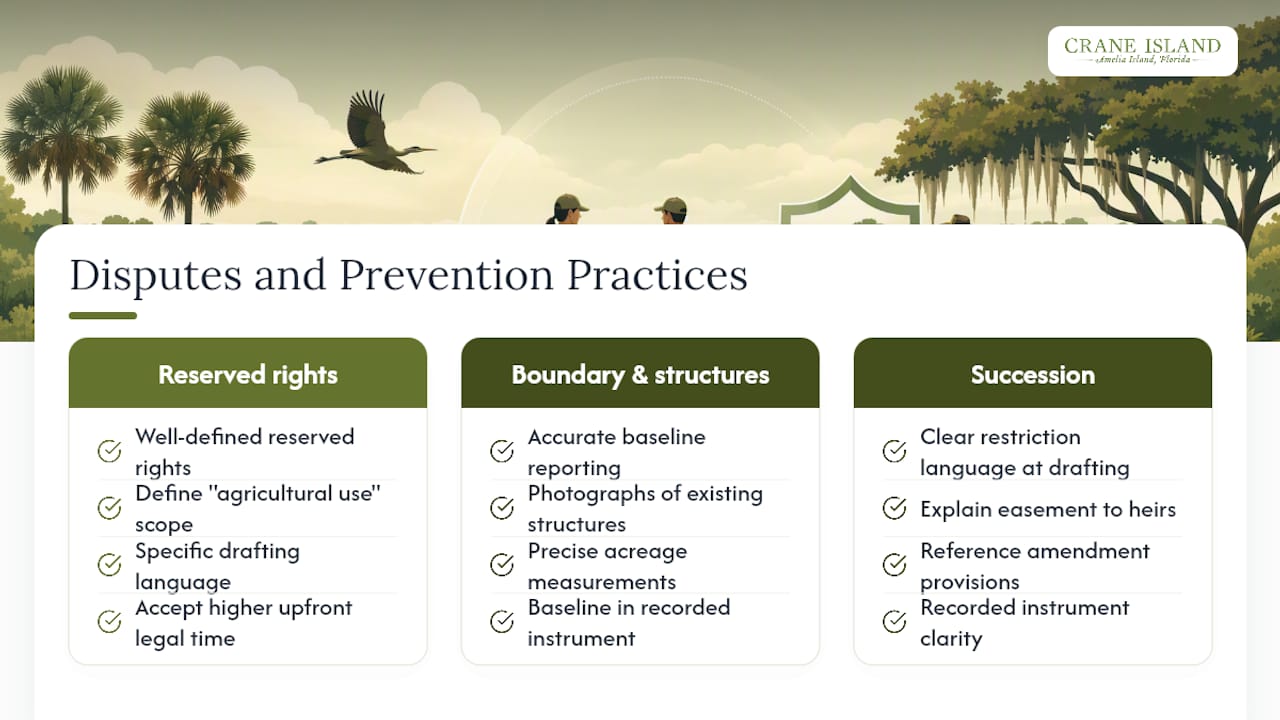
Boundary and structure disputes come next. Baseline documentation that's thin on detail, missing photographs of an existing shed, or vague on acreage measurements, gives both sides less to point to when a question arises. This is exactly why extension guidance treats accurate baseline reporting as the most practical defense a landowner can build in at the outset, not after a disagreement surfaces.
Succession disputes are increasingly common as easements signed twenty or thirty years ago pass to heirs who weren't part of the original negotiation. A new generation of owners may not share the same conservation priorities, or may not fully understand what the easement restricts until they try to build, subdivide, or sell.
Most of these conflicts resolve through negotiation between landowner and holder, sometimes with a mediator, referencing the recorded instrument and any amendment provisions it contains. Litigation happens, but it's the exception rather than the rule, since courts generally hold perpetual easements to a high standard and extinguishment requires substantial legal justification. The practical lesson for anyone considering an easement is that dispute prevention happens at drafting, not after the fact. Specific, well-defined reserved rights cost more legal time upfront and save far more later.
How Does Community Input Shape Florida Conservation Easements?
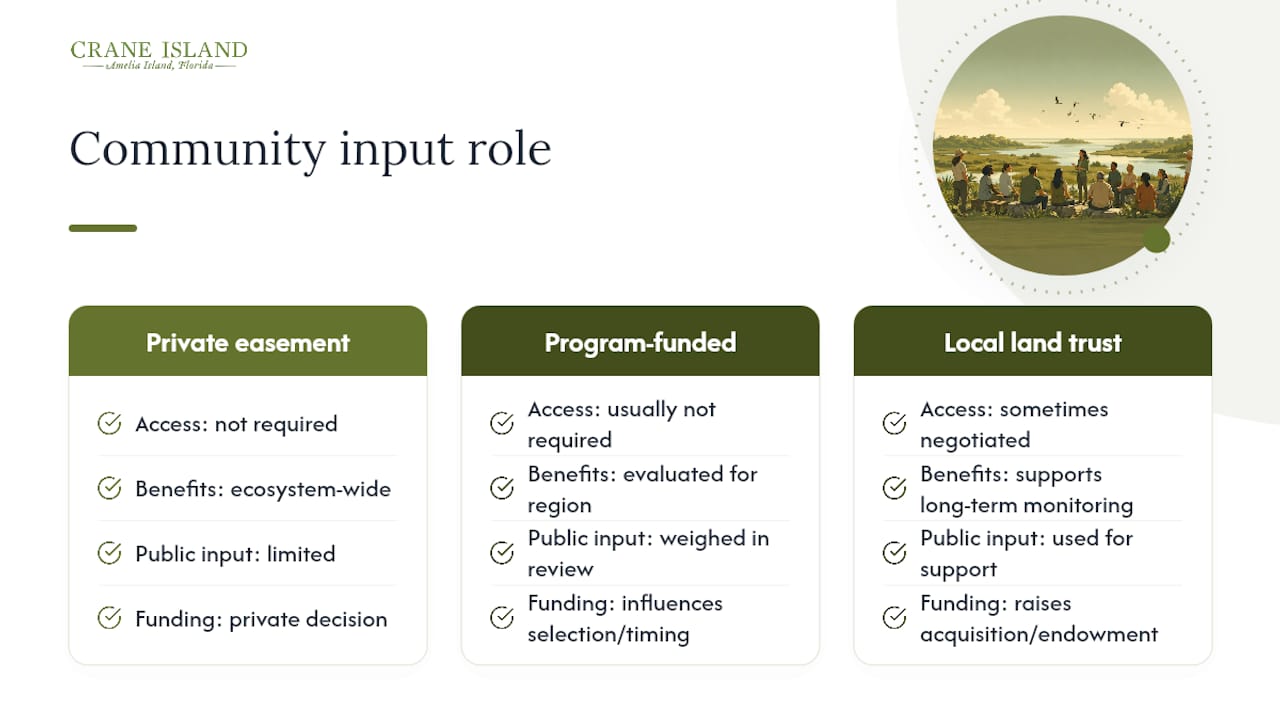
Conservation easements are private legal instruments, but the values they protect, wildlife corridors, water quality, working farmland, historic viewsheds, are rarely private in effect. A single easement along a river corridor can connect to a much larger regional conservation network, which is why state programs like Florida Forever and federal partners like NRCS weigh public benefit heavily when deciding what to fund.
Public access is a common point of confusion. Most Florida conservation easements do not require the landowner to open the property to visitors. The conservation value being protected, be it a wetland, a longleaf pine stand, or a stretch of oyster habitat, benefits the broader ecosystem whether or not anyone ever sets foot on the parcel. Landowners occasionally negotiate limited access provisions, such as a trail easement or scientific research access, but that's a specific choice, not a default requirement.
Where public input genuinely matters is in program-funded easements. Florida Forever and ACEP applications typically go through review processes that weigh regional conservation priorities, meaning a property's value to the broader landscape, its role in a wildlife corridor, its proximity to protected water bodies, can influence whether it gets funded and how quickly. Local land trusts also often engage nearby communities and stakeholders when raising acquisition or endowment funds, since public support tends to translate into long-term monitoring resources.
The upshot for landowners: your private decision to protect a piece of Florida land contributes to a public good, water quality, habitat connectivity, working landscapes, even when no one else ever walks the property.
Balancing Private Legacy Goals With Public Conservation
The landowners who end up satisfied with a conservation easement, rather than second-guessing it a decade later, are almost always the ones who named their goal clearly before they picked a holder. Habitat protection, agricultural continuity, and family legacy call for different terms, different holders, and different reserved rights. Heirs inherit not just land but the restriction itself, so succession conversations belong at the drafting table, not after a signature.
For landowners drawn to the idea of permanent stewardship but not ready to encumber their own deed, a conservation-minded residential community offers a different path toward the same underlying value.
— John Hillman
An Adjacent Path: Living Within Protected Land at Crane Island
Not every landowner wants to place restrictions on land they already own. Some are looking for the opposite entry point: buying into a place where the conservation work has already been done. That's a different question than "should I put an easement on my property," and it deserves an honest, separate answer.
Craneisland was built around that idea. On Amelia Island, only 14 homesites sit within a community woven seamlessly into preserved marshland and maritime forest, with direct access to the Intracoastal Waterway and the historic charm of Fernandina Beach close by. Lowcountry-inspired architecture and generous porches, true living rooms turned toward the landscape, encourage the kind of neighborly, outdoor life that a stewardship-minded buyer is often searching for.
Choosing Crane Island is a fundamentally different route from granting a conservation easement. You're not restricting your own deed. You're buying into a community where the surrounding land has already been set aside, so the marshland views, the tree canopy, and the open space feel permanent by design rather than by legal instrument. For a buyer weighing the effort of easement negotiation against simply living inside a landscape that's already protected, that distinction is worth sitting with.
If this feels like the lifestyle you've been picturing, explore available homesites at Crane Island and see which of the remaining fourteen might fit your plans for a custom home.
This article is general information, not a substitute for advice from a qualified lawyer. Consult a qualified legal professional about your own circumstances before acting on anything here.
Sources
- Chapter 704 Section 06 - 2025 Florida Statutes - The Florida Senate
- Conservation Easements - Florida Department of Environmental Protection
- Conservation Easements - Florida Land Steward - UF/IFAS
- Agricultural Conservation Easement Program - Florida (NRCS)
- Keeping the Perpetual in Florida's Conservation Easements - FIU Law Review
FAQ
Do You Get Paid for a Conservation Easement in Florida?
Sometimes. Payment depends on whether the easement is donated, a bargain sale, or a full purchase through a program like NRCS ACEP or Florida Forever, and on the land's conservation value.
Can You Get a Property Out of a Conservation Easement?
Rarely, and not unilaterally. Since easements are perpetual under Section 704.06, extinguishment or release generally requires court approval or specific legislative authority.
Can You Build a House on Conservation Easement Land?
Usually yes, but only if the easement explicitly reserves that right. Most Florida easements permit one single-family residence within a defined building envelope, along with continued agricultural or forestry use.
What Is the 7-Year Property Law in Florida?
This isn't a conservation easement rule; it typically refers to adverse possession claims, which are unrelated to easement terms. For land already under a recorded conservation easement, the restriction runs with the title regardless of any separate possession claim, so it's a separate legal question best answered by a Florida real estate attorney.