
A land stewardship community is a privately developed, permanently conserved luxury residential community that combines limited homesites, protected natural parcels, and formal stewardship funding to deliver long-term scarcity, privacy, and legacy value. For affluent buyers, that combination means something rare in modern real estate: a home whose surroundings are legally protected from change, whose natural character is funded to endure, and whose value is anchored in genuine irreplaceability. Craneisland on Amelia Island, Florida, stands as one of the most considered examples of this model in the American market, and John Hillman's work with the community reflects the kind of practitioner depth that separates authentic stewardship from marketing language.
Table of Contents
- What land stewardship communities offer affluent buyers
- Core features that define an authentic stewardship community
- How conservation tools, governance, and money actually work
- Your due-diligence checklist before you buy
- Crane Island: a living example on Amelia Island
- Key Takeaways
- Why stewardship communities deserve more rigorous scrutiny than they get
- Craneisland: private tours and stewardship documents available now
- Useful sources
- FAQ
What land stewardship communities offer affluent buyers
The appeal is not simply aesthetic. These communities deliver a specific set of benefits that conventional luxury developments cannot replicate, because the protections are legal, not aspirational.
- Preserved views and shoreline access. Recorded conservation easements prevent future development on adjacent parcels, locking in the waterfront and forest views that drew you to the property in the first place.
- Limited homesites and low density. Intentional scarcity, often fewer than 20 homesites, creates a legacy ownership model that drives long-term demand from a specific high-net-worth buyer pool.
- Biophilic design and wellness value. Biophilic design and native landscaping measurably improve air quality and resident mental well-being while reducing long-term energy costs.
- Community amenities aligned with conservation. Private trails, kayak launches, and communal gathering spaces are designed around the land, not imposed on it.
- Legacy and estate planning advantages. Conservation tools can protect landscape character across generations, making these properties a natural fit for legacy-focused buyers who want their land to reflect their values long after the purchase.
Statistic callout: Properties neighboring conserved land can command a notable resale premium depending on location and acreage ratios.
Every one of these benefits depends on verifiable trust signals: a recorded easement, a funded stewardship endowment, and third-party certification. Without those, the promise is marketing copy, not a legal commitment.
Core features that define an authentic stewardship community
The physical design of a true stewardship community is deliberate in ways that go well beyond landscaping choices.
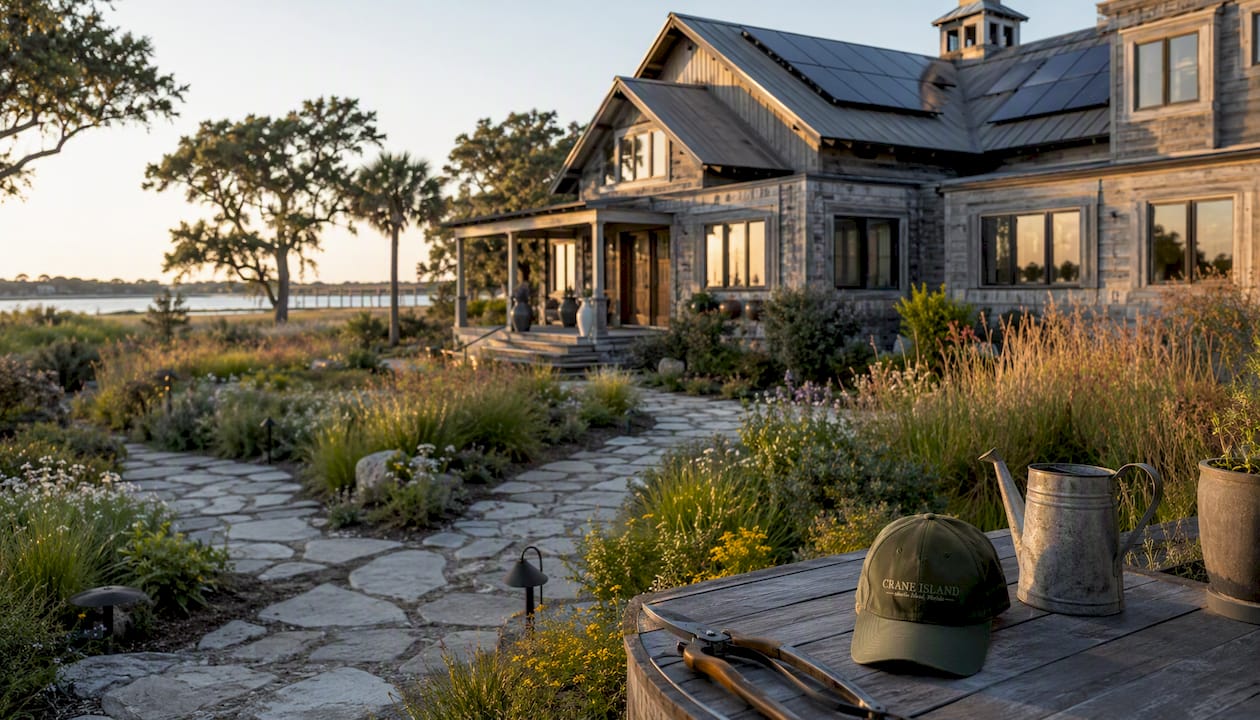
Conserved open-space parcels and building envelopes are the foundation. A building envelope defines exactly where a home may be sited on a given lot; everything outside that boundary is permanently off-limits to construction. When those envelopes are recorded in county land records alongside the easement, they create a form of scarcity that cannot be undone by a future owner or developer.
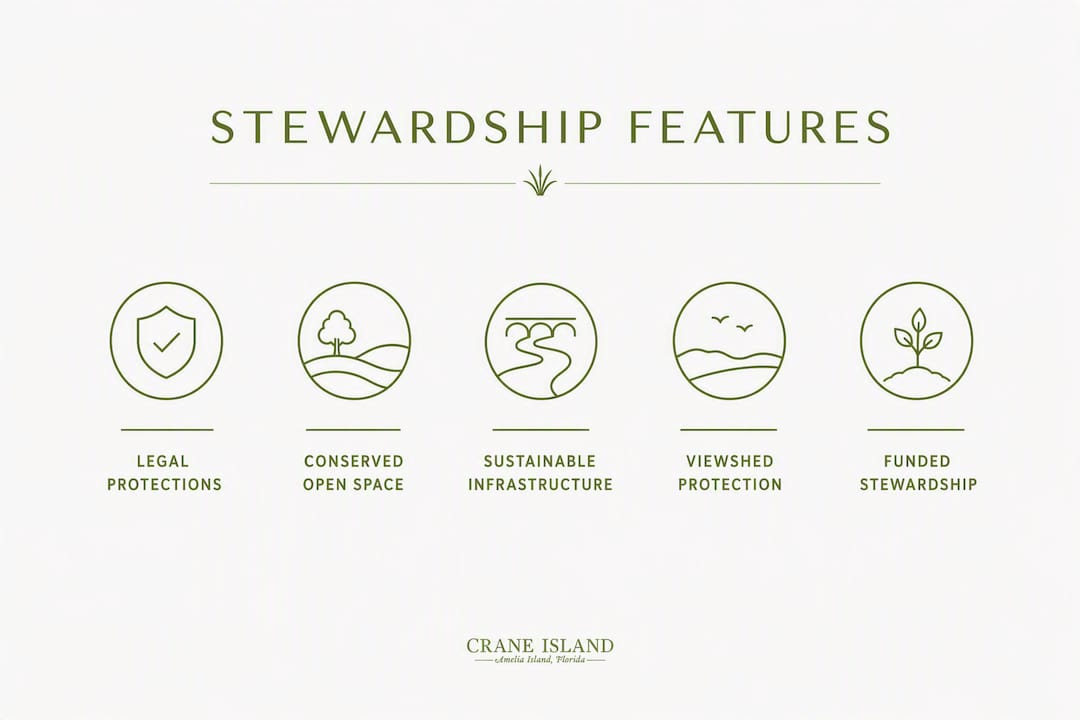
Infrastructure choices signal long-term intent. Developers who integrate renewable energy and greywater recycling into core infrastructure reduce the risk of diminished resale value compared with projects that treat these features as optional add-ons. Rainwater harvesting, high-performance building envelopes, and native-species landscaping are not amenities in this context; they are structural commitments to the land's health. You can read more about what to look for in a sustainable coastal community buyer's guide.
Viewshed protection is a subtler but equally important feature. Some communities record scenic easements specifically to prevent structures or vegetation from blocking sight lines to water, marsh, or forest. Ask whether viewshed protections are recorded or merely promised in marketing materials.
A common developer claim worth scrutinizing: "eco-friendly design." That phrase carries no legal weight. What matters is whether the protections are recorded, funded, and monitored by a third party.
How conservation tools, governance, and money actually work
Conservation easements
A conservation easement is a permanent legal agreement that removes specific development rights from a parcel and runs with the land in perpetuity when recorded in county records. Future owners are bound by its terms. Easements serve conservation purposes, and they can also function as tax and estate planning tools: donations of easement value may qualify for federal income tax deductions subject to IRS rules, and they can reduce estate tax exposure. Review both with a qualified tax advisor before closing.
Stewardship funding models
Well-structured stewardship funds (endowments) are preferable to ad hoc annual fees because they provide predictable, long-term funding for monitoring and management obligations required by easement holders. Annual HOA or stewardship fees are common in smaller communities, but without an endowment backstop, funding gaps can emerge when ownership turns over. Stewardship obligations typically include invasive-species management, trail maintenance, habitat monitoring, boundary surveys, and annual reporting; estimated costs commonly range from about 1% to 3% of property value annually.
| Value driver | Evidence |
|---|---|
| Conserved-land resale premium | 15%–50% above comparable unprotected properties |
| CRP-linked local appreciation | ~0.5% per 10-hectare conservation increase within 1,000 meters |
| Annual stewardship cost range | 1%–3% of property value |
Pro Tip: Request the baseline documentation report, the recorded easement language, and at least 12 months of energy and water performance data before signing a purchase agreement. These three documents separate demonstrable sustainability from marketing claims.
Red flags to avoid:
- No recorded easement in county land records
- Stewardship funded only by annual HOA dues with no endowment
- Vague or absent monitoring requirements in easement language
- Missing reserve fund disclosures
- Developer unable to provide third-party ecological assessment
Your due-diligence checklist before you buy
Numbered checklist
- Conduct a site visit and walk the full conserved parcel, not just the homesite. Note what is adjacent and what protections govern it.
- Request the recorded easement. Verify it is filed in the county recorder's office and review the conservation purposes and permitted uses.
- Confirm stewardship funding. Ask for the endowment balance or reserve fund statement, not just the annual fee schedule.
- Commission a third-party ecological assessment to verify habitat quality and identify any environmental liabilities.
- Review the title for deed restrictions, covenants, and any prior easement encumbrances.
- Verify certifications. Check LEED and WELL registrations on their respective certifier registries; do not rely on developer-supplied certificates alone.
- Request 12 months of utility performance data to confirm that renewable and water-efficiency systems perform as marketed.
Questions to ask and who to ask them
| Question | Ask | Document to request |
|---|---|---|
| Is the easement recorded and perpetual? | Developer / closing attorney | Recorded easement deed |
| How is stewardship funded long-term? | HOA / developer | Endowment or reserve fund statement |
| Who monitors easement compliance? | Easement holder (land trust) | Annual monitoring report |
| What are the building envelope restrictions? | Developer | Recorded site plan with envelopes |
| Are sustainability certifications current? | Developer | LEED/WELL registry confirmation |
Timeline and cost categories to budget: Due diligence windows in this market typically run 30–60 days. Budget for a purchase premium (the 15%–50% conservation uplift noted above), closing costs, annual stewardship fees (1%–3% of property value), and ongoing HOA costs. Financing can be more complex than a standard luxury purchase; some lenders require additional appraisal documentation when easements restrict development rights, so engage a lender experienced with conservation properties early in the process.
Crane Island: a living example on Amelia Island
Craneisland on Amelia Island, Florida, puts the principles above into practice at a scale that makes the model tangible. With only 14 homesites, the community achieves the kind of density limitation that preserve-living developments use to create genuine permanence and exclusivity. Each homesite is positioned within a defined building envelope, with the surrounding marshlands and maritime forest conserved as a permanent backdrop.
Residents have direct access to the Intracoastal Waterway and are minutes from the historic culture of Fernandina Beach, a combination that grounds the community in both natural heritage and living tradition. The Lowcountry architecture, with its deep porches and material palette drawn from the coastal vernacular, is woven into the land rather than placed on top of it. Porches here function as true living rooms, framing marsh views and drawing neighbors into the kind of unhurried conversation that defines the community's character.
Prospective buyers can request Craneisland's recorded site plans, easement documentation, and stewardship plan directly from the sales team, giving advisors the primary documents needed for thorough due diligence.
Key Takeaways
Land stewardship communities deliver lasting value through legal conservation instruments, funded stewardship, and intentional scarcity, not through marketing language alone.
| Point | Details |
|---|---|
| Definition and core value | A land stewardship community combines limited homesites, recorded conservation easements, and funded stewardship to create permanent scarcity and legacy value. |
| Resale premium evidence | Conserved-land properties can command a 15%–50% premium over comparable unprotected properties. |
| Annual stewardship cost | Budget 1%–3% of property value annually for stewardship obligations including monitoring and habitat management. |
| Top red flags | No recorded easement, no stewardship endowment, and absent third-party monitoring are the three clearest warning signs. |
| Craneisland as exemplar | Craneisland on Amelia Island offers 14 homesites with preserved marshland, Intracoastal access, and documented stewardship, making it a practical starting point for buyers evaluating this model. |
Why stewardship communities deserve more rigorous scrutiny than they get
The conventional wisdom in luxury real estate is that sustainability features add value. That is true, but it is also incomplete in a way that costs buyers money and peace of mind. The feature adds value only when it is permanent, and permanence requires legal instruments, not design intentions.
Most buyers touring a conservation-oriented community focus on the aesthetics: the native plantings, the marsh views, the architectural restraint. Those are real pleasures. What they often do not examine is whether the conservation is recorded, funded, and monitored by an independent third party. A beautiful community with no recorded easement is a community whose character can change the moment the developer sells the remaining land or the HOA runs short of funds.
The buyers who get this right treat the easement review the same way they treat a title search: non-negotiable, done by a qualified attorney, and completed before any emotional commitment to the property. The buyers who get it wrong are often the ones who discover, years later, that the "preserved" forest adjacent to their home was never legally protected at all.
Craneisland's model, with its documented conservation protections and limited homesite count, reflects what this category looks like when it is done with integrity. That is the standard worth holding every developer to.
Craneisland: private tours and stewardship documents available now
Craneisland offers something that most luxury communities cannot: a conservation-backed homesite on Amelia Island where the natural setting is legally protected, the community is intentionally small, and the architectural vision is rooted in the Lowcountry tradition that defines this stretch of the Florida coast.
If you are at the purchase-consideration stage, the most useful next step is a private site visit combined with a review of the community's recorded easement and stewardship plan. Both are available on request. Speak with a Craneisland sales advisor, walk the conserved parcels, and request the documentation your attorney needs to complete due diligence. Visit Crane Island to schedule your private tour or request the stewardship and easement documents directly.
Useful sources
- The Impact of the Conservation Reserve Program on Nearby Property Values — Empirical hedonic pricing evidence linking conservation enrollment to local property appreciation.
- How conservation easements protect historic estate values beyond the sale price — Core reference for easement mechanics, stewardship cost ranges, and resale premium evidence.
- Navigating sustainable luxury: key considerations for discerning buyers — Industry guidance on biophilic design, wellness value, and buyer expectations.
- Sustainable real estate trends — Market commentary on renewable infrastructure and certified sustainability as baseline buyer expectations.
- The rise of preserve living — Buyer motivation and scarcity model analysis for large-scale preserve developments.
- Nottingham Ranch conservation easement case notes — Legacy planning motivations among high-net-worth buyers choosing stewardship communities.
- Sustainable luxury living: ESG trends 2026 — Practitioner guidance on verifying certifications and requesting performance data.
- What Is Eco-Luxury Real Estate? A Complete Guide — Broader context on how luxury and conservation intersect in residential development.
- Conservation Communities Florida: Your 2026 Relocation Guide — Region-specific guidance for buyers considering Florida conservation communities.
- Real Estate Trends 2025: Impact on Luxury Agents — Market trends analysis contextualizing luxury buyer behavior and sustainability expectations.
FAQ
What is a land stewardship community?
A land stewardship community is a privately developed luxury residential community where conserved natural parcels, limited homesites, and formal stewardship funding are legally structured to protect the land's character in perpetuity.
How do conservation easements affect resale value?
Properties with recorded conservation easements can command a resale premium of 15%–50% over comparable unprotected properties, because the easement protects viewsheds and enforces permanent scarcity.
What annual costs should buyers expect?
Stewardship obligations typically cost 1%–3% of property value annually, covering invasive-species management, habitat monitoring, boundary surveys, and annual reporting to the easement holder.
What documents should I request before buying?
Request the recorded easement deed, the baseline documentation report, the stewardship fund or endowment statement, and at least 12 months of energy and water performance data.
Is Crane Island a good example of this community type?
Craneisland on Amelia Island offers 14 homesites with preserved marshland, direct Intracoastal Waterway access, and documented conservation protections, making it one of the clearest U.S. examples of the stewardship community model in practice.