
A deepwater dock on Amelia Island is a private dock that reaches water deep enough, at low tide, for your boat's draft, on a channel that connects to the Intracoastal Waterway and the Atlantic. The phrase is not a legal category. It describes a set of conditions you can measure: depth at mean low water, the route from your slip to the inlet, and a permit that lets you build or keep the dock. Below we walk through each one, so you can judge a waterfront property by facts rather than a listing's adjectives.
TL;DR
- "Deepwater" is a description, not a permit. Measure depth at mean low water along the whole route from the dock to the inlet, not just at the pier head.
- In Florida, a dock on state-owned submerged land needs an exemption, a general permit or an individual Environmental Resource Permit, and written authorization to use the submerged land.
- A lot with "dock potential" does not have an approved dock. The gap between the two is measured in permits.
- Inside a private community, an architectural review board may need to approve your dock as well as the county and state.
- At Crane Island, deep-water access to the Intracoastal is part of the setting, with only 14 homesites remaining.
Table of Contents
- What "deepwater" means on Amelia Island
- Tides, draft and the route home
- A private dock is not a marina slip
- How Florida regulates a private dock
- Inside a private community, add one more reviewer
- What to verify before you buy waterfront
- Why the Intracoastal frontage matters to value
- Our perspective
- Build near the water at Crane Island
- How the island compares for a boating household
- FAQ
- Sources
What "deepwater" means on Amelia Island
Talk to anyone who keeps a boat here and you will hear the same thing: depth is a local, tidal and seasonal matter. Amelia Island sits directly on the Atlantic Intracoastal Waterway, and the St. Marys Inlet gives boats a direct route from the waterway and the Amelia River system to open Atlantic water. The Port of Fernandina sits on the Amelia River, whose channel provides direct access to the Atlantic, which tells you something about the character of this stretch of river.
But a deep main channel does not make every dock deep. Most private docks sit on side creeks, marsh edges or cuts, and the water between the dock and the channel is where boats run aground. When a listing says "deepwater," we suggest you ask four plain questions:
- How deep is the water at the end of the dock at mean low water?
- How deep is the route from the dock to the Intracoastal channel?
- Does the route pass under any fixed bridge, and what is its clearance?
- How far is it to the inlet, and what is the water like on the way?
We have written a closer look at the numbers in our guide to deepwater access on Amelia Island, which covers the roughly 12 feet on the Intracoastal and the far greater depth at the inlet.
Tides, draft and the route home
Tidal range in this part of Florida is large enough that a dock which floats a boat comfortably at high water can leave it sitting on mud six hours later. That is why serious boaters work from mean low water, not from the water level on the day they visit.

Your boat's draft is the depth of the hull below the waterline, and you need more water than that. Florida's own aquatic-preserve criteria point the same way: DEP requires adequate water depths, with at least one foot of clearance between the vessel and the top of resources at mean low water. That is a regulatory floor for protecting seagrass and similar resources, but it is a useful habit for any owner: leave a margin under the keel.
The U.S. Army Corps of Engineers' small-boat-harbor manual lists the factors that shape a usable moorage: water-level fluctuations, tidal currents, sediment movement, bottom type, obstructions and bridge clearances. The manual also describes the access channel as the link between the entrance channel and the moorage area. For a homeowner, that access channel is the part to scrutinize. Marsh creeks collect sediment, and what was deep a decade ago may not be now.
A simple depth check before you commit
- Ask for a recent hydrographic or bathymetric survey of the dock and its approach.
- Run the route at low tide with your own boat, or with a captain who knows the creek.
- Note the bridges and any overhead lines between the dock and your usual destinations.
- Ask neighbors whether anyone has dredged, and whether that was permitted.
A private dock is not a marina slip
Some boaters are better served by a slip. The island has marinas, public docks and anchorages, and for people who want fuel, services and a staff nearby, that may be the right answer. We compare options by type in our guide to where boaters can dock on Amelia Island.
A private dock offers something else: your boat is steps from your door, you set your own schedule, and you are not on a waiting list. The trade-offs are responsibility and cost. You maintain the pilings and decking, you carry the insurance, and you answer to the permitting rules for as long as you own it.
| Private residential dock | Marina slip | |
|---|---|---|
| Access | Steps from your home | A drive or walk away |
| Control | Your schedule, your rules (within permits and community guidelines) | Marina rules and hours |
| Upkeep | Owner maintains and repairs | Marina maintains |
| Services | Typically none on site | Fuel, pump-out, staff, dock help |
| Permitting | Owner responsible | Handled by the marina |
| Sizing | Limited by permit and site | Varies by marina |
How Florida regulates a private dock
Florida treats docks as structures over public resources, so permits matter. The Florida Department of Environmental Protection (DEP) explains that dock projects may qualify for a statutory exemption, a general permit or an Individual Environmental Resource Permit (ERP), and that written authorization to use state-owned submerged land is required.
The size of a project helps decide the pathway. According to the same DEP guide, general permits cover docks up to 2,000 square feet, while Individual ERPs have no specific over-water area limit and can cover multiple docks, private or commercial.
For a single-family dock, DEP defines it as one private dock at one dwelling, used for recreation or leisure and designed to moor no more than two boats. The department's dock-permitting criteria also say a dock generally cannot extend more than 500 feet waterward of mean high water, or 20% of the waterbody's width, whichever is less. Under the criteria cited there, a single-family dock's access walkway is limited to four feet wide and its terminal platform to 160 square feet.

Those are state guidelines, and the rules that apply to a given lot depend on its location and the waterbody. Treat them as the vocabulary for a conversation with the agency and a qualified marine contractor, not a design brief.
The aquatic preserve factor
The waters around the north end of Amelia Island carry extra protection. The FWC's boating guide identifies the Fort Clinch Aquatic Preserve in northeastern Nassau County along Amelia Island, including open waters around St. Marys Inlet and the Amelia River. The preserve protects natural waters and their aesthetic, biological and scientific values. If a property sits near it, ask early how that affects a dock.
Timing and storm repairs
Plan for time. Marine projects frequently involve several agencies, which is why we wrote a DEP dock checklist for Florida waterfront owners, built to help avoid avoidable delays. After hurricanes, DEP's guidance (a 2016 document) allowed repairs to structures that were not completely destroyed, and restoration to what was authorized or legally existed before the storm. Whether an existing dock is legally in place is therefore worth confirming before you buy, because that status governs what you may rebuild.
Inside a private community, add one more reviewer
In a planned community the state and county are not the only gatekeepers. As one example, the design guidelines of Amelia Island Plantation state that new construction and dock modifications need prior architectural review board approval, and that a Nassau County building permit is required where applicable. Every community has its own document, so read the one for the lot you are considering. The principle holds broadly: a dock is a design element, and good communities review it the way they review a house.
What to verify before you buy waterfront
DEP's guide frames the central caution well: dock potential is not an approved dock. Before closing on a waterfront lot or home, we would ask for the following:
- Permit history. Is there a state authorization and any county approval for the existing dock, and does it match what is built?
- Submerged-land authorization. Written authorization to use state-owned submerged land, where required.
- Depth evidence. A survey, plus your own low-tide test with your boat.
- Community approvals. The architectural review requirements for docks, lifts and lighting.
- Condition. An inspection of pilings, decking and hardware by a marine contractor, not a general home inspector.
- Maintenance and insurance. Who pays for repair after a storm, and what your insurer requires.
- Route and clearances. Bridges, shoals and the distance to the inlet.
If you are buying a vacant homesite and plan to build, bring the marine contractor in during design, not after. Permitting strategy and the house plan inform each other, and the dock's position often shapes how the home and landscape sit on the land.
Why the Intracoastal frontage matters to value
Waterfront with real boating access is scarce, and buyers pay attention. We explain how the waterway affects what land is worth in our piece on the Intracoastal Waterway's role in land value. If you are still sorting through the island's choices, our guide to the best Amelia Island neighborhoods for custom homes lays out the options by character and setting.
Our perspective
We believe a dock should feel like part of the land it touches, not an afterthought bolted onto a lot. At Crane Island, we have always started with the place: the marsh, the maritime forest, the long light on the Intracoastal. We preserved nearly half of our land as open space, and we hold our homes to architectural standards inspired by Lowcountry tradition, so that every structure, including those at the water's edge, is woven into its surroundings.
Deep-water access to the Intracoastal is one of the things that sets this community apart on Amelia Island. But we also know that water is honest. It does not care what a brochure says. So our advice to any buyer, here or elsewhere, is to measure, to ask for the paper, and to take a boat out on a low tide before falling in love with a view. A porch looking over the marsh is a true living room, and a dock that works is what turns that room into a doorway to the waterway.
We would rather you arrive informed and delighted than surprised and disappointed. Ask us anything, and we will tell you what we know and what you should confirm with the proper authorities.
— John Hillman
Build near the water at Crane Island
Crane Island is a private, gated Lowcountry-inspired community on the western edge of Amelia Island, a few minutes from historic Fernandina Beach, with direct Intracoastal access and just 14 homesites remaining. We offer custom homesites and move-in ready luxury homes designed by acclaimed architects, along with The Crane Island Portfolio Homes Program for buyers who prefer a completed home.
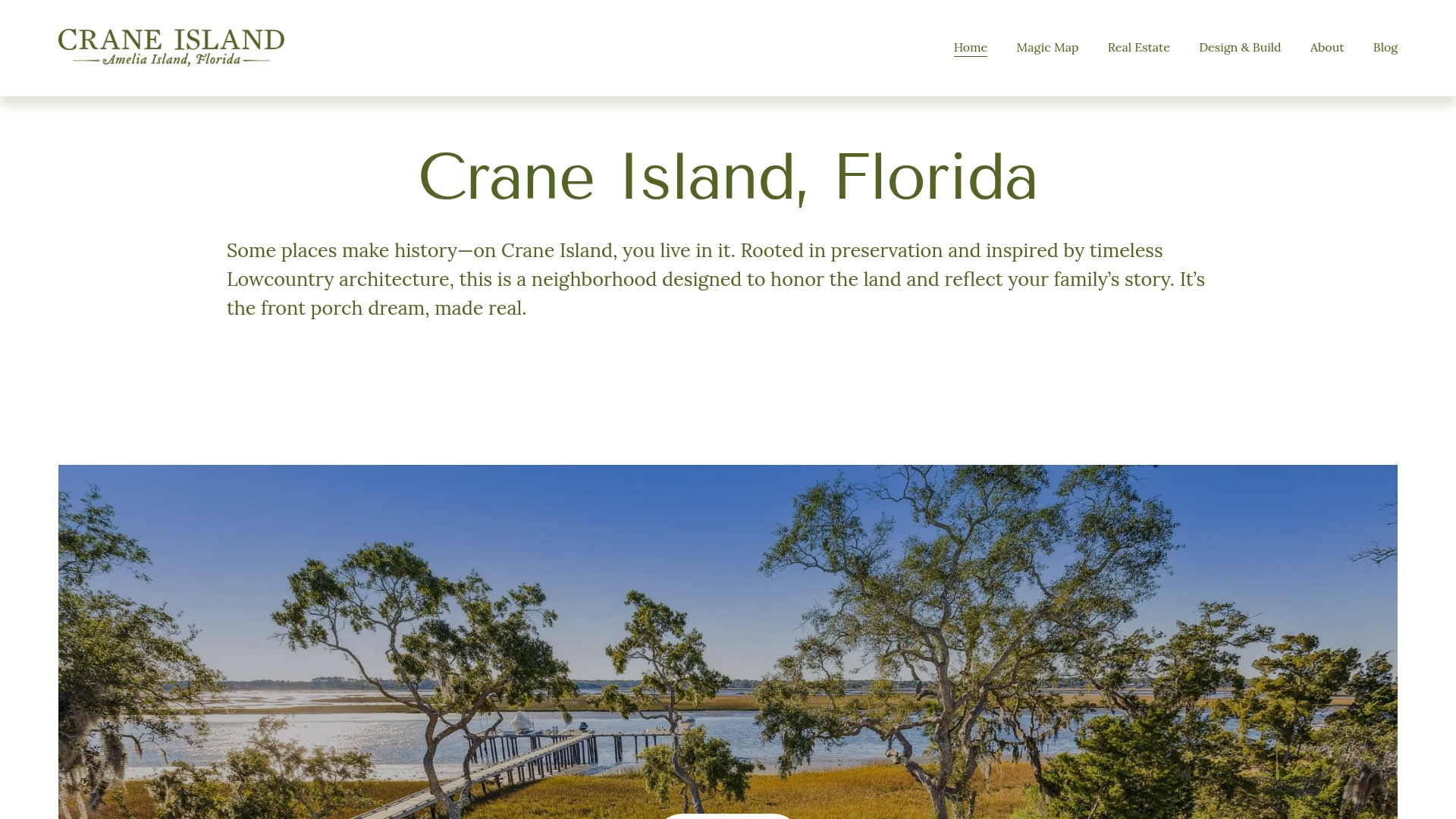
If boating is part of your plan, tell us at the start. We can talk through the setting, what water access means for each homesite, and the approvals that apply. Start with our homes and homesites, or read about custom Intracoastal homes in Fernandina Beach to see how the community fits together.
How the island compares for a boating household
Amelia Island pairs a working harbor town with quiet marsh country, and distance to the airport is modest. Our comparison of Fernandina Beach and other coastal towns looks at what daily life is like, and our Jacksonville proximity guide covers the practical side of getting in and out. For buyers weighing this against the Gulf-facing beach towns of the Panhandle, Beyond 30A explains why many choose the Atlantic side of Florida's north coast instead. And if the look of the house matters as much as the dock, our architecture buyer's guide shows what we mean by a home that belongs.
FAQ
Is there a single definition of a deepwater dock?
No. It is a common description, not a regulatory term. What matters is depth at mean low water at the dock, along the route to the channel, and the draft of your boat. Ask for a survey instead of relying on the label.
Do I need a permit to build a private dock in Florida?
Usually some form of authorization is involved. Florida DEP describes exemptions, general permits and Individual ERPs, and written authorization to use state-owned submerged land is required. Which applies depends on the project and site, so confirm with DEP and a marine contractor before you design or buy.
How many boats can a single-family dock hold?
DEP's definition of a single-family dock is one private dock at one dwelling, for recreational use, designed to moor no more than two boats. Larger or multi-slip projects are treated differently and typically go through the Individual ERP process.
Can I rebuild a dock after a hurricane?
DEP's 2016 post-storm guidance allowed repairs to structures that were not completely destroyed, and restoration to the condition that was authorized or legally existed before the storm. Check the current rules and your dock's permit status with DEP before starting work.
Does Crane Island offer deep-water access?
Yes, Crane Island offers direct, deep-water access to the Intracoastal Waterway. For the specifics of any homesite, including dock plans and approvals, contact us so we can walk you through the details.
Sources
- Dock Permitting in Florida (DEP guide)
- Dock Permitting in Florida (DEP single-family dock and depth criteria)
- Dock Permitting in Florida (DEP size and extent criteria)
- DEP Post Storm Guidance
- FWC Aquatic Preserves boating guide
- Port of Fernandina and Maritime Services
- U.S. Army Corps of Engineers small-boat harbor manual
- Boating and water access on Amelia Island
- Amelia Island Plantation design and construction guidelines