

For most coastal homes, a copper wall-mounted gas lantern at the entry, paired with copper or aluminum post lanterns along the path and a pier-mounted fixture at the dock, gives the best balance of warmth and durability. Natural gas suits a permanent connection near the house; propane works better for freestanding posts farther from the line. The short list below narrows the field to makers worth calling first.
TL;DR:
- Copper fixtures develop a durable patina over time, making them ideal for salt air environments despite higher upfront costs.
- Wall lanterns should be mounted roughly 66 to 72 inches from the ground near entryways, while post lanterns should be placed 7 to 9 feet high along driveways.
- Natural gas is best for fixtures close to the house, whereas propane offers flexibility for posts farther from the main line.
- Installation requires a licensed professional, with costs ranging from $200 to $600 per fixture for labor and $150 to $500 for gas line hookup.
- Maintenance includes annual burner and gas seal inspections, cleaning glass panels, and leaving copper to develop its natural patina without polishing.
Table of Contents
- Which Gas Lanterns Exterior Brands Are Worth Considering?
- How Should You Match Mount Type to Location?
- Which Materials and Finishes Age Well on the Coast?
- What Fuel and Burner Options Should You Compare?
- What Do Installation, Costs, and Maintenance Actually Involve?
- How Do You Finalize a Model Before You Buy?
- How We Think About Gas Lighting on Crane Island
- See These Lighting Ideas in a Real Coastal Community
- Sources
- FAQ
Which Gas Lanterns Exterior Brands Are Worth Considering?
Seven manufacturers stand out for anyone shopping exterior gas lighting seriously, from entry-level reproduction fixtures to hand-hammered copper commissioned for a lifetime. Prices vary by material, mount complexity, and whether the piece is stock or custom.
A few notes worth carrying into your shopping calls:
- Bevolo built its reputation on hand-riveted copper and a proprietary bat-wing burner, which shows up again in the burner section below.
- French Market Lanterns and Gaslights.com both function more like department stores for the category, letting you compare mount and finish side by side.
- American Gas Lamp Works and Tower Lighting lean into provenance, with Tower specifically marketing brass and copper pieces made domestically.
- Lantern & Scroll's CH-27 is a useful benchmark for anyone weighing gas against electric on a historic reproduction fixture.
- Everglow-style aluminum torches and post lamps trade some patina character for lower upkeep near pools and salt spray.
How Should You Match Mount Type to Location?
Mount type is the first decision, and it is largely dictated by where the fixture lives on your property, not by taste alone.
- Wall lanterns work best flanking an entry door, typically mounted so the bottom of the fixture sits at or slightly above eye level, roughly 66 to 72 inches from grade.
- Post lanterns suit driveways, motor courts, and long walkways; scale the post height to the width of the path, generally 7 to 9 feet for a residential drive.
- Pier-mount fixtures are built for dock posts and low garden walls, with shorter stems and a broader base built to shed weather.
- Hanging or pendant lanterns need at least 7 feet of clearance underneath on a porch or breezeway, both for foot traffic and to keep the flame away from overhangs.
- Garden torches handle open, wind-exposed spots like pool decks, where you want a fixture rated for gusts rather than a delicate glass enclosure.
Space path lanterns every 15 to 20 feet so the pools of light overlap slightly. Entry fixtures should frame the door symmetrically, and any torch near open water deserves a wind-rated burner rather than a standard flame.
Which Materials and Finishes Age Well on the Coast?
Copper is the material most gas lantern makers build their reputation on, and for good reason: it develops a natural patina that manufacturers consider a feature, not a flaw worth polishing away. Brass offers a brighter, more formal look but needs more frequent attention to avoid streaking. Aluminum sacrifices some of that heirloom character for a lighter, lower-maintenance body that resists corrosion well near open water. Painted or powder-coated cast metals sit at the budget end and hold up reasonably well inland, though salt air shortens their finish life faster than any of the alternatives.
- Copper: ages into a protective patina, lasts decades, costs the most upfront.
- Brass: warmer tone than copper, needs periodic polishing unless lacquered.
- Aluminum: lightest weight, best resistance to salt corrosion, less traditional look.
- Painted or cast metal: lowest cost, shortest coastal lifespan.
Pro Tip: If your home sits within a few hundred yards of saltwater, ask the manufacturer whether the fixture ships with a sacrificial finish or coating designed for marine exposure. It is a small spec question that saves years of touch-up work.
What Fuel and Burner Options Should You Compare?
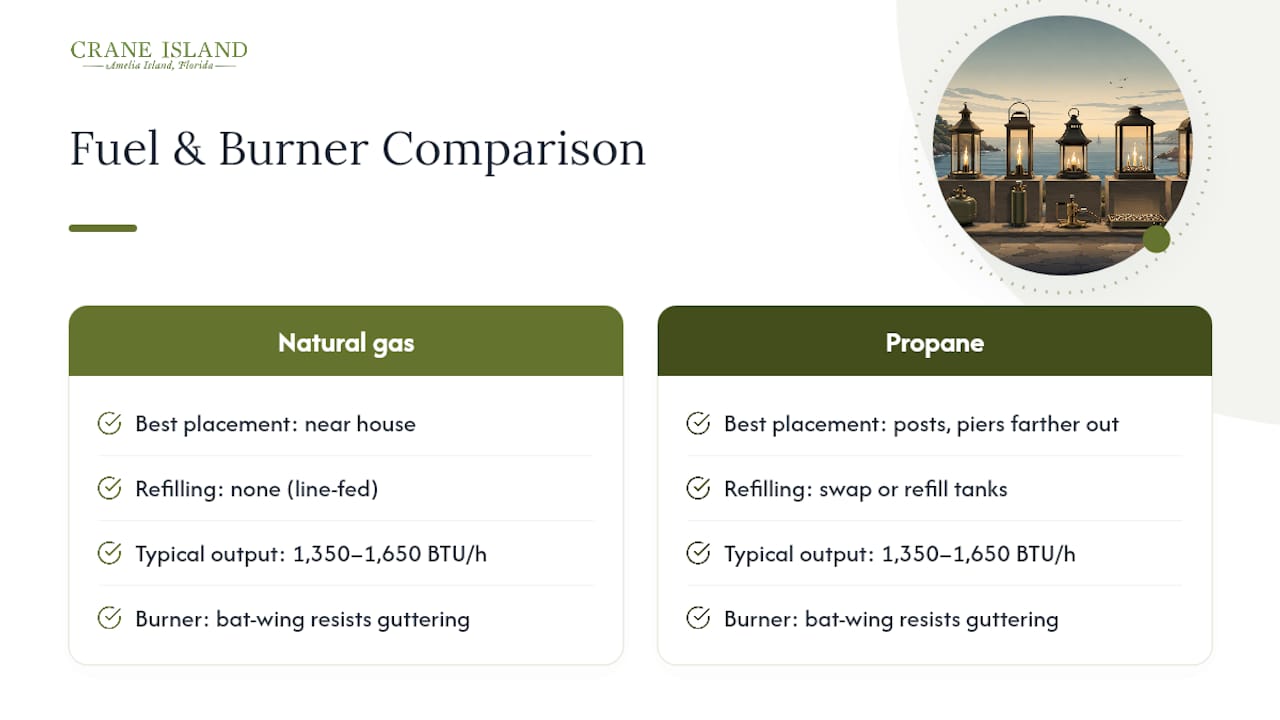
Natural gas makes sense when you already have a line running to the house; it never needs refilling and suits fixtures mounted near the structure. Propane gives you flexibility for posts and piers set farther out, at the cost of swapping or refilling tanks periodically.
Residential post lamps typically run in the 1,350 to 1,650 BTU per hour range, which produces a modest, steady flame rather than a bonfire. That output keeps fuel use low enough that many owners run their lanterns continuously without a meaningful cost concern. Bat-wing burners, the design Bevolo popularized, spread the flame across a wider, flatter shape that resists guttering in wind, an important spec for waterfront posts and open porches. Ignition options range from manual lighting to electronic ignition with a photocell or timer, letting the lanterns switch on at dusk automatically.
What Do Installation, Costs, and Maintenance Actually Involve?
Installation is not a do-it-yourself gas project. Hire a licensed plumber or gas fitter who can confirm your local code requirements, run or tap the line safely, and pressure-test the connection before the fixture is lit for the first time.
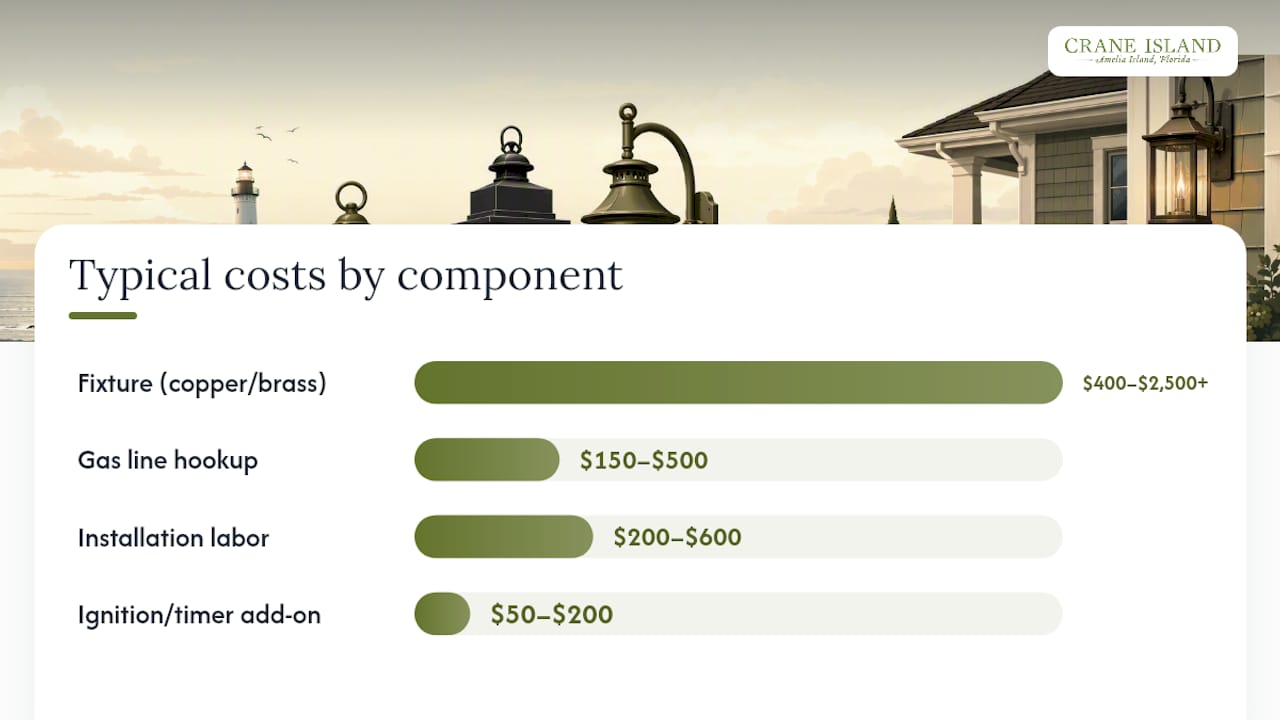
Costs break down across several line items, and it helps to see them separately rather than as one lump figure:
| Cost Component | Typical Range |
|---|---|
| Fixture (copper or brass) | $400 to $2,500+ |
| Gas line extension/hookup | $150 to $500 per fixture |
| Installation labor | $200 to $600 per fixture |
| Electronic ignition/timer add-on | $50 to $200 |
Maintenance is lighter than most owners expect, but it is not zero:
- Wipe glass panels a few times a year to keep soot from dulling the light.
- Have a technician inspect burner orifices and gas seals annually, especially before peak season.
- Leave copper patina alone; resist the urge to polish it back to a shine.
- Check propane connections and tank levels seasonally if you are not on natural gas.
On safety, exterior gas lanterns installed and serviced correctly carry a strong safety record, and the yellow-spectrum flame has the side benefit of attracting fewer insects than blue-spectrum electric bulbs. Many owners do leave lanterns burning continuously given the low BTU draw, though anyone smelling gas near a fixture should shut off the supply and call a professional immediately rather than troubleshoot it themselves.
How Do You Finalize a Model Before You Buy?
Before you call a vendor, settle six things in your own head: the fixture's application (entry, path, dock, pool), its wind and salt exposure, the scale needed for the space, your material preference, whether you want manual or electronic ignition, and your total budget across fixture plus installation.
- Confirm the burner model and its rated BTU output for your fixture size.
- Ask what warranty covers the burner versus the metal finish, since these are often separate.
- Ask about lead time, particularly for hand-hammered copper, which can run longer than stock aluminum.
- Request the exact mounting bracket specs so your installer can prep the site in advance.
- Get a written quote that separates fixture cost from labor and gas hookup.
A vendor who cannot answer the burner and warranty questions specifically is a red flag worth walking away from.
Pro Tip: Ask every finalist the same six questions in the same order. It is the fastest way to spot the vendor who actually knows their own product versus one reciting a sales script.
How We Think About Gas Lighting on Crane Island
A gas lantern's flicker does something an electric fixture cannot: it slows the evening down. That steady, warm light enhances the atmosphere of porch living, encouraging neighbors to gather outdoors as dusk settles over the marsh. Copper and brass fixtures suit Lowcountry architecture and salt air well, aging into a patina that belongs on houses meant to last generations. For more on how we think about outdoor spaces, our post on front porch living and our notes on dark sky outdoor lighting are worth a look.
— John Hillman
See These Lighting Ideas in a Real Coastal Community
Choosing a lantern is easier when you can picture it on an actual porch. Crane Island's homesites and completed homes show how copper and brass fixtures pair with Lowcountry architecture, marsh views, and the kind of outdoor living spaces designed for gathering at dusk.

Our interior and exterior design posts walk through how lighting, porches, and materials come together across the community's 14 homesites, and browsing them before you finalize your own fixtures can save you a redesign later. If you want to see how a porch, a path, and a dock light up together on real Amelia Island property, start with a look at Crane Island and reach out to arrange a design conversation or a visit to the community itself.
FAQ
Are Exterior Gas Lanterns Safe?
Yes, when installed by a licensed professional and serviced on a regular schedule; bat-wing burner design improves wind stability and the flame's yellow spectrum draws fewer insects than typical electric bulbs.
What Is the Best Outdoor Lantern for a Coastal Home?
A copper wall lantern at the entry and copper or aluminum post lanterns along paths generally hold up best near salt air, with aluminum trading some patina character for lower maintenance.
Do You Leave Gas Lanterns on All the Time?
Many owners do, since residential post lamps typically draw only 1,350 to 1,650 BTU per hour, and electronic ignition with a photocell or timer can automate the schedule if you prefer not to.
How Expensive Are Gas Lanterns?
Fixtures alone typically run from $400 for simpler aluminum or reproduction models to $2,500 or more for hand-hammered copper, with gas hookup and labor adding another $150 to $600 per fixture plus an electronic ignition or timer add-on costing up to $200, depending on line distance and site access.