
For true coastal exposure, choose aluminum, or a coastal-engineered Galvalume system with a PVDF or Tedlar finish, installed as standing seam with Type 316 stainless fasteners. Beachfront homes within roughly 300 feet of breaking surf need the most protective substrate and explicit coastal warranty language in writing. As the distance from the surf grows, standard coated steel and broader warranty terms become workable, but the specification always tightens the closer the home sits to salt water.
TL;DR:
- Aluminum roofing is recommended within 1,500 feet of saltwater due to its rust resistance and ability to re-passivate after scratches.
- Coastal-engineered steel systems like COASTALUME™ and Armored Coast provide similar protection at set distances of 300 feet or more from breaking surf.
- True PVDF coatings with 70% resin content and laminated Tedlar films offer the best color retention and chalk resistance in high-salt environments.
- Installing stainless steel fasteners, sealed flashings, and full-coverage underlayment significantly prolongs roof lifespan and protects warranties.
- Proper documentation, including test results and written setback guarantees, is essential to ensure warranty validity in coastal roofing projects.
Table of Contents
- Which Metal Is Best for a Coastal Roof?
- Coatings and Finishes: What the Paint Spec Actually Guarantees
- Which Roof Profile Holds Up Best Near the Water?
- The Hardware That Makes or Breaks a Coastal Roof
- What Warranties and Test Certifications Actually Mean
- What Does a Coastal Metal Roof Cost?
- How Do You Maintain a Coastal Metal Roof?
- Applying These Standards to a Custom Coastal Home
- Why Coastal Roof Specs Deserve More Scrutiny Than Curb Appeal
- Build Your Coastal Home With the Right Materials From the Start
- Sources
- FAQ
Which Metal Is Best for a Coastal Roof?
The material decision starts with one question: how far is the roof from breaking surf? That distance changes everything about which substrate will hold up and which warranty will actually pay out if it doesn't.
Aluminum remains the benchmark for immediate oceanfront exposure. It's non-ferrous, so it won't rust the way steel can, and if a panel gets scratched down to bare metal, it simply forms a new oxide layer rather than corroding. Industry guidance recommends aluminum for homes within about 1,500 feet of saltwater, where salt fog is heaviest and relentless. Panels typically run .032 to .040 inches thick for standing seam applications; thicker gauges cost more but resist oil-canning and denting in wind-driven debris events.
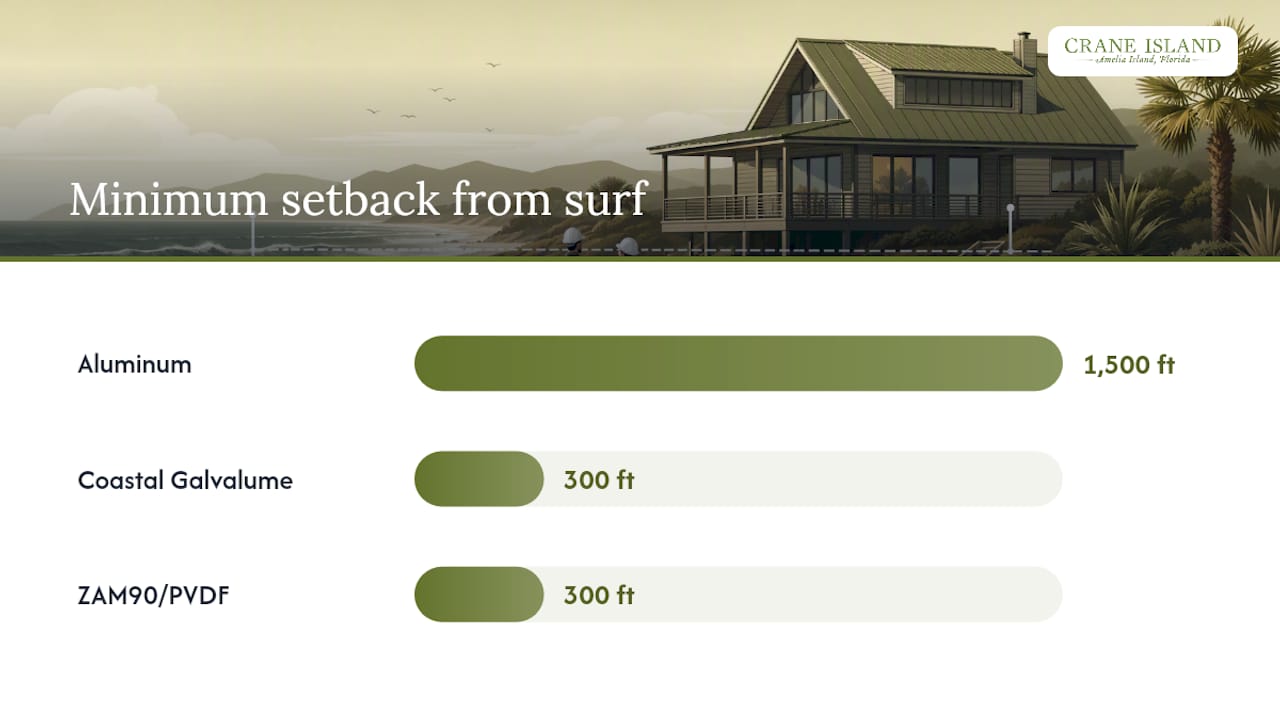
Galvalume with a PVDF or Tedlar finish works well once you're set back further inland, and coastal-engineered versions have pushed that boundary closer to the water than older products could. COASTALUME™, made by U. S. Steel, pairs a Galvalume substrate with DuPont Tedlar PVF film and carries warranty coverage as close as 300 feet from breaking surf, with substrate protection running up to 25 years and finish protection up to 50 years on some product lines.
Armored Coast, from RPS Metal Roofing, takes a different substrate route with ZAM90 and a baked-on PVDF finish. It offers warranty coverage down to 300 feet from breaking surf and zero setback from brackish inland water, which makes it a strong option for waterfront lots along tidal creeks and marsh estuaries where standard steel would fail fast.
Stainless steel and zinc sit at the far end of the cost spectrum. Both resist salt corrosion exceptionally well and can outlast the house itself, but the price premium usually only makes sense for architecturally significant roof sections rather than full coverage.
A rough exposure checklist for narrowing your options:
- Under 300 feet from breaking surf: aluminum or a coastal-engineered steel system rated for that setback, like COASTALUME™ or Armored Coast.
- 300 to 1,500 feet: aluminum remains ideal; coastal-engineered Galvalume is a strong, often more budget-friendly alternative.
- Beyond 1,500 feet: standard Galvalume with a true PVDF finish typically performs well and costs less.
- Brackish inland waterways: verify the manufacturer's specific setback language. Armored Coast's zero-setback claim for brackish water is a notable exception worth confirming in writing.
Coatings and Finishes: What the Paint Spec Actually Guarantees
Not all "PVDF" coatings are equal, and the difference lives in the resin percentage. Anything lower is a blended coating that chalks and fades faster in coastal UV exposure.
A true 70% PVDF finish can hold color for 30 to 40 years in full Gulf Coast sun, according to coastal roofing guidance, while lesser blends visibly chalk within a decade near the water.
Tedlar PVF film, used on COASTALUME™, works differently than a sprayed-on paint. It's a laminated film bonded to the steel surface, and it resists the surface chalking that plagues painted panels in high-humidity, high-salt air. Maintenance stays minimal: an occasional rinse rather than repainting.
When you read a manufacturer's warranty, separate two numbers that get conflated constantly:
- Substrate warranty covers the base metal against perforation from rust or corrosion, typically 20 to 25 years for coastal-grade steel.
- Finish warranty covers chalk, fade, and color retention, often stated separately and sometimes running longer than the substrate coverage.
Ask specifically what voids either warranty. Many coastal clauses exclude damage from standing salt deposits that were never rinsed off, so document your maintenance.
Which Roof Profile Holds Up Best Near the Water?
Panel profile determines how well a roof manages thermal movement, wind uplift, and the thousands of small openings where salt-laden moisture can work its way in.
- Standing seam is the profile most coastal specifications default to, and for good reason. The fasteners hide beneath interlocking seams rather than punching through the panel face, which removes the single biggest source of coastal leaks and rust streaking. Standing seam also handles the expansion and contraction of Florida and Gulf Coast heat swings without stressing the fastener points, and certified assemblies routinely carry high wind uplift ratings.
- Exposed-fastener panels cost less upfront but leave every screw head exposed to salt spray and UV. Each one is a potential leak point once the rubber washer degrades. If budget forces this choice, insist on Type 316 stainless screws with EPDM washers and a maintenance plan that includes annual fastener checks.
- Stone-coated metal tiles layer a steel or aluminum core under stone granules and an acrylic top coat, giving a tile or shake appearance with metal's structural backbone. Coastal specifications should call for AZ150 to AZ200 Galvalume coating weights, pushing toward the higher end for lots facing direct surf exposure.
Panel gauge matters less than seam geometry and coating quality. A thicker panel with a poor coating spec will still fail early; a properly coated, correctly fastened panel at standard gauge often outperforms it.
The Hardware That Makes or Breaks a Coastal Roof
Panel choice gets most of the attention, but specification discipline around fasteners, flashing, and underlayment often matters more than small gauge differences for how long a coastal roof actually lasts.
- Fasteners: require Type 316 stainless steel at every exposed location. Type 304 stainless can be acceptable for interior or sheltered attachment points, but never in direct salt spray zones.
- Flashing: specify stainless steel or AZ150+ Galvalume flashing, never bare galvanized. Factory-formed and sealed closures beat field-cut pieces every time.
- Underlayment: full-coverage, self-adhering synthetic underlayment gives a second line of defense if wind-driven rain ever gets under a panel edge.
- Cut edges: every field-cut panel edge needs touch-up coating or edge sealant, since bare cut steel corrodes fastest at exposed edges.
- Documentation: require the installer to photograph fastener patterns and flashing details before panels close them in, for warranty claims later.
Pro Tip: Ask your installer to save cut-edge and fastener photos in a shared folder tied to the project address. If a corrosion claim ever comes up, dated photo documentation is often the deciding factor in whether a manufacturer honors the warranty.
What Warranties and Test Certifications Actually Mean
A warranty is only as good as the exposure conditions it's written for, and manufacturers vary widely on where their coverage starts and stops.
Salt spray resistance gets measured through ASTM B117 and cyclic corrosion testing under ASTM G85, which simulate long-term salt exposure in accelerated lab conditions. Wind performance gets verified through Miami-Dade County's Notice of Acceptance (NOA) program and FM 4473 approval, both of which test full assemblies rather than just the panel material.
Before signing a contract, request:
- Copies of ASTM B117/G85 test results for the specific coating system, not just the base metal
- Miami-Dade NOA or FM 4473 documentation for the exact panel profile and fastening pattern being installed
- The precise coastal setback distance in the written warranty, since terms like "300 feet from breaking surf" versus a 1,500-foot exclusion zone can mean the difference between a covered claim and a denied one
- Written confirmation of what maintenance actions are required to keep the warranty active
What Does a Coastal Metal Roof Cost?
Installed pricing varies by material, profile, and how demanding the local wind code is, but a few patterns hold across coastal markets.
Standing seam aluminum typically sits at the premium end of the metal roofing spectrum, reflecting both material cost and the labor skill standing seam installation requires. Coastal-engineered steel systems like COASTALUME™ or Armored Coast usually price below aluminum while still qualifying for tight coastal warranty setbacks. Stone-coated metal tile often lands in a comparable middle range, depending on coating weight and fastener spec.
The specs that add the most cost are Type 316 stainless fasteners over standard alternatives, true PVDF or Tedlar finishes over base coatings, and Miami-Dade NOA-approved assemblies over uncertified ones.
Those same specs are frequently what qualify a home for wind mitigation insurance credits, which can offset a meaningful share of the premium over a policy's lifetime. A short prioritization order for a limited budget:
- Fasteners and flashing first. They're the cheapest line item and the most common failure point.
- Coating quality second. A true PVDF or Tedlar finish costs more upfront but delays repainting for decades.
- Certifications third. NOA and FM approval add cost but often unlock insurance savings that repay the difference.
How Do You Maintain a Coastal Metal Roof?
Coastal roofs need more attention than inland installations, but the routine is straightforward if you keep to a schedule.
- Inspect twice a year and after any named storm, checking fastener heads, flashing seals, and any exposed cut edges for early rust bloom.
- Treat small damage immediately. A scratch or exposed fastener left untreated becomes a corrosion point within months in heavy salt air.
- Rinse according to warranty terms, since some manufacturers specify rinse frequency as a condition of coverage, particularly in areas with heavy salt fog or limited rainfall.
- Document every maintenance action with dated photos, since warranty claims on coastal roofs frequently hinge on proof of upkeep.
Most premature coastal roof failures trace back to two causes: an under-specified fastener or flashing material, or an installer unfamiliar with coastal detailing shortcuts that work fine inland but fail at the coast.
Pro Tip: Keep a simple spreadsheet logging inspection dates, photos, and any repairs. It costs nothing and becomes your best evidence if you ever need to file a warranty claim years down the road.
Applying These Standards to a Custom Coastal Home
At Craneisland, we think about roofing the same way we think about every material choice on Amelia Island: it has to honor the setting and hold up to it. Salt fog off the Intracoastal Waterway and the exposure that comes with barrier island living reward the same discipline this article outlines. That's why we favor coastal-engineered standing seam systems, marine-grade fastener specs, and warranty language that names its setback distance rather than leaving it vague.
For a custom build on a homesite like those at Crane Island, we advise buyers to request the same documentation covered above from any builder: ASTM test data, NOA or FM approval for the exact assembly, and written coastal warranty terms. Projects like 53 Cord Grass Court show how these specifications translate into a finished Lowcountry home built to last.
Why Coastal Roof Specs Deserve More Scrutiny Than Curb Appeal
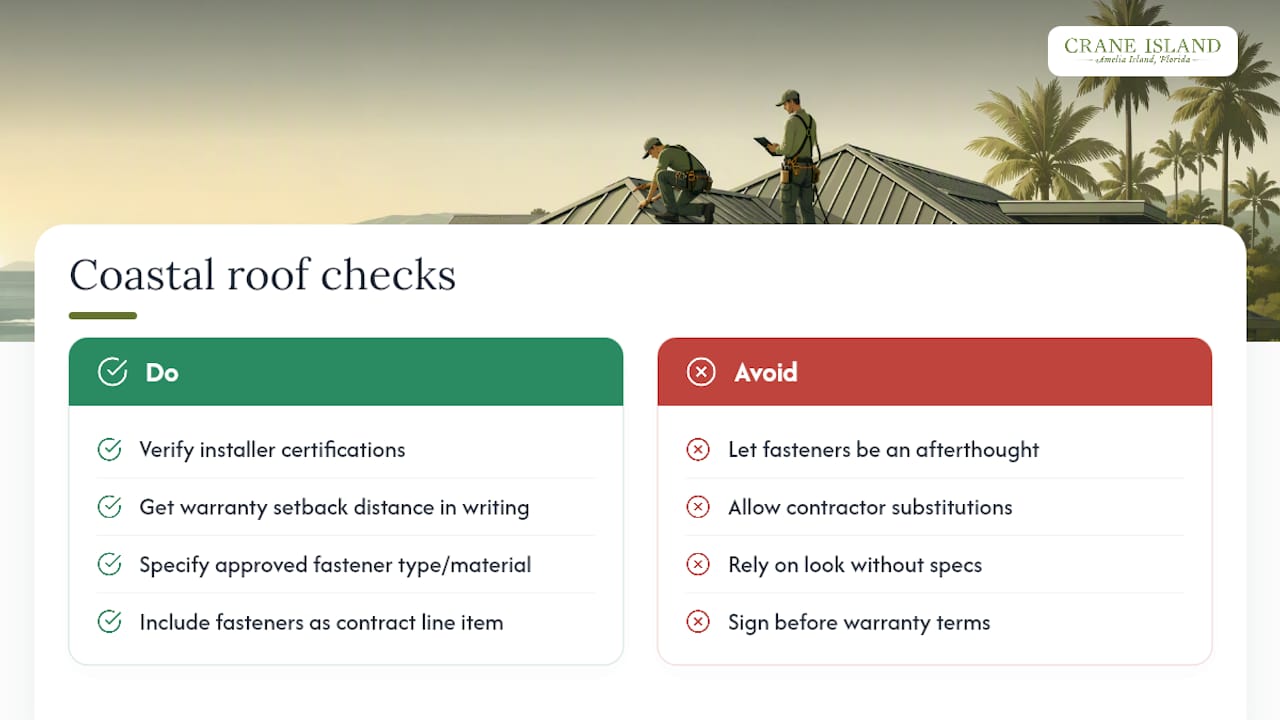
A roof that looks right in the rendering can still fail in eight years if the fastener spec was an afterthought. I've seen coastal projects where the panel material was chosen carefully, then undermined by a contractor who substituted standard fasteners to save a line item. The panel held; the screws didn't, and streaking rust told the whole story within two summers.
The lesson isn't complicated: verify installer certifications and get the warranty setback distance in writing before signing anything.
— John Hillman
Build Your Coastal Home With the Right Materials From the Start
The homesites are designed from the ground up with Lowcountry architecture and materials suited to marsh, waterway, and salt-air exposure, so the roofing conversation happens at the design table, not after a leak.
Our team works directly with buyers on material specification for custom builds, from panel profile through fastener metallurgy, alongside partners like Bayfair Custom Homes on hurricane-resilient construction standards. If you're weighing a custom homesite on Amelia Island, explore Crane Island's coastal living guide and reach out to the team to start a specification conversation for your build.
Sources
- COASTALUME™ coastal steel — U. S. Steel
- Armored Coast — RPS Metal Roofing
- Metal roofing on coastal homes | Gulf Coast Metal Roof Guide
- Stone coated metal roof for coastal homes — SKW Roof
FAQ
What Type of Metal Roof Is Best for Coastal Areas?
Aluminum performs best within about 1,500 feet of breaking surf because it's non-ferrous and re-passivates when scratched. Coastal-engineered steel systems like COASTALUME™ or Armored Coast are strong alternatives where their warranty setback distances match your site.
What Type of Roof Is Best for Coastal Areas Overall?
Standing seam metal roofing generally outperforms shingles, tile, and exposed-fastener metal in coastal zones because it conceals fasteners, manages thermal movement, and carries the highest wind uplift ratings among common roofing types.
What Is the 25% Rule for Roofing?
Check with your local building department, since coastal jurisdictions often apply stricter versions of this rule.
How Much Does a 2,000-Square-Foot Metal Roof Cost?
Pricing depends heavily on material and profile choice. Aluminum standing seam sits at the premium end, while coastal-engineered steel systems and stone-coated metal tile often price lower while still meeting tight coastal warranty setbacks. Get itemized quotes that separate fastener, flashing, and coating costs so you can see exactly where the budget goes.
Does Craneisland Build With Coastal-Grade Metal Roofing?
Craneisland's custom homes on Amelia Island are designed with materials suited to marsh and waterway exposure, and the team advises buyers on coastal roofing specifications, including fastener metallurgy and warranty setback terms, as part of the custom build process.