
A metal roof suits a coastal home when the whole assembly is chosen for salt and wind, not just the panel. That means aluminum or another corrosion-resistant metal, fasteners and flashing in a compatible metal, and an installation rated for your local wind zone. Get those three right and the roof can outlast the mortgage. Get one wrong and a 50-year roof can fail in a decade.
This guide is for owners and future owners of a coastal custom home, the kind of buyer who is weighing a build on the water and wants the roof settled well before the framing goes up. We cover materials, coatings, fasteners, wind, upkeep and cost, and where the details tend to go wrong.
TL;DR
- Near salt water, aluminum is the practical choice; bare or standard painted galvalume steel can corrode at cut edges and fastener holes.
- Fasteners, flashing, drip edge and gutters fail long before panels do, so specify them as one compatible set.
- Standing seam with concealed fasteners and a wind rating for your zone is the stronger coastal assembly.
- Expect roughly $10 to $32 per square foot installed depending on metal, region and roof complexity, with coastal upgrades adding to it.
- Rinse the roof with fresh water a few times a year and inspect it after every major storm.
Table of Contents
- Why salt air changes the roofing question
- Choosing the metal: aluminum, galvalume, zinc, copper
- Finishes and coatings
- Fasteners and flashing: where coastal roofs actually fail
- Wind: standing seam, attachment and ratings
- What a coastal metal roof costs
- Keeping a metal roof healthy near the water
- A metal roof as part of the architecture
- Build on Amelia Island with the roof settled early
- FAQ
- Sources
Why salt air changes the roofing question
Inland, a metal roof is a simple, durable choice. The Building America Solution Center, a federal building science resource, describes metal roofs as durable and low-maintenance, lasting up to 50 years or more, with steel, aluminum and copper the common materials. The same guide adds the coastal conditions: choose corrosion-resistant material, install flashing and drainage so water never ponds, and match screws and accessories to the panel so two metals never set up galvanic corrosion.
Galvanic corrosion is the quiet culprit. When two dissimilar metals touch and salt moisture bridges them, one metal sacrifices itself to the other, much like a small battery. One coastal design writer puts it plainly: dissimilar metals plus salt water build a small battery that eats one of them, which is why fasteners, flashing and gutters should be chosen together rather than by different trades at different times.
Salt also finds the small parts first. The same source notes that salt air attacks fasteners first because they are small and hold everything else on, and that flashings, drip edge and vents are often picked for price rather than exposure.
Choosing the metal: aluminum, galvalume, zinc, copper
The panel material is the decision most buyers think about first, and the evidence points the same way across professional sources.
Aluminum. The National Roofing Contractors Association's industry group for coastal guidance, NRCIA, calls aluminum the practical coastal metal because it resists corrosion in salt air. Its technical adviser notes that salt air attacks steel on a timescale of years rather than decades. A trade magazine feature on coastal roofing quotes a manufacturer's product manager saying that .040 or .050 inch aluminum is typically the go-to on the coast, with stainless steel and zinc also strong but more expensive, and galvanized steel liable to corrode rapidly in salt spray.
Why aluminum behaves differently: it is non-ferrous and forms its own protective oxide layer, while galvalume is steel that depends on its coating to protect the core. Once a coating is scratched or cut, steel has nothing of its own to fall back on.
Galvalume. Aluminum-zinc coated steel has been common in modern roofing since the late 1970s, according to the Roof Coatings Manufacturers Association, which also notes that top coatings eventually deteriorate and may need recoating. It is a sound roof in many places. On barrier-island and oceanfront lots, coastal roofers report accelerated corrosion at cut edges and fastener holes within 5 to 10 years in chloride-rich air.
Copper. Copper carries a commonly cited service life of 80 to 100 years or more and weathers to a green patina. It suits owners who want that look as part of the architecture, usually on porch roofs, dormers or accents.
The warranty distance test
Before falling in love with a profile, check where your lot sits. Manufacturers commonly exclude galvalume warranties within 1,500 feet of breaking surf, 800 feet of a large saltwater bay and 400 feet of a salt marsh or canal, and stricter limits reach 2,800, 1,200 and 600 feet. A home on a marsh edge or tidal creek can fall inside those distances even when the ocean is miles away. Read the actual warranty for your chosen product and measure from your own site plan.

Finishes and coatings
Paint is a second layer of protection, and it ages. A field guide from a Florida metal supplier compares PVDF finishes with SMP finishes and finds that PVDF holds color and film integrity longer in harsh sun and salt. Its material-only coastal ranges give a sense of the ladder:
| Material and finish | Material cost per sq ft |
|---|---|
| Bare galvalume | about $2.50 to $4.50 |
| Painted steel, SMP | about $3.00 to $5.50 |
| Painted steel, PVDF | about $4.00 to $7.00 |
| Bare or painted aluminum | about $4.50 to $8.50 |
| PVDF-painted aluminum | about $6.00 to $10.00 |
These are material-only figures from one supplier's guide, so treat them as a way to compare the options rather than a quote. Installed prices run much higher, as the cost section below shows.
Coatings also have to flex. The RMCA notes that elongation and recovery are critical coating properties because panels expand and contract with temperature, which is one more reason to ask for a finish system designed for the metal and the climate rather than a generic paint.
Fasteners and flashing: where coastal roofs actually fail
If you remember one thing from this guide, make it this. NRCIA reports that fasteners and flashings fail long before the panels do, and a panel rated for 40 to 70 years may sit on an underlayment that commonly needs replacement at 20 to 30 years.
FEMA reached the same conclusion from storm damage. Its Technical Bulletin 8 reports that post-disaster assessments show structural failures frequently occur at connections rather than framing members, and that corroded connectors and fasteners in coastal areas have contributed to loss of the load path. FEMA also recommends stainless steel fasteners over hot-dipped galvanized, with less maintenance and replacement over time.
A practical fastener-and-flashing checklist for your builder:
- Stainless or otherwise coastal-rated fasteners, clips and washers, matched to the panel metal.
- Drip edge, flashing, vents and gutters in the same or a compatible metal, not whatever is on the truck.
- Flashing and drainage that shed water rather than hold it against a seam or a wall.
- A written spec that names all of the above, so substitutions are visible.
The 2025 FORTIFIED Home Standard from the Insurance Institute for Business and Home Safety, a voluntary program, shows how specific this gets: new minimum 26-gauge corrosion-resistant metal drip edge fastened at 4 inches on center, all-new flashing at every roof interruption, and metal cap nails where design wind speeds reach 170 mph or more.
Wind: standing seam, attachment and ratings
Profile matters as much as metal. Exposed-fastener panels, the ones with screws through the face, can leak at their attachment points, and one Carolina roofing firm cautions that they need ongoing inspection on primary coastal residences because salt air is hard on fasteners and washers. The same firm says aluminum standing seam is often a better first choice for highly exposed oceanfront homes.
Standing seam hides its fasteners under the seam and can act as a structural covering. A coastal roofing feature reports that increasing attachment frequency or gauge, narrowing the panels, or adding external clamps can raise wind resistance up to three-fold.
Failure mode is worth knowing. A roof rarely lifts in the middle of a field. As one coastal design writer explains, it lets go at an edge and then unzips, so edge metal, clip spacing and eave detailing deserve as much attention as the panel.

The code floor depends on where you build. The Building America guide notes that the International Residential Code's coastal high-wind areas are the Atlantic and Gulf coasts with design wind velocity above 115 mph. In Florida's Miami-Dade, one roofing firm reports that product approval requires wind uplift ratings of 180 to 240 psf, and a Charleston, South Carolina firm says that county's high-wind zone calls for roofing rated at 130 mph or higher. Your local building department and your architect set the exact number for your lot.
The insurance angle is worth a conversation too. Our guides on wind mitigation in Florida and securing coastal Florida property insurance walk through how roof details can show up in a premium. A South Carolina roofer's guide reports that FORTIFIED-grade work may qualify for up to a 35% premium discount, though discounts vary by state and insurer.
What a coastal metal roof costs
Prices vary by region, metal and roof shape, so read these as published ranges for their place and year, not a quote.
- Nationally, Angi's 2026 data from 4,408 verified projects puts the average metal roof at $11,769, with most homeowners paying $6,043 to $18,345 and prices of $4 to $30 per square foot.
- In Virginia Beach, a metal roof typically runs $11.50 to $18.50 per square foot installed.
- On the coast of South Carolina, one roofer reports standing seam at $10 to $18 per square foot, up to about $30 for premium metal or complex geometry.
- In Palm Beach County, Florida, a 2026 guide prices standing-seam aluminum, the spec it describes as required within a mile of the waterline, at $22 to $32 per square foot installed, with an aluminum premium of 20 to 30% over galvalume.
What moves the number: metal type, panel profile, roof shape and complexity, tear-off and deck repair, and coastal upgrades such as stainless fasteners, upgraded underlayment and tighter clip spacing. A coastal installer lists FORTIFIED roof upgrades at roughly $1,000 to $3,000 plus $275 to $600 in evaluation fees.
The longer view favors the investment. Metal roofs commonly last 40 to 70 years, against 15 to 25 for architectural asphalt shingles. On a custom home with a complicated roofline, dormers and porch roofs, the roof is a fixed cost best settled during design, when it is a line in the drawings rather than a change order.
Keeping a metal roof healthy near the water
Metal roofs are low-maintenance, not no-maintenance. A Florida supplier's guide recommends rinsing roof surfaces and gutters with fresh water every 3 to 6 months in heavy salt exposure, and at least twice a year elsewhere near the coast, using mild soap and soft brushes. The same guide says to call a professional for widespread coating bubbles, active leaks, loose panels, fasteners backing out or growing pitting.
FEMA advises inspecting every part of the home at least once a year and after high-wind events, including a check for fastener corrosion. A simple annual routine:
- Rinse panels, valleys and gutters with fresh water; avoid pressure that forces water under laps.
- Look for rust staining at fasteners, cut edges and flashing.
- Check that trim and sealants are intact and nothing is lifting at the edges.
- Clear leaves and debris that hold moisture against the metal.
- Repeat after any named storm.
One more design note: metal can sound louder in heavy rain if the assembly isn't designed well, a point a South Carolina roofer raises as a reason to plan the full assembly before work begins. Decking and insulation choices handle that, and they are easier to specify in a new build than to retrofit.
The same logic applies to every exposed metal on a coastal lot, from gates to railings. Corrosion-resistant coatings matter on weather-resistant fencing just as they do overhead, so it pays to write one exterior-metals spec for the whole property.
A metal roof as part of the architecture
A roof is also the largest visible surface of a house. On a Lowcountry-inspired home, the roof shapes the silhouette: deep eaves, shed roofs over porches, a crisp ridge against the marsh. Our piece on Lowcountry architecture features for heat and flooding shows how form and climate work together, and our coastal metal roof specifications guide goes deeper on the details for owners and builders. If you are thinking about the broader design team, see how coastal architects design on Amelia Island.
Porches matter here as well. Porch roofs take the same salt and wind as the main roof and frame the view from the rocking chair, which is why we treat them as part of the roof plan, not an afterthought. Our front porch living guide explains the lifestyle behind them.
Our view: build the roof into the story of the land
We believe a coastal home should be woven into its setting, and the roof is where that starts. Salt, wind and sun are not obstacles to hide from. They are the conditions the house is designed to live with for generations.
That is why we think the roof belongs in the first conversation with your architect, not the last. On Crane Island, homes are designed by acclaimed architects within architectural standards inspired by Lowcountry tradition, and nearly half the island is preserved as open space, so the marsh and the forest are never far from your eaves. A roof chosen with care, in a metal that suits the air, with details specified as a set, lets the porch stay a true living room year after year.
We also believe in building for legacy. A material that can serve for decades, quietly, is part of what makes a custom home feel timeless.
John Hillman
Build on Amelia Island with the roof settled early
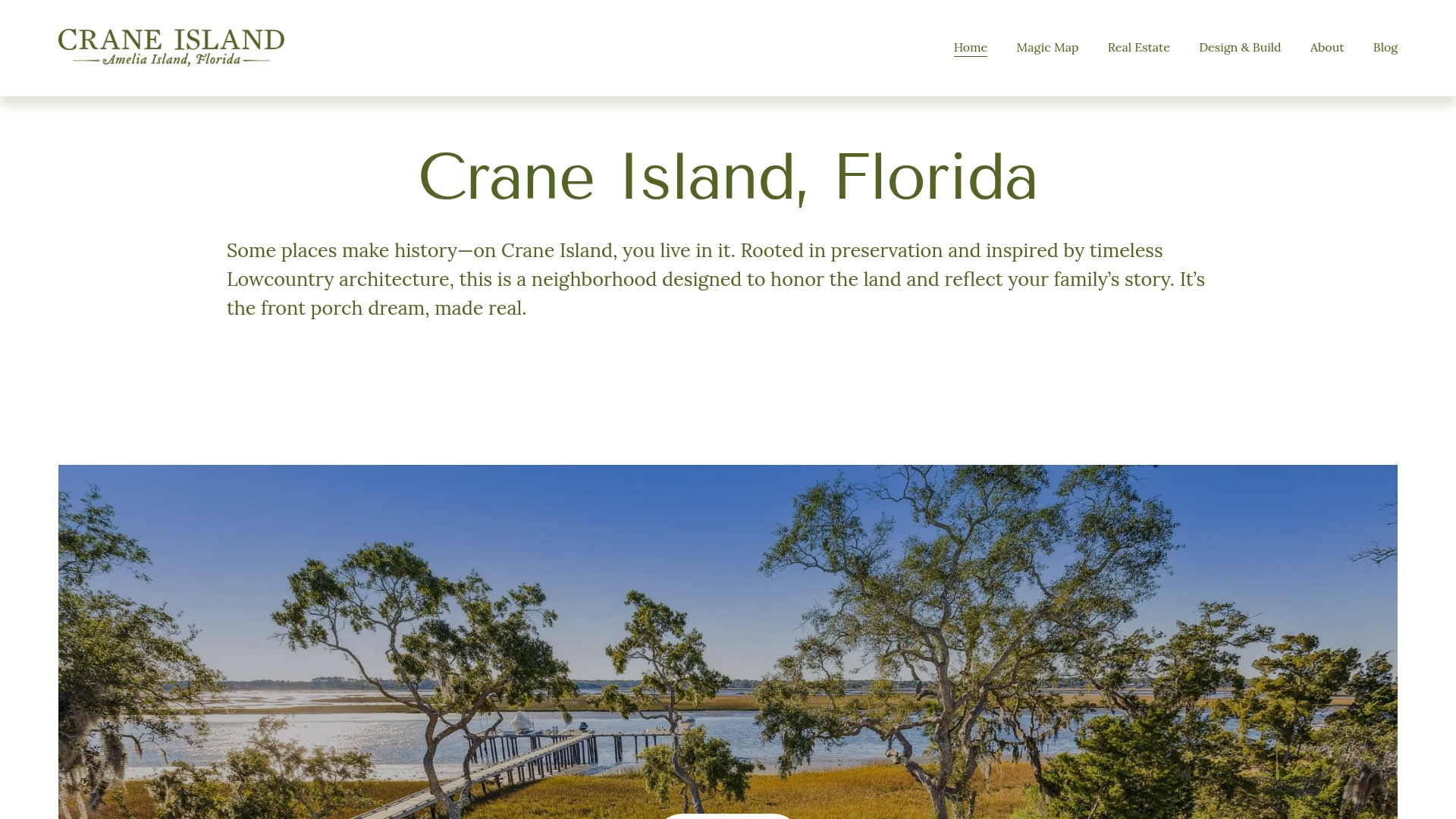
If you are planning a coastal custom home, Crane Island offers homesites and move-in ready homes in a private, preserved Lowcountry-inspired community on Amelia Island, with deep-water Intracoastal access and only 14 homesites available. Buyers who want a ready design path can also explore The Crane Island Portfolio Homes Program.
Every decision in this guide, from metal to fasteners to wind rating, is easiest to make before construction begins. Reach out through our site and we will be glad to talk through the island, the homesites and the way we approach building on the water.
FAQ
What is the best metal roof for a coastal home?
For homes with significant salt exposure, aluminum standing seam is widely recommended because aluminum naturally resists rust. Stainless steel, zinc and copper also perform well but cost more or look different. Whatever the panel, pair it with fasteners and flashing in a compatible metal.
How long does a coastal metal roof last?
The federal Building America guide says metal roofs can last 50 years or more, and professional sources cite 40 to 70 years for panels. Underlayment may need replacing at 20 to 30 years, and fasteners and flashings can fail sooner, so annual inspections are what keep the roof on schedule.
Do metal roofs hold up in hurricanes?
A properly engineered standing-seam roof can be a structural covering built for extreme wind forces, and attachment, gauge and panel width all change its resistance. Edges and connections are where roofs usually fail, so the installation detail and the rating for your wind zone matter as much as the metal.
Are metal roofs noisy in the rain?
They can be if the assembly isn't designed well, but decking, underlayment and insulation are chosen to manage sound. Planning the full roof assembly during design, rather than swapping materials later, is how builders avoid the issue.
How much does a metal roof cost near the coast?
Published 2026 ranges run from about $10 to $18 per square foot for standing seam in coastal South Carolina to $22 to $32 for aluminum standing seam in Palm Beach County, Florida. Metal, roof complexity and coastal upgrades drive the difference. Ask your builder for a line-item estimate on your own plans.
Sources
- Metal Roofs, Building America Solution Center
- Choosing the Right Metal Roof System for Your Home, NRCIA
- Coatings Tech Note 5, Metal Roofing, Roof Coatings Manufacturers Association
- Metal Roofing by the Sea, Metal Roofing Magazine
- Corrosion Protection for Metal Connectors and Fasteners in Coastal Areas, FEMA Technical Bulletin 8
- Code-Based Wind-Resistant Roofing for Homes, FEMA
- 2025 FORTIFIED Home Standard
- Roofs and exteriors near the water
- Galvalume vs Aluminum Roofing
- Metal Roof Cost in Palm Beach County 2026
- Metal Roofing Virginia Beach: Worth It for Coastal Homes?
- Best Roof Materials for Coastal Homes Explained
- Metal Roof Corrosion in Coastal Florida
- Coastal Roofing in Charleston: What Materials Last
- Coastal Roofing Materials Guide for South Carolina
- Asphalt vs. Metal vs. Solar Roofing for Coastal South Carolina
- How Much Does a Metal Roof Cost? Angi
- Oceanfront Aluminum Roofing in NC
- Metal Roof Cost 2026
- Advantages of weather-resistant fencing for your property