
A placemaking community, as we use the term here, is a luxury residential neighborhood designed from the ground up to create a strong, lasting sense of place through architect-led design, porch-first living, preserved coastal landscapes, and shared outdoor life. It is not a subdivision with amenities bolted on. It is a neighborhood where every home, path, and preserved oak grove works together to shape how neighbors actually live.
Three things matter most for buyers evaluating these communities on Amelia Island:
- Design controls are legally binding. Recorded covenants and an active Architectural Review Board (ARB) protect the neighborhood's character long after the last home is built.
- Preservation is documented, not promised. Conservation easements, marsh buffers, and canopy protections should appear in recorded plats and title documents, not just marketing materials.
- Limited inventory is a feature, not a sales tactic. Scarcity on a barrier island like Amelia Island is real, and it drives long-term value.
This guide walks you through every stage of evaluating, buying, and building in a community like Crane Island, where Lowcountry architecture, preserved marshlands, and porch culture come together on Florida's northeastern coast.
Key Takeaways
Placemaking communities built on recorded design controls, preserved landscapes, and limited inventory consistently outperform unprotected coastal neighborhoods on both lifestyle quality and long-term resale value.
| Point | Details |
|---|---|
| Design controls must be recorded | Verify covenants and ARB guidelines in county deed records, not just marketing materials. |
| Preservation requires documentation | A conservation easement held by a third-party land trust is the strongest protection for canopy and marsh buffers. |
| Limited inventory drives scarcity value | A fixed homesite count in the recorded plat is a genuine investment signal on a barrier island. |
| Timelines vary by pathway | Custom builds on Amelia Island involve a multi-month process from site selection to occupancy; move-in-ready homes generally close within a few months. |
| Craneisland exemplifies the model | Crane Island offers fixed-inventory homesites and completed homes with documented ARB oversight, preserved canopy, and Intracoastal access. |
Table of Contents
- What makes a placemaking community feel like a real place?
- Why do affluent buyers and investors choose these communities on Amelia Island?
- How do you evaluate a placemaking community before making an offer?
- What does the buying process actually look like — homesite vs. move-in ready?
- What design controls and environmental protections should you verify?
- What does daily life actually look like in a community like this?
- Crane Island: what a luxury coastal placemaking community looks like in practice
- What we believe about placemaking and why it matters for your decision
- Schedule a private tour of Crane Island
- Sources
- FAQ
What makes a placemaking community feel like a real place?
The difference between a neighborhood that feels alive and one that feels like a real estate product comes down to a handful of deliberate design decisions, each reinforcing the others.
Architectural language and human scale are the foundation. Lowcountry proportions, deep wraparound porches, elevated first floors, and natural materials like cypress and tabby create homes that feel rooted in their setting. Porches are not decorative; they function as true living rooms that face the street, the green, or the marsh, drawing neighbors into daily contact.
Preserved landscape gives a community its soul. Maritime oak canopy, dune and marsh buffers, and native plant palettes do more than look beautiful. They filter stormwater, protect wildlife corridors, and ensure that the views buyers paid for remain intact. You can read more about how nature and design shape luxury communities in communities built on these principles.
Shared outdoor rooms complete the picture: central greens, a River House or commons, walkable paths that connect homes to water. These are the spaces where walkable coastal community principles translate into daily neighbor interactions.
Regulatory tools lock in quality over time. Recorded covenants, ARB charters, and design guidelines are what prevent a future owner from replacing a Lowcountry cottage with something incompatible. Without them, every design decision made today is reversible.
Pro Tip: Ask to see the recorded covenants and ARB design guidelines before you tour. If a community cannot produce them on request, that gap is itself a red flag.
Why do affluent buyers and investors choose these communities on Amelia Island?
The lifestyle case is straightforward. Porch-first design creates a social rhythm that feels unhurried and intentional. Privacy and proximity coexist because the community is small and the lots are generous, but the shared spaces draw people together on their own terms.
The investment case is equally clear. Limited supply on Amelia Island's barrier island geography amplifies scarcity value, and buyers trade higher insurance and carrying costs for the premium attached to rare waterfront or preserved-canopy homesites. Design controls protect against incompatible infill, which is one of the most common destroyers of resale value in coastal markets. The Amelia Island luxury market splits across oceanfront estates, golf-community residences, and amenity-rich condos, with seasonal demand strongest from late fall through early spring.
For investors specifically, rental rules matter as much as list price. Communities with strong placemaking commitments typically restrict short-term rentals to preserve the quiet, neighborly character that makes them desirable. Confirm the rental policy in the recorded documents before assuming any income potential.
How do you evaluate a placemaking community before making an offer?
A thorough site visit and a few direct questions will tell you more than any brochure. Work through this list before you commit.
Questions to ask
- Are the covenants and ARB design guidelines recorded in the county deed records?
- What is the ARB's review timeline, and what triggers a mandatory resubmission?
- Is there a recorded conservation easement or deed restriction protecting canopy, marsh, and dune buffers?
- What are the permitted uses, and does the community allow short-term rentals?
- What is the HOA's current reserve fund balance, and when was it last audited?
- Are there any open-ended expansion clauses that could allow future development within the preserved areas?
Red flags that should pause a purchase
- Covenants that exist only in marketing materials, not in recorded plats
- Vague or unrecorded conservation commitments
- Expansion rights that allow the developer to add homesites to currently preserved land
- An ARB with no published charter or appeal procedure
Trust signals worth confirming
- A documented conservation easement held by a third-party land trust
- Named architect credentials and a recorded master plan
- A limited homesite count that is fixed in the plat
- A roster of pre-approved builders with documented ARB experience
Micro-location on Amelia Island drives value in ways that are easy to miss. Confirm jurisdiction (City of Fernandina Beach vs. Nassau County), FEMA flood zone designation, and whether any portion of the site falls within a Coastal Construction Control Line (CCCL) setback before you engage an architect.
What does the buying process actually look like — homesite vs. move-in ready?
Two clear pathways exist, and they carry different timelines, financing structures, and risk profiles.
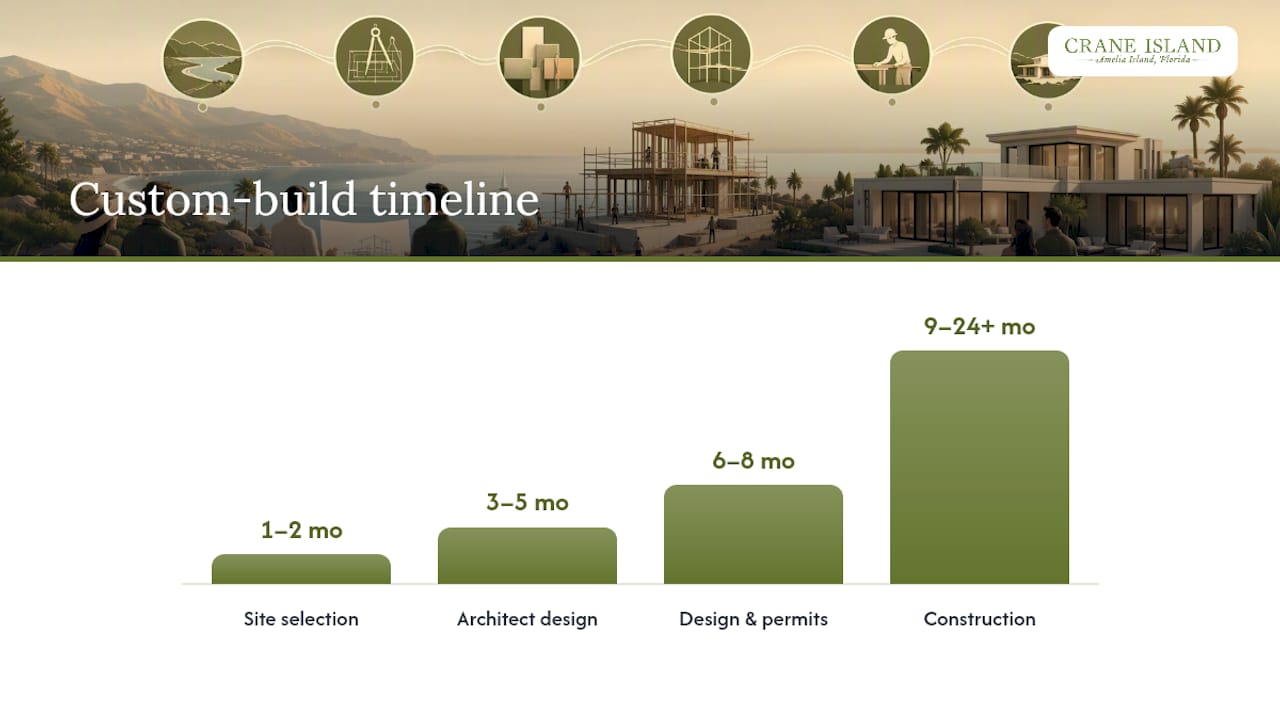
Buying a homesite and building custom is the longer path. A realistic calendar for a luxury custom home on Amelia Island runs roughly as follows:
- Months 1–2: Site selection, title review, FEMA and CCCL checks, ARB pre-application meeting
- Months 3–5: Architect engagement, schematic design, ARB submission and review
- Months 6–8: Design development, permitting with Nassau County or the City
- Months 9–24+: Construction, depending on scope and builder availability
Builders with documented ARB experience shorten review cycles and reduce costly design iterations. That experience is worth asking about directly.
Buying a completed or near-complete home compresses the timeline to a standard 30–60 day closing, but you should still verify that the home was built under the community's current ARB guidelines and that all permits are closed.
Primary cost drivers for either path include land price, required elevation and flood mitigation, the ARB-driven design premium, infrastructure and utility hookups, landscape and dock permitting, and HOA and community amenity funding. Insurance quotes and short-term-rental permit status can shift total carrying costs more than the list price difference between two comparable lots.
For financing, land loans and construction-to-permanent loans are the standard instruments for homesite buyers. Lenders will want to see the recorded covenants, the ARB guidelines, and a signed builder contract before committing to a construction draw schedule.
Pro Tip: Stage your offer and deposit schedule to align with ARB review cycles. An offer contingent on ARB pre-application approval gives you a structured exit if the review reveals design constraints that change your budget.
What design controls and environmental protections should you verify?
The difference between a community that preserves its character for generations and one that gradually erodes comes down to whether its commitments are legally enforceable.
Look for these in the recorded documents:
- A conservation easement held by a recognized land trust, specifying protected acreage and permitted uses
- Deed restrictions that limit build footprints, impervious surface coverage, and canopy removal
- Site planning standards requiring minimized grading, native coastal buffers, and stormwater best practices
- Lighting standards that protect nesting wildlife, particularly sea turtles on barrier islands
The ARB charter should specify the application process, review timeline, criteria for approval, and a formal appeal procedure. Request sample guideline excerpts and past approval letters to understand how the board interprets its own standards. Sustainable coastal community practices at this level include documented native plant palettes, dune and marsh buffer widths, and low-impact construction protocols.
| Community fact to verify | Where to confirm |
|---|---|
| Number of homesites (fixed in plat) | Recorded subdivision plat, Nassau County records |
| Conservation easement acreage | Easement document, third-party land trust records |
| Intracoastal / water access rights | Title commitment, recorded access easement |
| ARB design guidelines version | Community HOA records, builder pre-application packet |
What does daily life actually look like in a community like this?
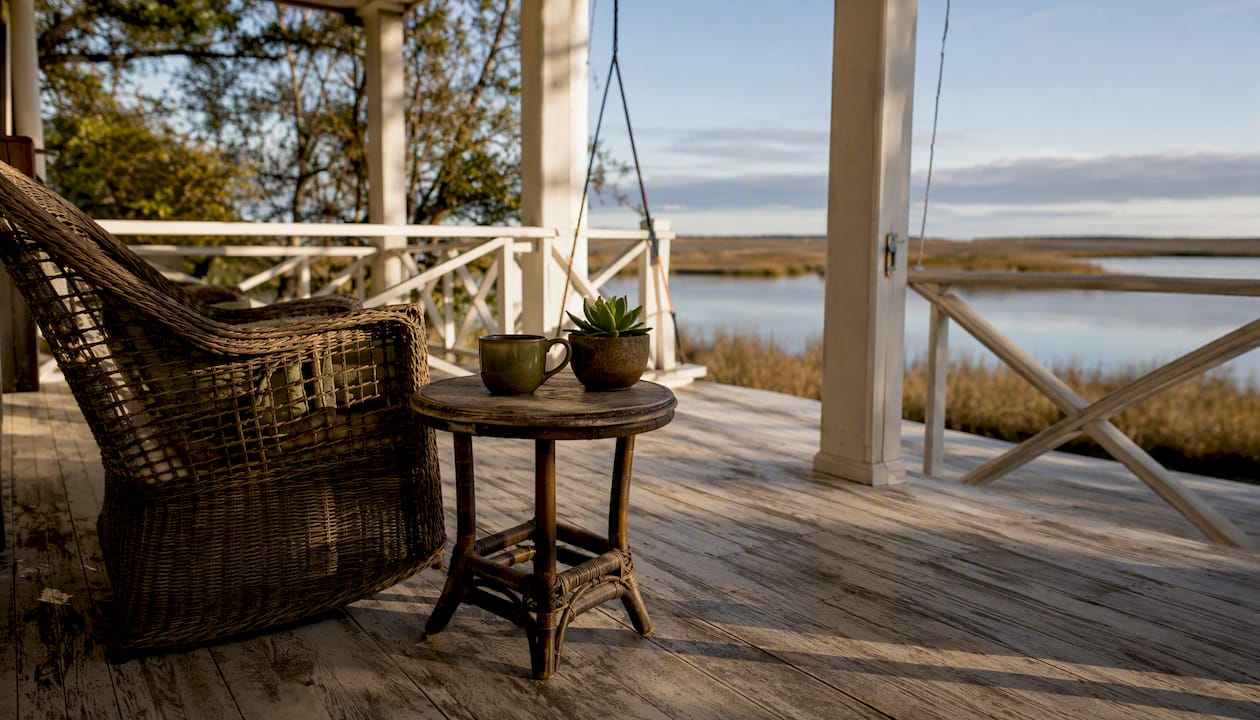
The rhythm of life in a well-designed placemaking community is quieter and more connected than most buyers expect. Mornings tend to begin on the porch, with marsh views or tree canopy framing the light. Neighbors meet on the central green or at the River House without any formal occasion prompting it. The architecture creates those encounters naturally.
For full-time residents, the community becomes a genuine neighborhood: familiar faces, shared stewardship of the landscape, and a social life that does not require leaving the island. For snowbirds and second-home owners, the preserved setting means the community looks and feels the same every time they return. For investors considering limited rental options, the restricted short-term-rental policy means the community retains its character, which supports long-term appreciation even if short-term income is constrained.
Porch culture and communal greens shape these daily patterns in ways that are hard to quantify but easy to feel on a site visit. That is exactly why a guided tour matters more here than in a conventional subdivision.
Crane Island: what a luxury coastal placemaking community looks like in practice
Crane Island is the clearest example on Amelia Island of these principles applied at full resolution. The community offers custom homesites and move-in-ready luxury homes in a preserved Lowcountry coastal enclave with direct Intracoastal Waterway access, architect-led design standards, and a fixed, limited homesite count.
Key facts buyers should confirm directly with the community:
- Limited homesites: The plat fixes the number of available homesites, creating genuine scarcity in a market where barrier-island land is already constrained.
- Preserved maritime canopy: The community protects its oak canopy and marsh buffers through recorded deed restrictions and ARB oversight.
- Intracoastal access: Private bridge access and water access rights are documented in the title and recorded easements.
- ARB and design controls: The ARB process at Crane Island includes Lowcountry design standards, a pre-application review, and restrictions on transient rentals to protect community character.
For buyers who want to go deeper, the Crane Island placemaking blog covers the design philosophy, preservation practices, and community principles behind the development in detail.
What we believe about placemaking and why it matters for your decision
The conventional wisdom in luxury real estate is that location is everything. We think that framing is incomplete. Location sets the ceiling; design controls and preservation commitments determine whether a community reaches it or falls short over time.
What most buyers underestimate is how quickly an unprotected neighborhood can drift from its original character. A single incompatible structure, an eroded buffer, a porch replaced by a garage-forward facade: each change is small, but the cumulative effect on place attachment and resale value is real. The communities that hold their value and their soul are the ones where the design commitments were recorded, not just marketed.
Crane Island's approach, with its fixed homesite count, documented conservation strategy, and ARB oversight, is the kind of structure that protects a buyer's investment and their daily experience simultaneously. A site visit is the only way to feel whether that structure translates into a place you want to call home. We encourage you to arrange one.
Schedule a private tour of Crane Island
Crane Island offers private tours for qualified buyers, giving you direct access to the preserved landscape, the River House, and the homesites currently available. When you reach out, request the ARB design guidelines, the recorded plat, the HOA budget and reserve fund summary, and sample home elevations. These documents tell you more about a community's long-term health than any sales presentation.
To schedule your visit or request community materials, contact the Crane Island team directly at Craneisland. Limited homesites remain, and the community does not reopen inventory once a homesite is sold.
Sources
- Evaluating Luxury Build Opportunities Around Amelia Island
- Amelia Island & Fernandina Beach Homes for Sale | Fernandina Beach, FL
- Amelia Island Luxury Home Market 2026: Buyer Guide
FAQ
What is a placemaking community in real estate?
A placemaking community is a residential neighborhood designed to create a strong sense of place through architecture, shared outdoor spaces, and preserved natural landscapes, rather than simply maximizing lot count or amenity square footage.
How do design controls protect a luxury home's resale value?
Recorded covenants and an active ARB prevent incompatible development and maintain the architectural character that buyers paid a premium for, which supports long-term appreciation in design-controlled enclaves like Crane Island.
What financing options work for buying a homesite in a placemaking community?
Land loans and construction-to-permanent loans are the standard instruments; lenders typically require recorded covenants, ARB guidelines, and a signed builder contract before approving a construction draw schedule.
How early should I check FEMA flood maps when buying on Amelia Island?
Run the FEMA map check and Coastal Construction Control Line review before engaging an architect, since flood zone designation and coastal setbacks can materially change your design program and budget.
Are short-term rentals allowed in communities like Crane Island?
Crane Island heavily restricts transient rentals through its recorded covenants to protect community character; buyers with rental income goals should confirm the specific rental policy in the recorded documents before making an offer.