
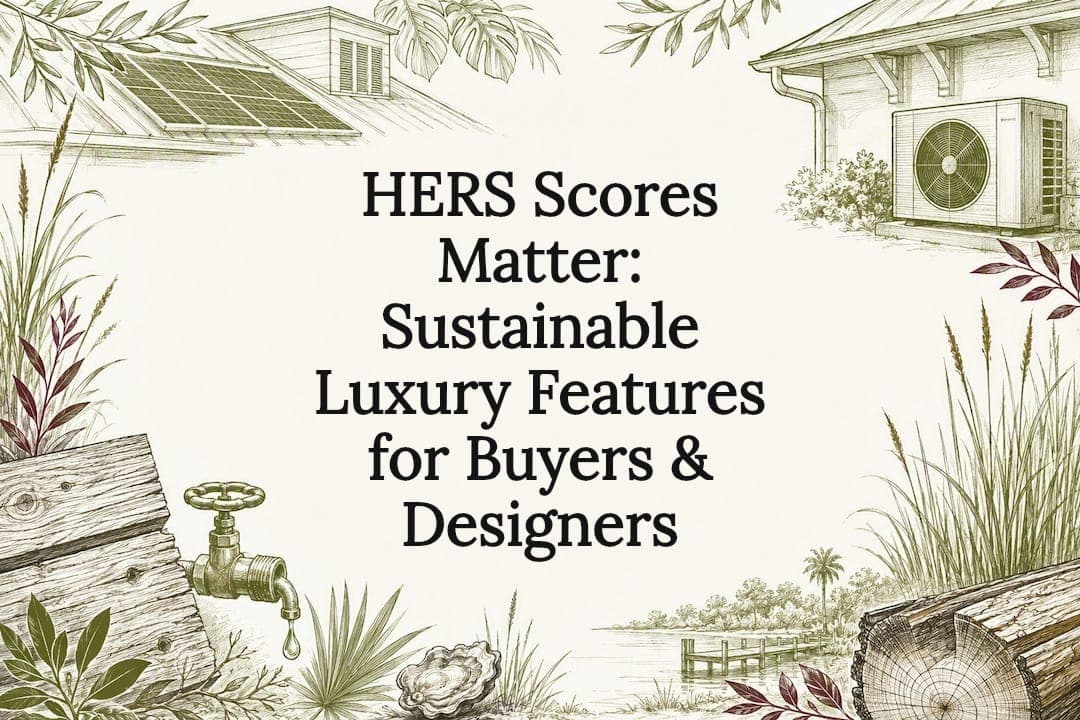
Sustainable luxury home features combine high-performance energy systems, low-embodied-carbon materials, water stewardship, superior indoor air quality, and site restoration, all delivered with the craftsmanship affluent buyers expect from a high-end residence. The measurable piece matters as much as the beautiful piece: a HERS score, a LEED certification, a documented cistern capacity. What follows is a specification-level walk through the categories worth understanding before you build or buy.
TL;DR:
- Sustainable luxury homes should have a tightly sealed envelope with high-performance glazing and a HERS score near zero to ensure energy efficiency.
- Using reclaimed, FSC-certified, or low-carbon materials is essential to reduce embodied carbon without sacrificing craftsmanship.
- Water systems like rainwater harvesting and drought-tolerant landscaping significantly lower demand on municipal resources and support site resilience.
- Indoor air quality benefits from balanced ventilation, high-efficiency filters, and low-VOC finishes to promote health and wellness.
- Home durability depends on regular maintenance of systems like solar arrays and water features, with predictive servicing extending their lifespan.
Table of Contents
- What Are the Core Categories of Sustainable Luxury Home Features?
- How Do You Specify Energy Systems for Performance and Resilience?
- What Materials Reduce Embodied Carbon Without Sacrificing Craftsmanship?
- How Do Luxury Homes Handle Water Conservation and Reuse?
- What Indoor Air Quality Features Matter Most in a Luxury Home?
- How Does Landscape Design Contribute to Sustainable Luxury?
- What Do the Best Sustainable Luxury Projects Prove?
- How Do You Verify Sustainable Features Before You Build or Buy?
- How Durable Are Sustainable Luxury Features Over Time?
- Where Is Luxury Sustainable Design Headed?
- Crane Island: Where Conservation Meets Custom Luxury
- Sources
- FAQ
What Are the Core Categories of Sustainable Luxury Home Features?
A truly sustainable luxury home is not one good idea repeated. It is several systems working in concert: the building envelope, the mechanicals, the materials, the water strategy, the air inside, and the land outside. Miss one, and the others underperform. An airtight envelope paired with a poorly sized heat pump wastes the envelope's advantage. A rainwater cistern feeding a garden of thirsty, non-native plants wastes the cistern's capacity.
For buyers and designers scanning a project, these are the categories worth checking first:
- Energy and renewables: airtight construction, high-performance glazing, solar arrays, battery storage, and all-electric mechanicals that together lower operating cost and add resilience during outages.
- Materials: reclaimed wood, FSC-certified lumber, mass timber, and low-carbon concrete that reduce the carbon locked into construction while adding texture and provenance.
- Water: rainwater harvesting, graywater reuse, and efficient fixtures that cut demand on municipal systems and protect coastal water tables.
- Indoor environmental quality: balanced ventilation, filtration, and low-VOC finishes that improve daily air quality and reduce allergens.
- Landscape and site stewardship: native plantings, preserved open space, and habitat-friendly design that support biodiversity and reduce irrigation load.
- Smart monitoring: systems that track energy and water use in real time, giving owners the data to verify that the home performs as designed.
The USGBC's LEED residential rating system gives design teams a structured way to document these categories rather than relying on marketing claims. Certification is not the point of a sustainable luxury home. It is the receipt. As Michael Booth of BAMO frames it, sustainability works best as a design philosophy woven through every decision, not a checklist bolted onto a finished floor plan. That distinction shapes everything else in this guide.
How Do You Specify Energy Systems for Performance and Resilience?
The envelope comes first. High-R insulation, an airtight building shell, and triple-pane or high-performance glazing reduce the load before a single mechanical system gets installed. That sequencing matters: oversized solar arrays cannot fix a leaky envelope, but a tight envelope lets a smaller, quieter system carry the whole house.
From there, prioritize:
- All-electric mechanicals, particularly air-source or ground-source heat pumps, which handle both heating and cooling efficiently.
- A solar photovoltaic array sized to the home's modeled annual load, paired with battery storage for outage resilience.
- EV-ready electrical infrastructure, since retrofitting it later means opening finished walls.
- Efficient domestic hot water systems, often heat-pump water heaters, that pair well with an all-electric design.
Pro Tip: Ask your builder for the home's projected HERS score before groundbreaking, not after occupancy. An Index near zero signals a near net-zero home; anything above 60 suggests the mechanicals are compensating for a weak envelope.
RESNET reports that over 400,000 U.S. homes received a HERS rating in 2024 alone, which means the metric now has enough market depth to compare confidently across builders and regions.
What Materials Reduce Embodied Carbon Without Sacrificing Craftsmanship?
Embodied carbon, the emissions baked into a material before it ever reaches the site, is where luxury and sustainability intersect most naturally. Reclaimed wood, salvaged stone, and artisan finishes carry a story that new materials cannot replicate, and that provenance is itself a form of luxury.
Materials worth prioritizing:
- Reclaimed timber and FSC-certified wood for framing, flooring, and millwork.
- Mass timber (cross-laminated timber) for structural elements with a fraction of concrete's carbon footprint.
- Low-carbon concrete mixes and recycled stone for foundations and hardscape.
- Products carrying Declare or Health Product Declaration labels, which disclose full ingredient lists.
Avoiding materials on the Red List, a set of chemicals of concern used in conventional building products, keeps interiors healthier over decades of use. Guidance on Red List free materials points to bio-based options like rammed earth, cork, and straw panels as viable substitutes with meaningfully lower embodied carbon than conventional luxury finishes. A related look at responsibly sourced materials in luxury communities explores how these choices support both wellness and design continuity.
Ask suppliers for embodied-carbon figures and transparency declarations before finishes are locked into a contract. Retrofitting that request after materials arrive on site rarely goes well.
How Do Luxury Homes Handle Water Conservation and Reuse?
Coastal and estate properties are increasingly designed around water as an asset to manage, not a utility to ignore. Rainwater cisterns, sized to a property's roof area and regional rainfall, can supply irrigation and even toilet flushing when paired with graywater systems that recycle water from sinks and showers.
Beyond capture, look for:
- Low-flow fixtures throughout, which cut daily demand without any change in user experience.
- Smart irrigation controllers that adjust watering to actual soil moisture and weather data.
- Drought-tolerant, native plant palettes that reduce irrigation need at the source.
- Permeable paving and stormwater management, especially valuable on coastal or flood-prone sites.
On some larger estates, advanced on-site wastewater treatment becomes a practical option where municipal infrastructure is limited or where the owner wants full water independence.
What Indoor Air Quality Features Matter Most in a Luxury Home?
Wealthy buyers increasingly treat air quality as a wellness feature, not a mechanical afterthought. Balanced ventilation systems, energy recovery ventilators (ERVs) or heat recovery ventilators (HRVs), bring in fresh air continuously while recovering the energy that would otherwise be lost through an open window.
Pair that with high-efficiency filtration, MERV 13 or better, and HEPA where allergy sensitivity is a concern. Research on indoor environmental quality links improved ventilation and low-VOC materials to measurable gains in occupant health and comfort, not just subjective comfort claims.
- Daylighting strategies and circadian-tuned lighting reduce reliance on artificial light and support natural sleep cycles.
- Low-VOC paints, sealants, and adhesives minimize off-gassing in newly finished spaces.
- Indoor airPLUS certification and WELL Building Standard fundamentals give buyers a documented benchmark to request from builders.
How Does Landscape Design Contribute to Sustainable Luxury?
The land around a luxury home carries as much sustainability weight as the structure itself. Native plant palettes reduce irrigation and support local pollinators, while wildlife-friendly design, think brush piles, native hedgerows, and undisturbed buffer zones, can qualify a property for certified habitat status.
- Green roofs and living walls double as design statements and stormwater management tools.
- Rain gardens capture runoff while adding a designed, textural landscape element near entries and patios.
- Preserved open space, marshland, and forest buffers protect long-term property value by maintaining the views and ecological function that drew buyers there in the first place.
Stewardship of this kind is not a compromise on beauty. It is frequently the reason a property photographs and sells well years later.
What Do the Best Sustainable Luxury Projects Prove?
A handful of U.S. projects show what happens when sustainability drives the design brief from day one rather than getting layered on at the end. Tah Mah Lah pursued net-zero energy and zero carbon emissions, leaning heavily on reclaimed materials and water-recycling systems to hit regenerative goals most luxury projects never attempt. Heron Hall went further, targeting Living Building Challenge standards with a 10 kW photovoltaic array and a 15,000-gallon rainwater cistern that together give the home real off-grid capability. Sarasota's Element House stacked certifications, LEED Platinum, Florida Green Building Coalition Platinum, Indoor airPLUS, and DOE Zero Energy Ready Home, while still reading as an architecturally ambitious residence rather than a laboratory experiment, according to Sarasota Magazine's coverage.
The best sustainable estates treat infrastructure as architecture. A cistern, a solar array, a rain garden, each is designed to be looked at, not hidden behind a hedge.
Crane Island applies this same logic at the community scale. Preserving nearly half its land as open space, holding new construction to Lowcountry architectural standards, and limiting the community to 14 homesites are choices that mirror the case studies above: conservation and design ambition working from the same brief, not competing against each other. A buyer's guide to sustainable coastal communities goes deeper into how this approach shapes long-term market value.
How Do You Verify Sustainable Features Before You Build or Buy?
Specification-level clarity protects you from paying a premium for claims that never get verified. Use this sequence with your design team:
- Set performance targets in writing, including a HERS score goal, modeled annual kWh usage, and an embodied-carbon target for structural materials.
- Require product transparency documentation (Declare labels or Health Product Declarations) for major finishes before contracts are signed.
- Ask for a full energy model and a written operation and maintenance (O&M) plan, not just a rendering package.
- Confirm commissioning is included, the process of testing systems after installation to verify they perform as designed.
- Request warranty terms specific to solar, battery, and heat-pump systems, since these often carry different coverage than standard home warranties.
Pro Tip: Frame every "green" upgrade in lifecycle terms, not just first cost. A heat pump system that costs more upfront but cuts operating expenses for 20 years usually wins on total cost of ownership, even before counting resilience value during outages.
How Durable Are Sustainable Luxury Features Over Time?
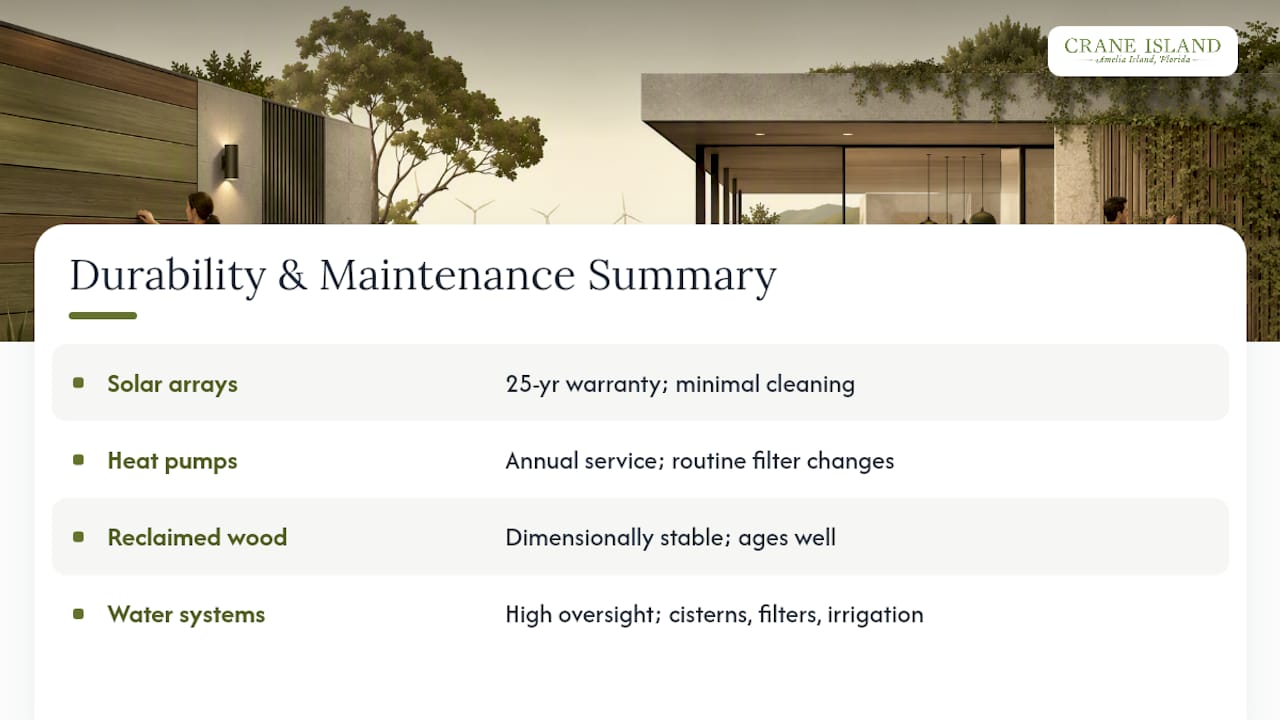
Sustainable systems are not maintenance-free, but they tend to be maintenance-predictable, which is its own form of luxury. Solar arrays typically carry 25-year performance warranties and require little beyond periodic panel cleaning and inverter checks every decade or so. Heat pumps need routine filter changes and annual service, similar to conventional HVAC, but their sealed, all-electric design tends to reduce the mechanical wear associated with combustion-based systems.
Reclaimed wood and mass timber age differently than new-cut lumber. Reclaimed material has already gone through its major shrinkage and settling decades ago, which often makes it more dimensionally stable over time, not less. Low-VOC finishes and Red List free materials also tend to hold their appearance longer, since many conventional finishes that off-gas heavily also degrade and yellow faster under UV exposure.
Water systems require the most active oversight. Cisterns need periodic inspection for sediment buildup, graywater systems need filter maintenance, and smart irrigation controllers need seasonal reprogramming as landscapes mature. None of this is burdensome, but it does mean a written O&M plan matters as much for year ten as it does for the first year of occupancy. Owners who treat that plan as a living document, updated as systems age, protect both the home's performance and its resale story.
Where Is Luxury Sustainable Design Headed?
Sustainability is becoming inseparable from legacy planning in the luxury market. Buyers increasingly ask not just what a home costs to run, but what it will still be worth, and what land it will still protect, in twenty years. Crane Island's conservation-first model, preserved marshland, Lowcountry architectural discipline, a small, deliberate homesite count, offers a working template for that kind of stewardship done at the community level, not just the house level.
— John Hillman
Crane Island: Where Conservation Meets Custom Luxury
If the categories above describe what to look for, Crane Island describes where to find them already built into the land itself. Rather than retrofitting sustainability onto a finished subdivision, Crane Island preserves nearly half its total acreage as open marsh and forest, holds every home to Lowcountry architectural standards, and offers direct Intracoastal Waterway access unavailable elsewhere on Amelia Island.
With only 14 homesites in the entire community, each lot is paired with the chance to build a custom residence that reflects both personal narrative and the island's natural character, rather than a spec home dropped onto a cleared lot. Buyers who want a move-in ready path can explore the Portfolio Homes Program, which offers a more direct route to custom-luxury living without managing every construction decision personally. For those ready to see what remains available, Crane Island's current homes and homesites are the place to start that conversation.
Sources
- USGBC — LEED rating systems: residential
- Heron Hall — McLennan Design
- NCBI — Indoor environmental quality research
FAQ
What Are the Key Features of a Sustainable Home?
A sustainable home combines an airtight, well-insulated envelope, efficient all-electric mechanicals, renewable energy readiness, low-embodied-carbon materials, water conservation systems, and strong indoor air quality. In luxury applications, these systems are also documented through certifications like LEED or a low HERS score, so performance is verified rather than assumed.
What Are Common Features Found in Luxury Homes That Are Also Sustainable?
High-end sustainable homes often include solar arrays paired with battery storage, reclaimed wood or mass timber structural elements, rainwater cisterns, and smart monitoring systems that track energy and water use in real time. Projects like Heron Hall pair a 15,000-gallon cistern and rooftop solar with high-end architectural finishes, showing the two goals reinforce each other rather than compete.
What Are the Environmental Considerations of Luxury Homes?
The largest environmental considerations are operational energy use, embodied carbon in materials, water demand, and impact on the surrounding site's ecology. Coastal properties add stormwater management and habitat preservation to that list, since large lots and waterfront proximity carry outsized influence on local water quality and wildlife corridors.
What Makes a Home Look Wealthy While Staying Sustainable?
Provenance and craftsmanship read as wealth more reliably than square footage alone. Reclaimed materials, artisan millwork, and thoughtfully framed natural views (a well-placed porch, a preserved marsh vista) communicate luxury while supporting sustainability goals; a guide to expensive-looking interior details covers finish-level choices that reinforce this effect.
Does Crane Island Offer Homesites With These Sustainable Features Built In?
This community preserves a significant portion of its land as open space and applies Lowcountry architectural standards across a limited number of homesites, providing a conservation-integrated foundation to build on. Specific home designs and available homesites can be viewed directly on Crane Island's website, where current pricing and availability are listed.