
Coastal communities near historic towns do exist, and the best of them share a handful of traits worth seeking out: preservation-minded land planning, resilient construction, true walkable proximity to a historic center, and a deliberate limit on how many homes are ever built. Crane Island, our Lowcountry-inspired community on Amelia Island, illustrates the pattern: nearly half its acreage held as preserved marsh and maritime forest, only 14 homesites, direct Intracoastal Waterway access, and a short reach to historic Fernandina Beach.
TL;DR:
- Before signing, order a boundary and topographic survey and verify the flood zone and base flood elevation; both shape foundation choices, construction budgets, and insurance costs.
- In coastal high hazard V zones, NFIP requires open or pile supported foundations; confirm freeboard above BFE and engineering against wind, flooding, erosion, and corrosion.
- Measure the actual walking route, assess sidewalks, shade, lighting, and crossings, and test it at different times and during high water where tidal flooding occurs.
- Confirm architectural review and enforceable rules govern regional design, lot coverage, trails, and shared spaces after purchase, not just before construction.
- Preserved marsh and forest absorb storm surge, filter runoff, and moderate heat; check whether development plans protect buffers, creek edges, and tree canopy.
Table of Contents
- What should affluent buyers look for in a coastal community near a historic town?
- Coastal resilience and siting basics every buyer must confirm
- Placemaking and lifestyle: what creates lasting community value near a historic town
- How do you evaluate actual proximity and walkability to the historic town?
- Due diligence checklist and timeline for buying a homesite or custom coastal home
- Environmental preservation practices specific to coastal Lowcountry regions
- How community governance supports sustainability and a shared sense of place
- Why preservation and placemaking near a historic town matter
- Crane Island: a direct path to this kind of coastal living
- FAQ
- Sources
What should affluent buyers look for in a coastal community near a historic town?
A marketing brochure can claim "steps from downtown" without much to back it up. Before you weigh a homesite, confirm these fundamentals for yourself.
- Authentic proximity: a connected, sidewalk-lined route to town matters more than a straight-line mileage figure on a map.
- Design controls: architectural guidelines that reference local materials, porch depth, and height limits signal a community built to belong, not just to sell.
- Placemaking over spectacle: trails, small gathering spots, and ongoing programming tend to outlast any single oversized clubhouse.
- Marine access: confirm whether access means a shared ramp, a private marina, or true deep-water Intracoastal frontage, since each shapes the boating lifestyle very differently.
- Scarcity: a capped homesite count is a meaningful signal that custom building here carries long-term value rather than commodity pricing.
Each of these criteria protects something different: your daily experience, your home's architectural integrity, and the resale strength of a limited collection of properties. Buyers who weigh all five tend to end up happier with the decision five years in, not just on closing day.
Coastal resilience and siting basics every buyer must confirm
Before any homesite earns serious consideration, request the flood zone designation and base flood elevation (BFE) in writing. These two figures determine your foundation type, your construction budget, and your long-term insurance costs.
- Pull the Digital Flood Insurance Rate Map (DFIRM) for the parcel and note whether it sits in a V, VE, or A zone, since each carries different construction rules.
- Ask whether the design requires an open or piled foundation, which NFIP Technical Bulletin 5 mandates for new construction in coastal high-hazard V zones to keep the area beneath the home free of obstruction.
- Confirm the builder commits to freeboard above the BFE and to engineering that resists wind, flooding, erosion, and corrosion, as outlined in FEMA's coastal construction guidance.
- Verify the design references ASCE 24 and ASCE 7 engineering standards or the International Residential Code, which that same FEMA guidance identifies as the baseline for coastal flood hazard construction.
Coastal siting decisions carry real cost consequences: homes built to resist higher winds, flooding, erosion, and corrosion generally cost more to build and maintain than inland construction, a tradeoff that shows up later as lower insurance premiums and fewer retrofit headaches when the engineering is done right from the start.
Placemaking and lifestyle: what creates lasting community value near a historic town
A single grand clubhouse photographs well, but it rarely sustains daily life the way a network of smaller, well-placed gathering spots does. Industry coverage of Future Place 2026 described this shift as building an "infrastructure of belonging": connected trails, modest food venues, and programming that runs year-round, rather than one expensive amenity that gets used twice a year.
What this looks like in practice:
- Walking trails that connect neighborhoods to shared green space rather than looping in isolation.
- Porches positioned as true living rooms, oriented toward marsh views or quiet lanes where neighbors naturally pause to talk.
- Lot patterns and setbacks that favor pedestrians over driveways and garage doors as the dominant streetscape.
Preserved open space does double duty. Holding nearly half the land in marsh and forest protects sightlines toward Fernandina Beach's historic district and helps keep the homesites feeling like a rare opportunity rather than another subdivision phase.
Pro Tip: Walk a community's trail network at dusk before you decide. Lighting, shade, and the number of people out walking tell you more about daily life there than any brochure.

How do you evaluate actual proximity and walkability to the historic town?
"Walkable to town" is one of the most overused phrases in coastal real estate, so verify it yourself before you believe it.
- Measure actual walk and bike times along the real route, not a straight line on a map, since a half-mile with no sidewalk can feel far longer than a mile on a shaded, connected path.
- Weigh route quality, including shade, street lighting, and safe crossings, more heavily than raw distance.
- Check municipal planning documents or historic-district buffer rules, since these determine whether the town's edge will stay protected or face future commercial pressure.
- Walk the route yourself at different times of day, and where tidal flooding is a factor, during a high-water period, to see how the path holds up under real conditions rather than ideal ones.
A community that performs well on all four checks is genuinely connected to its town. One that only performs well on the first is simply nearby.
Due diligence checklist and timeline for buying a homesite or custom coastal home
Treat the purchase of a coastal homesite the way you would any major capital investment: verify first, commit second.
- Order a boundary and topographic survey alongside DFIRM flood-zone verification before signing a purchase agreement.
- Request signed engineering and architectural commitments to ASCE, IRC, and NFIP-adjacent standards, along with elevation certifications for any completed or planned structure.
- Budget for the coastal construction premium associated with elevated foundations, corrosion-resistant materials, and wind-rated assemblies, since FEMA's guidance confirms these measures add upfront cost in exchange for lower long-term risk.
- Set a realistic timeline from contract to move-in that accounts for custom design review, permitting, and the longer lead times coastal foundations typically require.
For readers weighing material choices along the way, a partner resource on coastal-appropriate doors and finishes and a guide to metal roofing standards for coastal Florida both offer useful detail on the kind of corrosion-resistant, wind-rated choices this due diligence should confirm.
Environmental preservation practices specific to coastal Lowcountry regions
Lowcountry landscapes, with their tidal marsh, maritime forest, and barrier island ecology, respond poorly to development that treats land as a blank canvas. The communities that age well instead work around what is already there: preserving marsh buffers, limiting impervious surface near tidal creeks, and keeping maritime forest canopy intact rather than clearing it for broader lots.
At Crane Island, that approach means close to half the land stays in its natural state as marsh and forest rather than becoming additional homesites. That choice does more than protect a view. Intact marsh buffers absorb storm surge and filter runoff before it reaches the Intracoastal Waterway, while maritime forest canopy moderates heat and shelters the kind of wildlife that drew residents to the Lowcountry in the first place.
Our community's approach to sustainable coastal development and the specific way it integrates maritime forest into site planning both reflect this same principle: build fewer homes, disturb less ground, and let the preserved landscape do real ecological work rather than serve as a decorative backdrop.
How community governance supports sustainability and a shared sense of place
The rules a community enforces after closing matter as much as the ones marketed before it. A homeowners association with teeth, meaning real architectural review and enforceable design standards, keeps a Lowcountry-inspired community looking and functioning the way it was designed to decades after the first homes go up.
That typically means design guidelines rooted in regional materials and porch-forward architecture, limits on lot coverage that protect preserved open space from gradual erosion, and maintenance standards for shared trails and gathering spaces that keep an "infrastructure of belonging" working rather than falling into disrepair. Market research from RCLCO on master-planned communities found that today's lifestyle buyers weigh long-term value, community infrastructure, and environmental quality deliberately rather than impulsively, which places real weight on governance that protects those qualities over time.
Our own governance model centers on legacy. We built our legacy home community standards around the idea that a limited homesite count only holds its value if the rules governing those 14 properties stay consistent for the families who build there and the generations who inherit them.
Why preservation and placemaking near a historic town matter
We have spent enough time around coastal development to notice a pattern: communities that lean hardest on a single dazzling amenity rarely age as gracefully as the ones that quietly get the fundamentals right. A trail that connects to something, a porch oriented toward a real view, a marsh left alone instead of filled in. None of that photographs as dramatically as an infinity pool, but it is what residents actually live with every day.

The conventional wisdom treats proximity to a historic town as a line on a map. We think the more honest measure is whether a place earns its spot beside that town, through scale, materials, and restraint, rather than simply borrowing its name. The limited number of homesites reflects that belief more than any marketing claim could.
If that resonates, we welcome a conversation about what building here could look like for your family.
— John Hillman
Crane Island: a direct path to this kind of coastal living
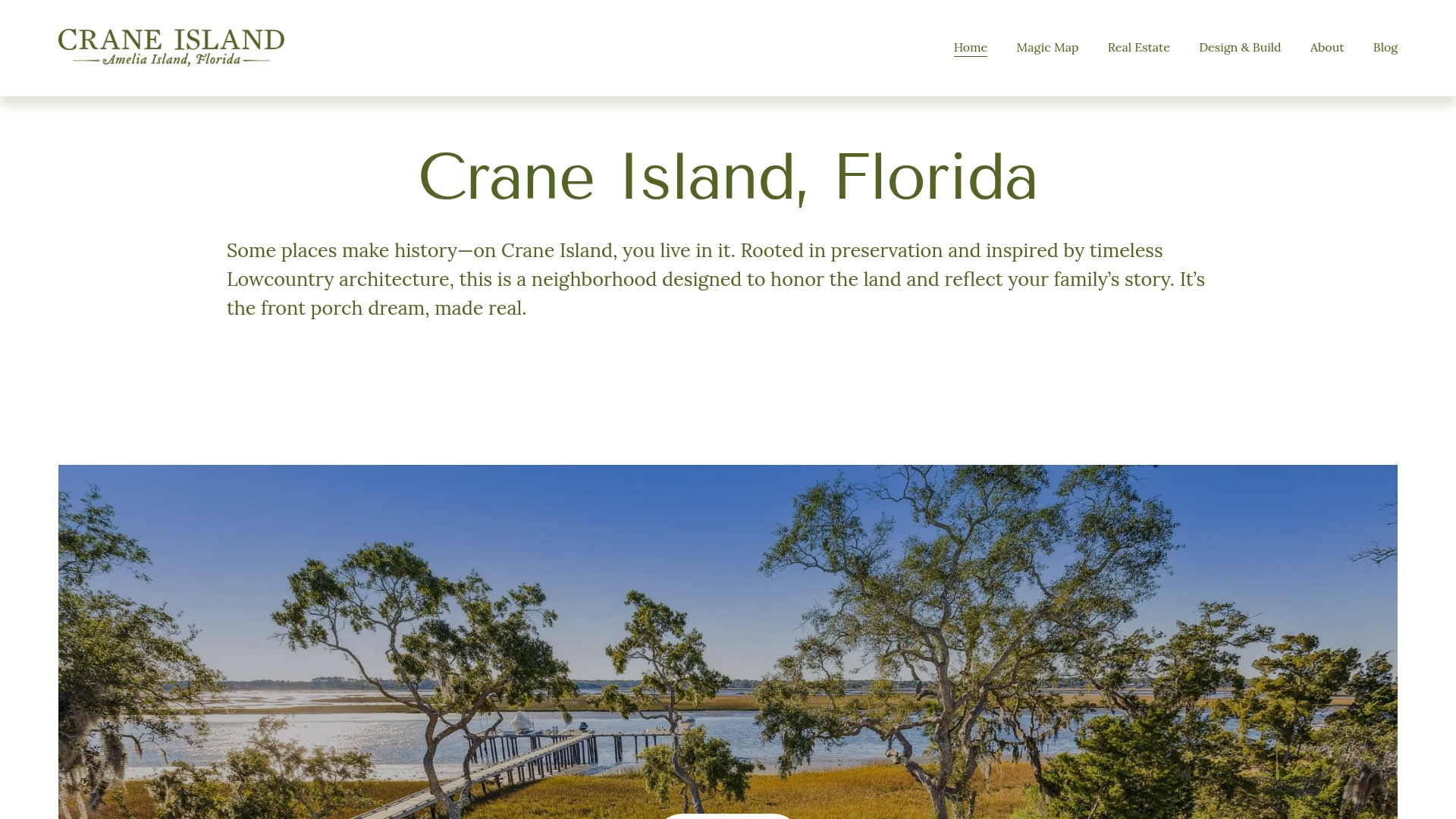
For buyers who want this approach rather than simply reading about it, this community offers it directly on Amelia Island, with nearly half the land preserved as marsh and maritime forest, a small number of homesites, and direct Intracoastal Waterway access alongside an easy reach to historic Fernandina Beach's shops, restaurants, and waterfront culture.
A few ways to take the next step with us:
- Request a private homesite packet detailing availability, siting, and our architectural guidelines.
- Schedule a tour of the preserved landscape and the homesites currently available.
- Speak with our design team about custom building through The Crane Island Portfolio Homes Program.
Start by exploring current homes and homesites or browsing available Intracoastal properties to see what fits your plans for Amelia Island.
FAQ
What makes a coastal community near a historic town a strong long-term investment?
Strong communities combine preservation-minded land planning, resilient construction standards, and genuine walkable access to the town rather than marketing distance alone. Market research from RCLCO found that buyers in these communities weigh long-term value and environmental quality deliberately, which rewards places with documented resilience and real open space.
How does flood zone designation affect building a coastal home?
Flood zone designation determines your required foundation type and base flood elevation, with V and VE zones requiring open, pile-supported foundations under NFIP Technical Bulletin 5. Confirming this early protects your budget, since construction in these zones generally costs more than standard inland building.
What does 'walkable to a historic town' actually require?
Genuine walkability means a connected route with sidewalks, shade, and safe crossings, not just a short distance on a map. Testing the route yourself at different times of day, and checking municipal plans for historic-district buffers, confirms whether a community is truly connected rather than merely nearby.
How many homesites does Crane Island offer?
Crane Island offers 14 homesites on Amelia Island, each set within a community that preserves close to half its land as marsh and maritime forest. Details on availability and the design process are outlined through The Crane Island Portfolio Homes Program.
Why do master-planned communities now emphasize trails and programming over large clubhouses?
Industry coverage of Future Place 2026 found that buyers respond more to an everyday "infrastructure of belonging," like trails, small gathering spots, and ongoing programming, than to a single large amenity. These features see consistent daily use, which tends to support stronger resale demand over time.
Sources
- 8 takeaways from day 2 of Future Place 2026 | Builder Online
- FEMA P-499: Home Builder's Guide to Coastal Construction
- Free of obstruction requirements for buildings in Coastal High Hazard Areas (NFIP Technical Bulletin 5)
- The top-selling master-planned communities of mid-year 2026 | RCLCO