
A home in a gated community is a home inside a residential development where entry is controlled by guards, automated gates or keypads, and where an association enforces shared rules and maintains common property. Buyers pay for privacy, consistency and care of the place, and the best way to choose is to look past the gate itself to the governance, the fees, the land and the architecture behind it. This guide walks through each of those, with a closer look at luxury and coastal communities across Florida, Georgia and South Carolina.
TL;DR
- A gated community is a subdivision kept out of through traffic by barriers and an entry system, with an association that enforces covenants (Texas A&M research).
- Homes inside gates often cost about 5% to 10% more than comparable homes nearby, and up to 10% to 20% in some sought-after cities (CNBC, 2025).
- Budget for dues, special assessments and insurance, and read the covenants before you fall in love with a floor plan.
- On the coast, ask about flood zones, wind mitigation and insurance early, because those costs shape what you really pay each year.
- At the luxury end, the lasting value is usually the land, the architecture standards and the preserved surroundings, more than the gate.
Table of Contents
- What a gated community actually is
- How common are they, and where?
- Why buyers choose gates
- Are homes in gated communities more expensive?
- Reading the rules before you sign
- How to weigh the tradeoffs well
- Coastal risk: the part buyers skip
- What sets luxury gated communities apart
- A buyer's checklist for touring
- Our perspective
- Explore Crane Island
- FAQ
- Sources
What a gated community actually is
Researchers at Texas A&M describe a gated community as a subdivision set apart from through traffic by barriers, with a system meant to discourage unauthorized entry. The entry may be a staffed guardhouse, an automated gate opened by a card, remote or keypad code, or something as simple as a warning sign (Texas A&M, "What is a Gated Community?").
Behind that entrance sits a legal structure. Common-interest developments give residents a framework for collective private ownership and private governance, and the homeowners' association typically handles tasks such as trash collection, security and upkeep of shared property (University of California Press). In practice, that means the gate is the visible part and the association is the part that shapes your daily life.
Three kinds of entry, three kinds of experience
- Staffed gates. A guard greets visitors and checks them against a list. This is the most hands-on arrangement and the most expensive to run.
- Automated gates. Residents use cards, remotes or codes. Guests are admitted by a call or a resident's pre-approval.
- Passive barriers. Signs, a single-lane entrance or a private road discourage casual traffic without a physical gate.
Ask which model a community uses, who staffs it, and what it costs per year to operate. That figure ends up in your dues.
How common are they, and where?
The federal government started tracking this in 2007, when the American Housing Survey added questions about walls or fences around a community and the entry systems that control access (U.S. Census Bureau). Earlier survey data gives a sense of scale: the 2001 survey found roughly 7 million households, about 6% of the national total, living behind walls or fences, with 4 million of them in access-controlled communities (USA Today, 2002).

By 2025, CNBC reported that Florida and California have the highest number of gated communities, in part because of weather and available space (CNBC). That matches what buyers see on the Southeast coast, where year-round outdoor living and waterfront land have long supported master-planned neighborhoods.
The largest example people usually name is The Villages in Florida, a retirement community that spans three counties and three zip codes and covers more than 20,000 acres (Common Edge). Size is not the same as quality of experience, though, and many buyers at the upper end prefer the opposite: fewer homes, more land and a stronger sense of neighbors.
Why buyers choose gates
Studies of residents find a familiar mix of reasons: protection from crime, maintenance, higher property values and a sense of community (Members Only: Gated Communities and Residential Segregation). Researchers Blakely and Snyder observed something subtler for upper-end communities that already sit in low-crime areas: the main draw is privacy and the exclusion of non-residents more than crime prevention (Blakely and Snyder). An analyst quoted by CNBC makes the same point, that demand for gates has more to do with controlling who comes in than with a measured need for security (CNBC).
That is useful for you as a buyer. If privacy and quiet are what you want, evaluate them directly: how many entrances are there, how much traffic does the road see, how far apart are the homes, and what does the land around them look like? A gate that opens onto a crowded street grid delivers less of what you want than a small community with preserved marsh and forest around it.

Are homes in gated communities more expensive?
On average, yes. CNBC reports that homes in gated communities run 5% to 10% above similar homes in the same area, and as much as 10% to 20% in some desirable cities. Buyers may also pay HOA fees and, in some places, separate membership dues for clubs and facilities (CNBC).
The same article shows how widely dues vary. One Florida community charges $500 to $800 a month, another charges $915 a year plus $76 to $950 a month, and a third charges $2,770 to $5,050 a quarter, none of which includes membership fees. Those figures are examples from a single report, not a benchmark for any community you are considering, so request the current budget from the one you are touring.
What to ask about money
- Current dues and what they cover. Gate operation, landscaping, roads, docks, parks, reserves.
- Reserve study. A well-funded reserve means fewer surprise assessments for roads, gates and drainage.
- Special assessments in the last five years. The history tells you how the board plans.
- Transfer fees and capital contributions at purchase.
- Club or amenity memberships and whether they are optional.
It also helps to see how association rules reach into everyday ownership. Even something as ordinary as a garage door usually needs architectural review in a managed community, and this overview of HOA garage door rules shows how that approval process tends to work. Reading your community's design guidelines before you buy saves you from the same surprise on larger projects.
Reading the rules before you sign
HOAs enforce bylaws and deed covenants (Texas A&M). Those documents decide what you can build, paint, plant, rent and park. They are also what protect your neighbors' investment, which is the reason many buyers want them. Ask for the full document set before you make an offer, and read in particular:
- Architectural review procedures and typical timelines
- Rental and short-term rental limits
- Rules on boats, trailers, docks and vehicles
- Fence, landscape and exterior lighting standards
- Enforcement and fine procedures
A good association is clear, consistent and predictable. When the standards are written down and applied evenly, they become a form of stewardship.
How to weigh the tradeoffs well
Gated living is not one-size-fits-all. Research notes that gated communities can contribute to residential segregation and create new layers of neighborhood differentiation (Gated Communities in the United States, PMC), and that some residents are motivated partly by fears of strangers (Members Only, PMC). Thoughtful buyers often respond by choosing communities that feel open in spirit: shared porches, parks and walking paths that bring neighbors together, with a privacy that comes from land and layout.
So instead of asking whether gates are good or bad, ask what the community is built to do. Does it bring people together? Does it protect land? Does it hold its architecture to a standard that will still look right in thirty years? Those answers matter more than the keypad.
Coastal risk: the part buyers skip
For a coastal home, insurance and flood exposure belong in the first conversation. Standard homeowners' and commercial policies typically exclude flood and similar disasters, according to California's insurance regulator (California Department of Insurance), and that principle holds for most standard policies, so confirm the details of any policy with a licensed agent in your state. The same department's climate report recommends earlier disclosures, updated hazard maps and clearer climate-risk information for buyers (California climate insurance report, 2021). That is a California document, but the habit it describes is good practice anywhere: ask for the flood zone, the elevation certificate and the claims history before you commit.
Some insurers also recognize community-level security. One filing from California lists a 15% credit for a guard-gated community patrol service (California Department of Insurance, 2017). Credits differ by insurer and state, so ask your agent whether anything applies to the home you want.
For Florida buyers, our own guides go deeper on the practical side:
- Three moves to secure coastal Florida property insurance
- How coastal wind mitigation can reduce hurricane premiums
- When private flood insurance makes sense beyond the NFIP cap
What sets luxury gated communities apart
Above $2 million, the gate stops being the headline. Buyers comparing places along the Southeast coast, from Amelia Island to the Lowcountry of South Carolina and Georgia's barrier islands, tend to look at the same things:
- Land and setting. Protected marsh, forest and water frontage that cannot be built over.
- Density. A limited number of homesites, so the community stays calm.
- Architecture. Written standards that keep every home in harmony with the region's traditions.
- Water access. Deep-water docks or boating access are rare and hard to replicate.
- Community life. Parks, porches and gathering places that make neighbors out of owners.
- Builder and design flexibility. Custom homes that reflect a family's story, within a clear design framework.
The best of these places feel less like developments and more like villages that grew from the landscape. If you are exploring that world, our guides to conservation communities in Florida, coastal living in Florida and luxury waterfront communities compare the options by type, and our new urbanism guide explains why walkable, porch-centered design has such a pull.
A buyer's checklist for touring
- Visit on a weekday morning and a weekend evening. Notice traffic, noise and how neighbors use shared spaces.
- Ask who owns the roads, parks, docks and open space, and who is responsible for them long term.
- Request the covenants, budget, reserve study and recent meeting minutes.
- Confirm the flood zone, elevation and wind-mitigation features of any home you like.
- Walk the land. Preserved marsh and mature trees tell you more about the developer's intent than a brochure.
- Ask how design review works, and meet the architects or builders if the community has an approved list.
- Ask your insurance agent for quotes before you make an offer.
Our perspective
We have spent a great deal of time thinking about what people really want when they ask for a gated community. In our conversations, it is rarely the gate. It is the feeling of arriving somewhere that has been cared for, where the road slows you down, the porches face one another and the marsh is still a marsh.
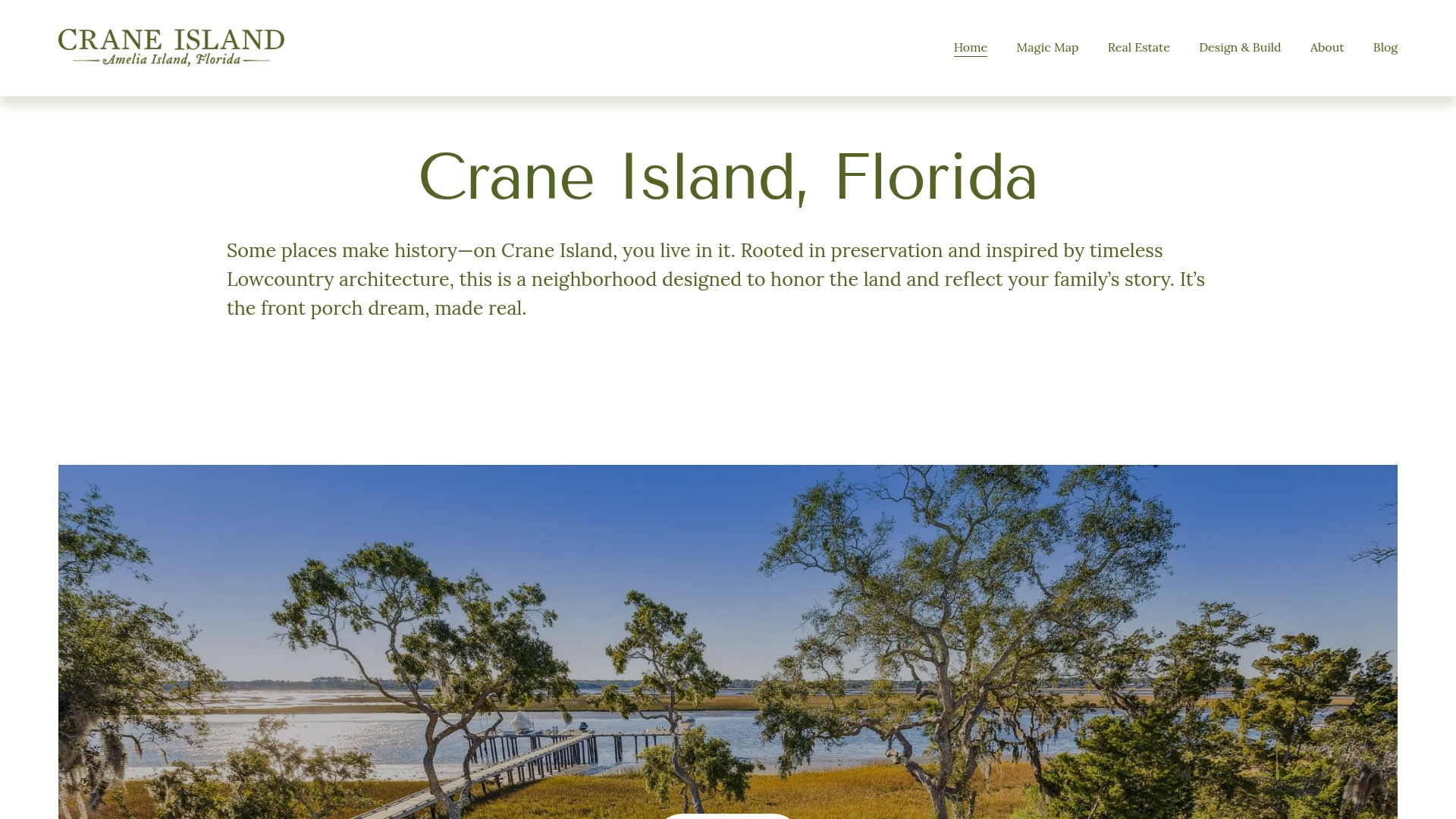
That is how we approached Crane Island on Amelia Island. We preserved nearly half the land as open space, we hold every home to rigorous architectural standards inspired by Lowcountry tradition, and we offer deep-water Intracoastal access that is unavailable elsewhere on the island. With only 14 homesites, the community stays intimate, and each custom home can honor the story of the family who builds it.
We believe that is what lasting value looks like: homes woven seamlessly into the land, porches that act as true living rooms, and neighbors who know one another. When you evaluate any community, ours included, ask what it will protect, how it will govern itself and whether you can picture your own legacy there.
John Hillman
Explore Crane Island
If you are comparing luxury communities on the Southeast coast, we invite you to see what Crane Island offers: custom homesites and move-in ready homes in a private, environmentally preserved, Lowcountry-inspired community on Amelia Island, close to the historic charm of Fernandina Beach. You can browse homes and homesites or learn about The Crane Island Portfolio Homes Program.
Pricing is shared directly with interested buyers, so reach out through the site and we will walk you through what is available.
FAQ
Which states have the most gated communities?
Florida and California have the highest numbers, according to CNBC, in part because of favorable weather and available space (CNBC). They are also common across the South and West, which is where most new luxury coastal development is concentrated.
Are homes in gated communities worth the extra cost?
That depends on what the extra cost buys. The premium is often 5% to 10% over comparable nearby homes (CNBC), and it pays off most when it funds well-kept common land, consistent architecture and strong governance. Compare what dues cover and how the community has maintained its standards over time.
What should I check before buying in a gated community?
Start with the covenants, the annual budget, the reserve study and the architectural review process. On the coast, add the flood zone, elevation certificate and an insurance quote from a licensed agent. Then walk the community at different times of day.
Is a gate mainly about security?
Not always. Research on upper-end communities suggests residents often value privacy and limited access more than crime protection (Blakely and Snyder). If security matters to you, ask how entry is managed and by whom.
Sources
- What is a Gated Community? (Texas A&M)
- The Insecure American (University of California Press)
- American Housing Survey 2007 historical changes (U.S. Census Bureau)
- Gated communities more popular (USA Today, 2002)
- Why Americans love gated communities (CNBC, 2025)
- Do Gated Retirement Communities Have Anything to Teach Us (Common Edge)
- Members Only: Gated Communities and Residential Segregation (PMC)
- Gated Communities in the United States (PMC)
- Crime and Security in Gated Communities (Blakely and Snyder)
- Flood Insurance Resources (California Department of Insurance)
- Climate and insurance report, 2021 (California Department of Insurance)
- HPS 2017 Consumer Footnotes (California Department of Insurance)
- HOA garage door rules