
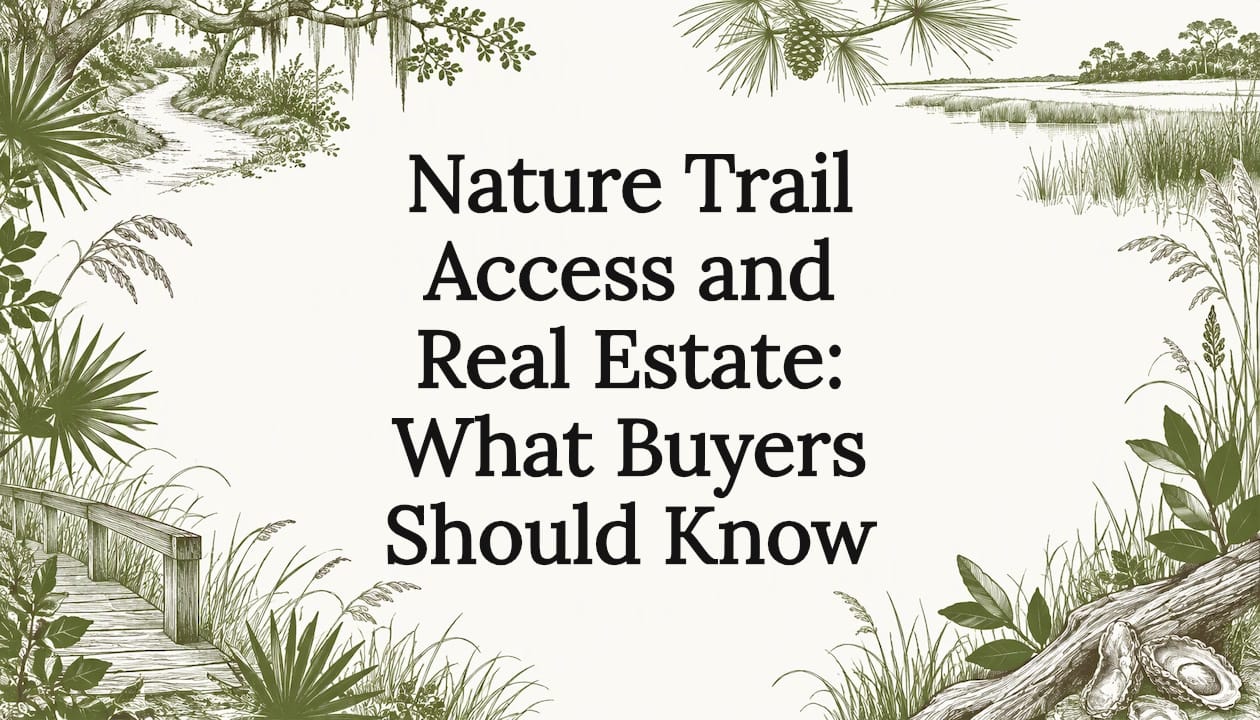
Trail access is worth looking for in a home, but the phrase covers very different things: a public greenway that runs past your back fence, a private path woven through a community's preserved land, or a trailhead a short drive away. The kind of access decides how much daily pleasure you get, how much privacy you keep, and whether the value shows up when you sell. For buyers who want nature at the doorstep without strangers at the property line, a small, private, preserved community offers the clearest version of it. That is the idea behind Crane Island on Amelia Island, where nearly half the land is kept as open space.
TL;DR
- "Trail access" can mean a public greenway, a private community path or a nearby trailhead. Each gives a different lifestyle and a different effect on privacy.
- Research on home prices near trails finds premiums in some places and little in others. Results depend on the trail, the neighborhood and how close you really are.
- Public trails bring more foot traffic, which can raise questions about privacy, litter and noise. Private, preserved open space avoids much of that.
- Before you buy, confirm who owns the trail, who may use it and who maintains it.
- Crane Island offers custom homesites and move-in ready homes beside preserved marshland and forest, with only 14 homesites available.
Table of Contents
- What nature trail access really means
- How trail access can affect value
- Public trail or private paths: privacy and everyday life
- Questions to settle before you buy
- Nature at the doorstep: how preserved open space changes the picture
- Crane Island: living beside preserved marsh and forest
- Perspective
- Explore homes and homesites at Crane Island
- FAQ
- Sources
What nature trail access really means
A nature trail is a path through natural ground, built for walking, hiking, jogging or cycling. The Connecticut Department of Transportation's review of greenways describes them as routes that link residential areas with jobs or parks, used for walking, hiking, jogging, biking, skating, horseback riding and other outdoor recreation. An example is a boardwalk through a marsh, a mowed path along a forest edge, or a paved multi-use trail between neighborhoods and a park.
When a listing says "trail access," it can describe any of these:
- A public trail adjacent to the lot. Anyone may use it, and your property line may be its edge.
- A trail within the community. Residents and guests walk paths on shared land, often maintained by an association.
- A connection to a wider network. The community's paths link to routes outside the development.
- A trailhead nearby. You drive or bike a few minutes to reach it.
The Chester County Planning Commission notes that a community may provide internal trails and sidewalks, connect them to systems outside the development, or work with its municipality to establish those connections. It adds that the surface should suit the users: a mowed grass path may be enough in one setting, while an accessible paved multi-use trail suits another.
The lifestyle difference is real. A path steps from your porch changes how you spend a morning. A trailhead ten minutes away is a destination you plan for.
How trail access can affect value
Buyers often ask whether a trail adds to a home's price. The honest answer from the research is that it sometimes does, and the size varies a great deal.
- The Indiana Association of REALTORS' May 2025 analysis looked at 10,000 home sales from 2021 to 2023, controlling for home size, age and ZIP code. It estimated a 6% price premium at 60 feet versus 1,000 feet from a trail, and 24% near the Monon Trail, while noting that effects vary by trail.
- A study of nearly 10,000 San Antonio-area sales from April 2001 to March 2002 estimated premiums of roughly 2% for neighborhood trails, 4% for greenbelts and 5% for trails combined with greenbelts.
- A 2005 study of Austin, Texas, by Sarah Nicholls and John Crompton found that greenbelt adjacency produced significant premiums in two of three neighborhoods, and recorded no negative impacts. Physical access was significant in one neighborhood and not in the other two.
- A 2018 analysis of Ogden, Utah, by Matthew Gnagey and Therese Grijalva reported a 0.6% direct premium for each minute closer in driving time to the nearest trailhead, and 1.4% when total effects are counted.
A worked example shows why the percentages need care. Take a home that would otherwise sell for $3,000,000. A 2% premium is $60,000, a 6% premium is $180,000. These are illustrations of arithmetic, not predictions: none of these studies covers a luxury coastal market, and the Connecticut review cautions that results differ by trail type, location and neighborhood, so a figure from an unusually large or distinctive trail should not be applied automatically to an ordinary one.
The practical reading for a buyer is this: the closer and more usable the access, the stronger the lifestyle case, and the more the setting matters. A trail is one part of a larger picture of open space, views, architecture and a community's long-term care of its land. We explore that wider picture in our piece on what really drives resale value of coastal homes.

Public trail or private paths: privacy and everyday life
A trail that anyone may use is a gift to a town and a trade-off for the homes beside it. The Connecticut review lists the concerns nearby owners raise: loss of privacy, trespassing, litter, noise, vandalism and crime from strangers passing through. Plenty of owners value the activity on a public greenway, and the Austin research recorded no negative price effects. But the question of who walks behind your home is worth answering before you choose a lot.
Private community trails change the equation. They are used by neighbors and their guests, on land the community controls. A residential trail system in Aiken, South Carolina, shows how such rules look in practice: it describes sunrise-to-sunset access, walking-only use and leashed dogs, with volunteers helping maintain the paths, and it warns walkers about roots, wet bridges, mud and wildlife. Those are the ordinary realities of natural-footing paths in the Southeast, and good community rules plan for them.

Municipal design guidance points the same way. Rio Rancho, New Mexico's park and trail chapter suggests trash receptacles and dog-waste stations every half mile, and says barriers such as gates, boulders or bollards may deter motor vehicles while keeping ADA access where appropriate. Its chapter also advises that trail alignments minimize grade changes, with seating at half-mile intervals and signs at key access points. A well-run trail, public or private, shows this kind of care.
Questions to settle before you buy
The Austin researchers found that physical access and mere adjacency did not have identical effects from one neighborhood to the next. That is a reminder not to assume a nearby trail means direct access. Work through these questions for any property:
- Who owns the land the trail crosses? Your survey and title documents show boundaries and recorded easements, which are legal rights for others to cross a piece of land.
- Who may use it? Public, residents only, or residents and guests.
- Can you walk from your door to the trail, or does it start across a road or behind someone else's lot?
- What is the surface and how is it kept? Mowed grass, boardwalk, shell or asphalt, and who pays for repairs.
- What are the rules? Hours, pets, bikes, and whether motorized vehicles are kept out.
- Is the land around the trail protected? Land set aside as open space through a plan or covenant is likelier to stay as it is than land that could be developed later.
For a purchase in the $2 million to $10 million range, your real estate attorney and title company should review the easements and covenants on any lot you are serious about. That is the professional to rely on for the legal reading of these documents.
Nature at the doorstep: how preserved open space changes the picture
For many buyers, the trail is really a stand-in for something larger: a daily relationship with woods, water and quiet. Open space that is protected rather than left over is what makes that relationship last. Municipal guidance suggests trail design should minimize disturbance to terrain and vegetation in undeveloped open space as much as practicable, with disturbed areas replanted in native or naturalized plants. Communities planned around the land from the start follow that logic naturally. Our guide to environmentally sensitive development and our primer on nature-first development set out how.
The same thinking applies to wildlife, which is part of what makes a walk memorable. Our notes on wildlife-friendly neighborhoods for coastal buyers cover what to look for in a community that shares its land well.
Shared green spaces do not have to be long trails to matter. Small parks and communal lawns draw neighbors out and give the community its rhythm, as we describe in research and budgets on pocket park benefits. A porch, a park bench and a path through the trees together make a neighborhood feel like a place people actually know each other.
Crane Island: living beside preserved marsh and forest
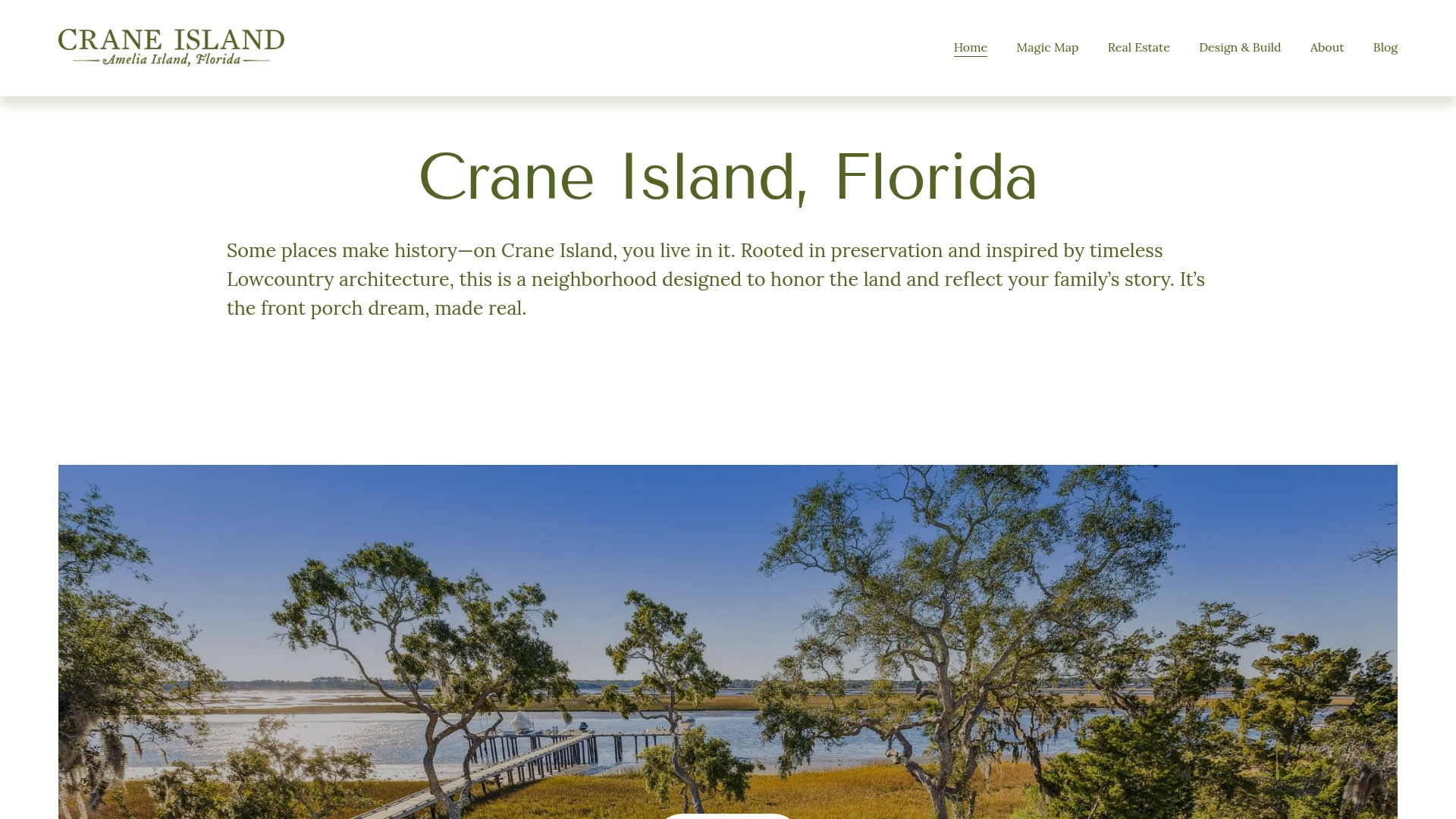
Crane Island sits on Amelia Island, Florida, and is built around the idea that a home should be woven into its land. Nearly half the community is preserved as open space, with marshlands and forests left in their natural state. Homes follow rigorous architectural standards inspired by Lowcountry tradition, and the porch is treated as a true living room that frames the view. Neighbors gather in open spaces and parks, and residents have direct deep-water access to the Intracoastal Waterway, which is unavailable elsewhere on Amelia Island, along with the historic streets and culture of Fernandina Beach close by.
With only 14 homesites available, the community stays intimate. If that scale appeals to you, our overview of small community living explains what you gain. For a look at the setting, what makes Amelia Island real estate unique is a good place to begin, and where nature and design shape luxury communities shows how we think about the two together.
Perspective
When buyers tell us they want trail access, we hear something more specific: they want to step outside and be somewhere beautiful, without having to plan for it. We believe that comes from how a community is laid out, not from a line in a listing.
At Crane Island we are inspired by the Lowcountry habit of building around the land. Preserving nearly half of it as open space means the marsh and the trees are part of daily life, not a backdrop seen from a car. A porch becomes a true living room, the neighbors' porches become the village, and a quiet walk becomes part of the day.
The evidence on trails reminds us that a premium is never automatic. It depends on the place, the neighbors and how the land is cared for. That is why we put our energy into the things that last: rigorous architectural standards, preserved land, a small number of homesites and deep-water Intracoastal access. We think a legacy home deserves nothing less.
John Hillman
Explore homes and homesites at Crane Island
If the idea of living beside preserved marsh and forest on Amelia Island speaks to you, we invite you to see what is available. Crane Island offers custom homesites and move-in ready homes, as well as The Crane Island Portfolio Homes Program. You can browse the community's homes and homesites to begin.
Our architects and builders work with buyers who want a home that honors their own story as well as the island's. For legacy-minded families, our guide to legacy home communities is a gentle place to start, and our frequently asked questions page answers practical questions about the community.
FAQ
What is an example of a nature trail?
A nature trail can be a boardwalk across a marsh, a mowed path along a forest edge or a paved multi-use trail linking a neighborhood to a park. What they share is a route through natural surroundings, used for walking, hiking, jogging or cycling. Surface and width are chosen to suit the people who will use it.
Does living near a trail raise a home's value?
Sometimes. The Indiana Association of REALTORS estimated a 6% premium at 60 feet versus 1,000 feet from a trail, while the Austin study found significant effects in some neighborhoods and not others. Trail type, location and neighborhood all shift the result, so a figure from one place is not a promise for another.
Is a private community trail different from a public one?
Yes. A private trail is used by residents and their guests on land the community manages, so there is typically less through traffic. A public trail is open to everyone, which brings the privacy, litter and noise questions that the Connecticut review lists. Check the recorded easements and community rules for the specific property.
What should I check about trail access before buying?
Confirm who owns the land, who may use the trail, whether you can walk to it from your door, how it is maintained and whether the surrounding land is protected. Your real estate attorney and title company can read the survey, easements and covenants for you.
Does Crane Island offer homes near preserved natural land?
Yes. Crane Island preserves nearly half its land as open space, including marshlands and forests, and offers custom homesites and move-in ready homes with Intracoastal Waterway access. Only 14 homesites are available.
Sources
- The Impact of Greenways and Trails on Proximate Property Values, Connecticut Department of Transportation
- HOA - Trails and Multi-Modal Connectivity, Chester County Planning Commission
- Parks and Trail Design, City of Rio Rancho
- Beyond the Backyard: How Natural Amenities Affect Home Prices, Indiana Association of REALTORS
- The Impact of Greenways on Property Values, Journal of Leisure Research, 2005
- The Relative Impacts of Trails and Greenbelts on Home Price
- The impact of trails on property values: a spatial analysis, 2018
- Nature Trails, Cedar Creek, Aiken